There cannot possibly have been a Beginning, nor could there possibly be an End to the universe, because: an infinitely large thing cannot expand or collapse as a whole, nor can it be destroyed as a whole.
If you fear never finding a meaningful “purpose” in life, from attending church, or science class, or by serious introspection, or from buying bags of fortune cookies; fear not, for the tree of life is infinite, therefore there are infinite purposes being fulfilled, already, every moment, within you.
You are made of trillions of cells, each conducting daily affairs. Individual cells are made of living constituents also busying themselves with their own everyday matters – many purposes coming and going. And these living creatures are also made of smaller living creatures fulfilling many purposes in their own local everyday dealings. To infinity!
You are infinitely divisible, in that you are made of cells, and these are made up of smaller living things, and so on, without an end to this. Infinite dreams of engineering feats. Infinite concerted efforts among living workers building them. Infinite celebrations of accomplishment. Infinite bemoanings of failure. Infinite seekings of bliss among infinite living entities within you. Infinite gracious gestures between your living constituents. Infinite purposes unfulfilled, and infinite purposes fulfilled. Every moment.
A living electron, proton or other such tiny living creature, may be involved with other living sub-atomic creatures in multi-sub-atomic-organisms, like atoms; and a living atom may be involved in living networks with other living atoms in a living way; and a living molecule may be involved in a multi-molecular organism such as an organelle; and an organelle may be involved in the living organism of a cell, and a cell may be involved in a multi-cellular organism, such as a plant or such as you yourself; and you yourself may be involved in a living way in multi-human living organisms like a functioning family or a circus troop or a team of firefighters; and these living organisms may be interacting within even larger living organisms, like trade unions defending the health and safety of all its members, church parishes organising bake sales to raise funds for turkey dinners for the poor, city governments organising the efforts of many multi-human organisms, creating, in some cases, well-organised multi-multi-human organisms; and these larger living organisms may be interacting within even larger living organisms; and so on, to infinity “above” (in the macrocosm).
How many purposes, every moment, might your living activity, your living mindset, what you devote yourself to day to day, moment to moment – how many purposes, in an infinite tree of life, above and below, might you be involved in fulfilling (wittingly or not)?
Also, every action you take causes infinite after-effects! So, how can you predict or control every last after-effect from what you do? How can you know, for sure, what you do fulfills “your purpose”? Also, what if new purposes arise out of your striving toward a single purpose? Is a single purpose what you truly would want to find and devote yourself to, in the end? In an infinite universe, with infinite purposes, many developing/arising spontaneously, maybe this is silly – to set our minds exclusively to known definite purposes?!?
If that wasn’t fulfilling enough, and didn’t inspire any conclusive purpose in your life, then the authors of the Bible and the Qur’an have gleefully prepared for you very simplistic goals or ideals – simple objectives to devote yourself to. (Even though these principles are simple, the authors were not naïve in that they understood that attaining these objectives can be tricky business at times)
Jesus, is a simple principle of setting out to helping all those within your reach with every last bit of energy you can muster.
The New Testament can essentially be summarised as “Hey, you there, please try as best you can, with every ounce of effort you can muster, to tend to all the various needs of living beings within your reach, big and small, far and near”.
The Qur’an (with the central name of Muhammad) can be summarised as “Hey, you there, please try as best you can, with every ounce of effort you can muster, to contain your burning desires – cool your hot temper, calm your cravings, temper your temptations, and instead strive as best as you can to warm up those who are cold”.
The Old Testament promotes many such straight-forward principles and outlines their details as well, with the book of Isaiah being the same subject as the New Testament, but with a focus on your inner world – Jesus inside you. It is essentially the same idea as the New Testament framed in context with your inner life – taking care of your various organs, tissues and cells; or the inner life of any living entity, like the organs of a nation.
It was very much the intention of the authors of these works to have us eventually read these texts symbolically, and to enjoy rational principles that we can understand and apply, in order to avoid evil and promote peace and prosperity.
If your foundation in life is to help all living entities within your reach, inside and outside, with every last minute available in the day, with every last dime, with every last breath, with every last reserve at your disposal, instead of spending your energy burning in rage, jealousy or desire; this ideal, in of itself, can be enjoyed as an overarching great “purpose” to devote yourself to, even though it may take many forms – it may manifest itself in your life through many varied “purposes” throughout your life.
You can make this the purpose of all your purposes.
The King of Kings.
To say it is really really really Bad to eat of the Tree of Knowledge between Good and Bad (original sin), is intentionally contradictory:
“Don’t judge between right and wrong – that is what is right.”
Eh? That’s contradictory!
“It is discernably wrong for you to discern what is wrong.”
Totally contradictory! Right?
“I judge you to have sinned by you using judgement of what is sinful.”
This is intentionally contradictory!
The author of this sequence, in chapters 2 and 3 of Genesis, was trying to coax you the reader to think deeply about morality / ethics – framing the issue in such a way as to warn you about searching for absolute “good” things to worship – of resting your mind on a specific notion of what you think is best – how best to conduct one’s life. It basically starts scripture – it sets the tone for the rest of scripture, by warning you that there are consequences to reading these books only for absolute rules – of how to govern yourself.
The opposite Tree – the Tree of Life, is set up as a contrast to living your life by rules of conduct – so, instead of operating under a rigid set of rules, you listen and react to the myriad lifeforms you interact with, inside and out, throughout the portion of the Tree of Life you are immersed within, moment to moment, and listen and respond and adapt to events, often unfamiliar, in the moment, without constraining your action to a list of morals, with your current limited knowledge – without doubting if what you are doing is sinful or not – without worrying all day if it is the right or wrong decision.
If you then say – “Oh, Oh, I know my favorite Tree – I choose to eat of the Tree of Life! That’s the ticket! Forget the crappy ol’ Tree of Knowledge of Good versus Bad! Who wants that spoiled fruit anyways! I choose Life!”
OK then.
What you have just done, genius, is to judge eating from the Tree of Life as Good and to eat of the Tree of Knowledge versus Good and Bad as Bad!
Ha!
Don’t you see – you can’t say eating of the Tree of Life is Better – because you are then eating from the other Tree - of Knowledge of Good and Bad!
This is an absolutely brilliant convoluted tale – the tale of the serpent – a truly remarkable contemplation on ethics itself, and how tricky morality can be to implement gracefully, in an eternally changing universe with infinite complexity unfolding each moment.
At the end of the day, there is no perfect way to prepare for all eventualities, all developments in life, all crises, all disasters, all sorts of affairs that arise – there is no perfect way to prepare yourself for every eventuality. Whether you prepare yourself by loading up with rules – “If this happens, I should do that, but if the other thing happens, I should do plan B. etc…” ; or whether you prepare yourself by clearing your mind of any such hard-coded reactions and breathing in the details of every moment freshly, reacting to all living pressures from within and all living pressures from without (often totally new experiences that you have not judged good or bad yet), and reacting with all manner of novel ideas that suit the needs of the moment. Neither approach will necessarily guarantee success.
The author is also pointing out that both Trees are intertwined – they are intermingled, they are operating in the same garden.
The principle of working as hard as you can to help all living things inside and outside you, the Principle of all Principles, the King of Kings, this over-arching principle that all major works of Semitic scripture beckon the reader to strive for, this principle is exceedingly hard to achieve in an ever-changing universe with infinite diversity and complexity. In order to achieve this state in your life, it can help to eat from both trees in the garden. In terms of the Tree of Knowledge of Good and Bad, well, sure, with your limited knowledge of the world – with the limited knowledge of situations and needs that arise, there is no harm in sussing out what is best for the living things outside you and inside you. At the very same time, keeping your mind open to the unforeseen various situations that arise on The Tree of Life within and outside of you – that beckon you to act in certain novel ways, well, this can help you apply your existing morals more effectively (if you keep to the principle of helping all living things), and these new experiences with the Tree of Life can then, afterwards, help you refine and update your morals. Both Trees are operating in the same garden.
You change every moment.
You are animated by an infinite tree of life, within, outside, and moving through you, every moment. Infinite individual living entities – all affecting you, while they themselves also change from moment to moment.
There are infinite moments within every moment.
Your cells – members of that branch below you on the tree of life – experience their existence relatively quicker than you experience yours. Your actions, as a whole, take longer to play out, than their individual actions. A single cell can make a decision relatively quicker than you can.
The living organisms in which you participate – on the branches of the tree of life outside of you, experience life relatively slower than you experience yours. You can make a decision relatively quicker than living groups or networks or institutions you participate in as a whole. We all bemoan the slowness – the lumbering turtle-pace of our multi-human institutions. “Too much red tape!!!” “Too much bureaucracy!!!” “Fast-track it all!!!” We can complain about red tape all day, but, at the end of the day, that’s just the speed at which multi-human institutions work – that’s just the nature of interacting with larger organisms.
Elephants don’t reproduce as often as insects, not because “insects are only interested with procreation”, but because the reproductive cycle of an elephant simply takes way more time to play out than within an aphid. Body size affects the speed at which all internal processes of a creature operate (generally speaking). Insects are not obsessed solely with procreation, as is often repeated – they simply get on with it at a massively accelerated rate because they are friggin’ tiny. Drone ants live for a week or less. That’s crazy – a single week! Imagine your own entire existence spanning Monday to Sunday! A fly lives for a month. An aphid lives for a few weeks to a few months. An elephant lives for up to 70 years, and, I think, if they didn’t have such a hard life, they might be able to live longer. Insects are not “obsessed with reproduction”. This notion represents a lack of basic understanding of the experience of time between creatures of different size.
A small bird or insect seems to behave with such frantic neurotic rapidity, while an elephant seems to behave with such pensive lumbering slowness. Physical constraints, like locomotive-speed constraint, due to body size, shape the minds of creatures, because all processes of the mind are physically locomotive.
All living beings have a mind.
All processes of any mind operate through physical means.
All processes of any mind are therefore affected by the physical size of the living entity itself.
What you may feel as immaterial “spirit” driving the life within you, is still, in fact, real physical living creatures, or physical signals induced by living creatures – actual physical real things in motion within you.
The fact that all minds are physical in basis, explains the difference in experience of time from moment to moment between creatures of different size. For example: Signaling from one cell to all the other cells in an elephant takes longer than signaling from one cell to all the other cells in a fruit fly.
Even though the elephant experiences fewer thoughts per second (generally speaking), than the fruit fly, they are both experiencing life in the same present. They don’t have their own local time. They simply have their own unique experience of the ever-present present.
Time does not exist.
Who has ever proved the existence of Time, in of itself, in the first place, eh?
Time is a useful abstract concept we use when remembering multiple events in the past, or imagining series of events in the future, but there is only now. There is only evidence for the present.
Memory occurs only in the present.
Imagining the future can only be conducted in the present.
Who has ever proved otherwise?
Two clocks running at different speeds during the present, is just that: two clocks, running at different speeds, during the present. Period.
If time doesn’t exist, then to have time start or end at specific points would prove difficult, no?
You, and any other living entity in the universe, cannot possibly travel to, or access in any way “the past” or “the future”. These don’t exist. (Like, duh!)
Dreaming of spiritual immortality in a finite universe is a ridiculous enough pursuit, but pondering an immortal spiritual life for yourself, surviving eternally in an infinite universe, without an end to it, animated by infinite ever-changing living entities, is infinitely more ridiculous.
If you can, at one point in your life, devote yourself to Jesus, and change your life, is this not a change in spirit? Is this not a change in the light that shines within you? So, then, if you want to allow yourself to be born again, you are admitting that your spirit has thus changed during the course of your life, right? So then, how can you claim that your spirit has forever been the same and will forever be the same? Eh?
The physical living creatures, on each branch of the tree of life below you, each adding to your youness, each of these cannot possibly all be beckoned to hold fast into some static continuous state for eternity! All holding the same living arrangement?! Forevermore?!
There are infinite living entities outside and within you, and this infinite complexity, this infinite diversity, no matter how much you may pray, can never possibly stand still (“unchanging spirit forever”), and could never possibly offer you an infinitely-long afterlife in an allegedly eternally-maintainable spirit-world, no matter how much you invest in your spiritual bank-account.
Book one, Chapter one, Verse one, Hebrew Word one:
“In The Beginning…”
The English word “The” is absent in the original Hebrew of Genesis 1:1.
This was inserted (invented).
Read symbolically, word #1 of scripture might mean: “Within beginnings”.
With the central symbol in (at least medieval) Jewish mystical lore being The Infinite (“Ayn Soph” – “without measure”, employed as a noun – “The Infinite”), word #1 of scripture might be understood to mean:
“Within infinite beginnings”.
If this is so, then, in the universe that the Bible describes: electrons would be divisible, and the bits that electrons are made of would also be divisible, and so on, to no end; and there would be creatures larger than galaxies and creatures even larger than those, and so on, to no end. Not only this, but this would push the duration of the universe (that the Bible describes) to ever-present/eternal; while rendering the universe inexhaustible, incompressible, unexpandable and undeniably indestructible in all sorts of ways!
The authors understood and planned for this insertion in translations from the Hebrew (“In The Beginning…”), as would be necessary for the translated narrative to make plausible sense to the reader in other languages, in a time when only a finite universe can be readily imagined – a universe with a Beginning, Middle and End, like a fairy tale, laaa-deee-daaa; much like modern academic cosmologists crave so desperately, resorting to inventing invisible matter and invisible energy, out of very thin air, to keep alive their precious notion of a simplistic Beginning.
There are infinite beginnings – infinite new living forms coming into existence, every moment. The universe never started and it will never stop. It is infinite in duration.
The authors of the Bible and Qur’an understood the infinite nature of the universe very well. With Revelation, the reading of their texts will change from:
Once upon a time…
The Universe Began.
Then, like, a whole buncha stuff happened.
Then, good people will be resurrected from their graves and live happily ever after (but for just 1000 years). Yay!
The End.
to:
Life exists, and has always existed, and will forever exist.
Life itself never started, and it will never stop.
Infinite individual living creatures are created and perish each moment.
Infinite life cannot be extinguished.
There are innumerable beginnings, innumerable happenings, and an endless number of endings, transpiring each moment, in the ever-present exclusively-single eternal universe of limitless complexity and diversity.
This concept is best encapsulated symbolically in scripture in the Tree of Life, which, in (at least medieval) Jewish mystical lore, is heavily associated with The Infinite.
The discovery, with microscopes, that we are made of individual living creatures – individual living cells, with clearly visible intelligence of their own, might entice those learning of this marvel to envision that cells themselves are made of smaller living things, just as marvelous.
This, in turn, can inspire logical deductions regarding the infinite nature of the universe, allowing for infinite levels of life within life.
This, in turn, might inspire these folks to envision an infinite tree of life reaching above us as well as below.
Although not necessary, discovering our cells (and other cells in nature) would help immensely with (and help trigger) these cosmological cogitations.
Did the authors of Semitic scripture have the use of high-magnification? Microscopes?
Discovering the cellular world would’ve required lenses:
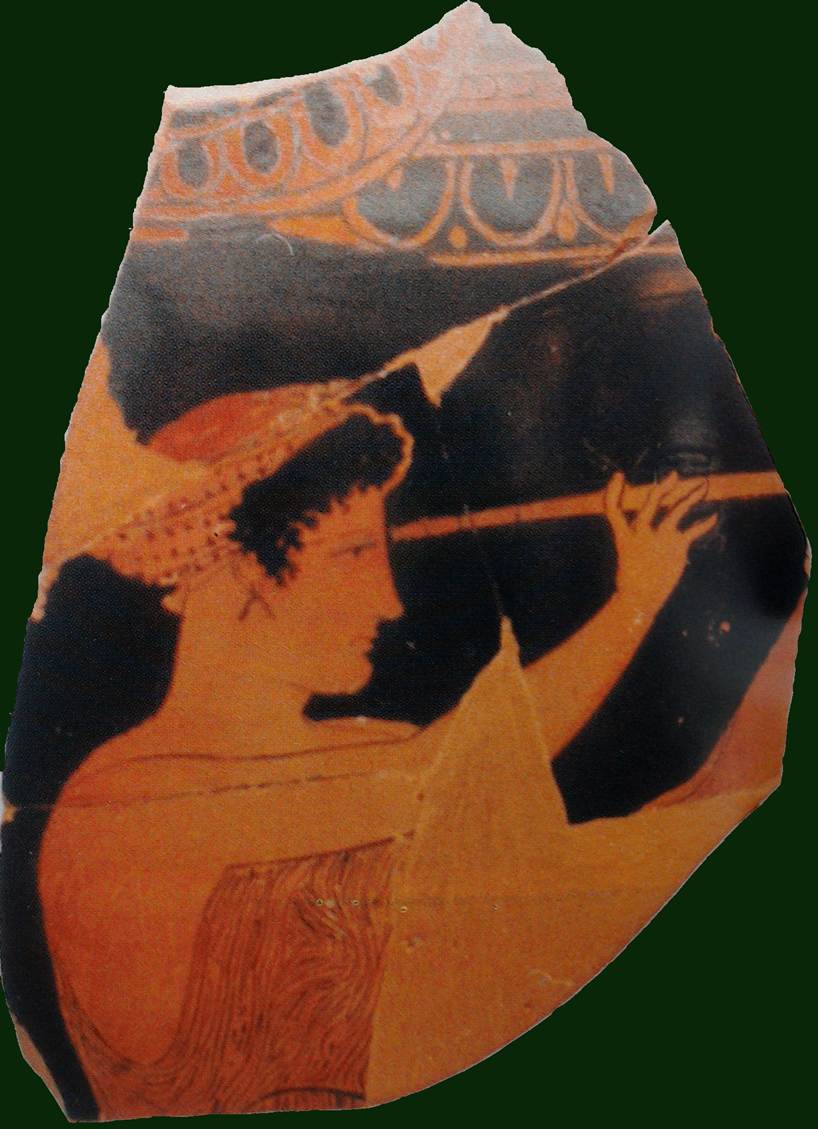
“What is this person doing? This painted fragment of a fifth/fourth-century BC Greek pot was excavated at the Shrine of the Nymph (which was destroyed in 86 BC) on the south slope of the Acropolis in Athens between 1955 and 1960 in connection with the construction of a road.
It is roughly contemporary with Plato, whose teacher Socrates was lampooned by Aristophanes in the play The Clouds, in a scene where a crystal lens features in the story. This person may even have attended a live performance, in which case an ‘opera glass’ was clearly available!
Millions of people have filed past this object in the Acropolis Museum at Athens without ‘seeing’ it (in an alcove of Room V, Case 6, Object Number NA.55.Aa, 4).
Why do they not ‘see’ it? Is it because we only ‘see’ what we are told in advance can exist? Is it because something which is ‘impossible’ takes on a cloak of invisibility so that all the displaying in the world cannot achieve a single perceptual acknowledgement? Presumably we have here the phenomenon of consensus blindness.”
The Crystal Sun
Robert Temple
Plate 10 – with the caption (after page 222)
(consensus blindness – concerning lenses :)
“Although Galileo is rightly credited with introducing the telescope to the world in 1609, he certainly did not invent it.
As Robert Temple points out in this impressively researched book, excellent rock-crystal lenses had been known for several thousand years, and it seems incredible that Archimedes – or some Chinese or Egyptian inventor even earlier – did not make the obvious and simple experiment of looking through two of them at the same time.”
Arthur C. Clarke
Colombo, Sri Lanka, May 1999
Introduction to The Crystal Sun
In The Crystal Sun, Robert Temple lists oodles of lenses from antiquity, many of which are available for inspection today. He claims he has come across (or heard of) a grand total of 450 items (with some being lost), but only catalogues the named ones (in the hardback edition) and then investigates and describes a good handful of them at the outset of his 600-page foray into the history of optics in ancient times.
He begins with the Layard Lens, which has the unmistakable outline of an eye-socket, is ground to a toroid shape, has a rim to set the lens within some holding apparatus, is available in the British Museum for inspection, and dates to around 700 friggin’ BC.
Besides the lenses and other optical knowledge from antiquity that Temple outlines and delves into, he also reports the curious case of miniature carvings in antiquity:
From Natural History by Pliny (first century AD):
“Callicrates used to make such small ivory models of ants and other creatures that to anybody else their parts were invisible. A certain Myrmecides won fame in the same department by making a four-horse chariot of the same material that a fly’s wings would cover, and a ship that a tiny bee could conceal with its wings.”
Pliny later recounts the same, but mentions marble:
“Fame has been won in the making also of marble miniatures, namely by Myrmecides, whose four-horse chariot and river were covered by the wings of a fly, and by Callicrates, whose ants have feet and other parts too small to be discerned. So much for the sculptors in marble and the artists who have achieved the greatest fame.”
Sourced from:
The Crystal Sun
page 78
And, over 3000 years before that, in Egypt:
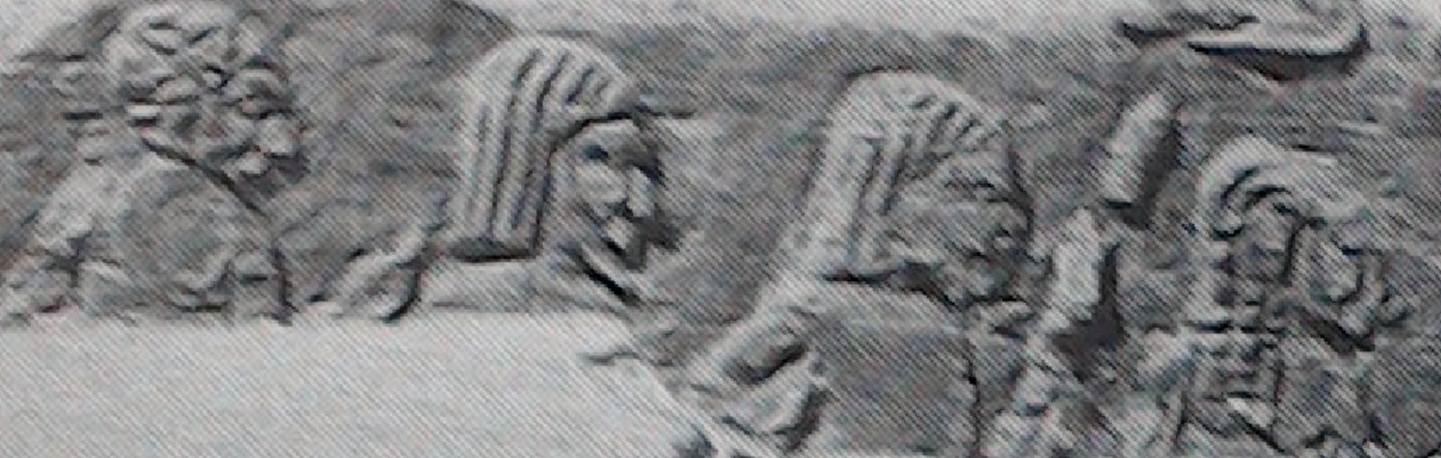
Each of these heads – each of these carvings – is around 1 millimeter in width!
These carvings are, mesmerizingly, 5300 friggin’ years old!
(before the pyramids)
“While digging in the predynastic cemetery at Abydos in Upper Egypt, which is known as Omm el Qabb – ‘mother of pots’ – because it contains literally millions of pieces of pottery shards, Dr. Gunter Dreyer excavated an ivory knife handle in the tomb of an unknown predynastic king of the period known as Naqada II. It was made of elephant ivory, rather than hippo ivory, and is dated to circa 3300 BC.”
“Dreyer had to clean them of dirt with the point of a pin.”
The Crystal Sun
Plate 38, and pages 121-122
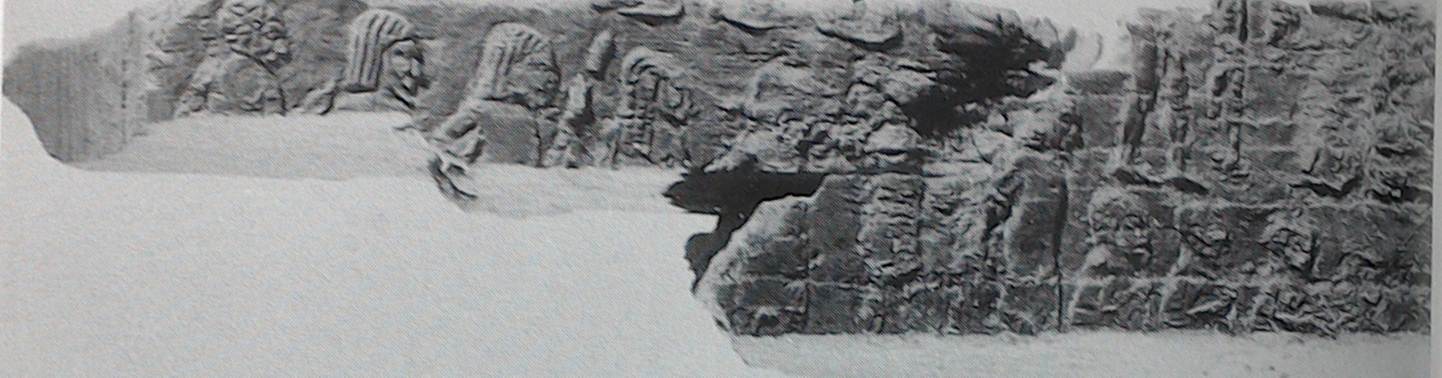
1 millimeter???
Each of these carved heads are just 1 millimeter wide???
What?
Wait a minute…
That means….
Woahhhh………………..
That means that the features are well-under 1 mm, right?
Well, a single plant cell is one-tenth of a millimeter across!
If these features are around 1 tenth of a millimeter, then if the artisan producing this intricate work would have focused his or her lenses upon incised plant tissue, he or she would’ve readily observed the living cells within!
Note that this size-limit that we see, was the limit of the carving ability (or necessity/function/desirability of the finished product), and not necessarily the limit of magnification available (not an insignificant point, especially with the stakes at hand here).
Your own cells are about 0.025 millimeters big. So, you would only be able to squeeze in just 40 of your own cells in a straight line, across one of the carved heads above!
5300 years old!!!
A central and almost necessary premise (assumption) of this whole work here, is that the authors of the Bible, the Qur’an, and other works of Semitic scripture – were well-aware that we are made of sentient and intelligent living beings (intelligent living cells), and that they extended this knowledge to assume that even these smaller constituents of ours – the cells they saw in their microscopes – are also made of smaller sentient and intelligent living beings, in an infinite tree of life. The idea that life is made of life is even inherent in the symbolic meaning of the names of God, so the concept takes center stage in scripture.
In order to develop this cosmology, it may not have been necessary for the authors of scripture to view their own cells with microscopes, but it definitely would’ve helped out a whole bunch, and, it really isn’t that far-fetched an idea in the first place, technologically speaking.
If lenses and magnifying apparatus had become commonplace at some point in the distant past, especially in a time of abundance and opportunity to investigate nature, maybe the authors of Semitic scripture were inspired by the marvels revealed by microscopes in their time.
The modern discovery of our living cells didn’t have the same effect – of producing a cosmology that gave rise to a deeply intricate view of nature with something like a Tree of Life – or even a fringe cult wearing cone-shaped hats promoting this view of a Tree of Life, much less some proper rational definition of Life and Mind from reasonable professionals donning reasonable headwear.
This should be expected.
It should’ve been a shock to us.
The discovery of living sentient and intelligent cells should’ve ushered in a new revolution in perceiving our multi-cellular existences, and of our place within nature, and of our sentience and of our intelligence.
With the discovery that all visible earthly creatures, from us humans to fruit flies, are made of smaller living creatures, living cells, with independent existences of their own, with minds of their own; this begs the questions: Are there living entities smaller than cells? and: Are cells made of smaller living entities?
Nobody seems to have bothered with these basic forays into the fundamental possible implications from the modern discovery of cells. In ancient times, it seems that this discovery induced a greater curiosity in those looking through the lenses. Luckily, we still have copies of copies of copies of copies of copies of copies of copies of copies………………….. of their symbolic narratives, which attempt (brilliantly and convincingly) to convey their view of an infinite tree of living activity!
With Big Bang, there is no infinite tree of life.
Or, more correctly:
With The Infinite Tree of Life, there is no big bang.
Behold!
Feast your eyes!
This is what any people with lenses might be able to discover!
Mystery upon mystery!
These whole images are of single shells of single cells, radiolaria, which range in size between 0.03 millimeters to a whopping 2 full friggin’ millimeters:
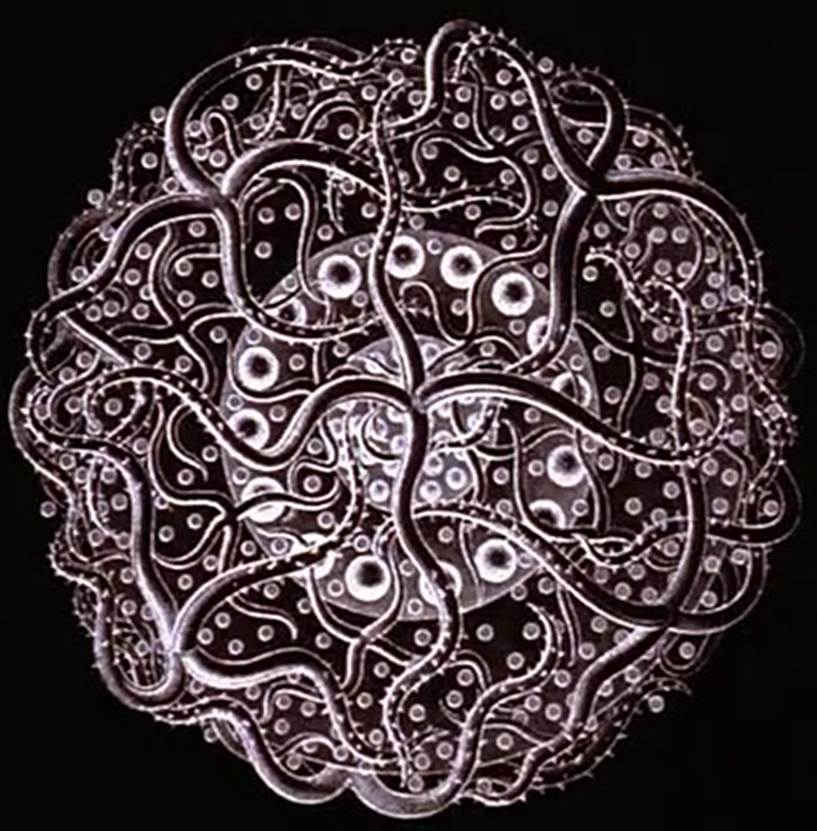
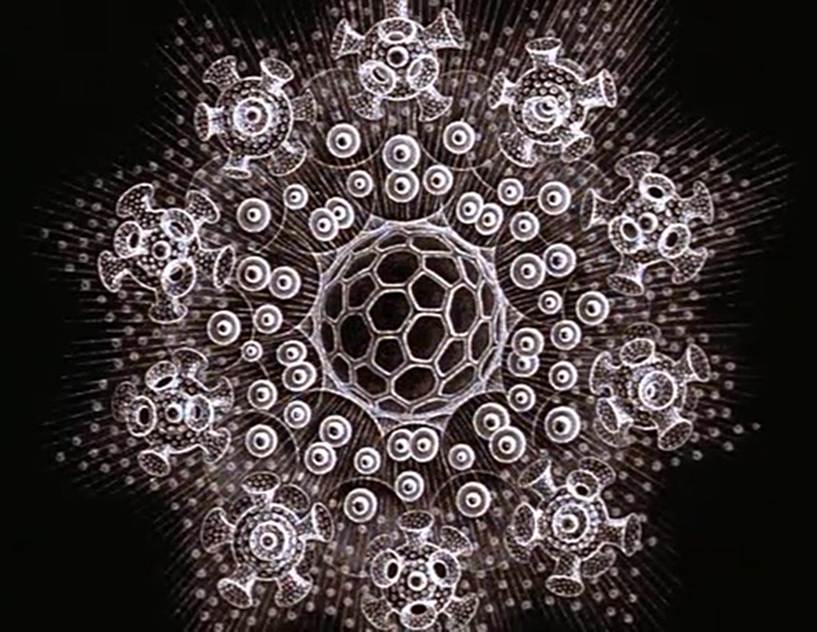
Yes, all of the above is just a single cell!
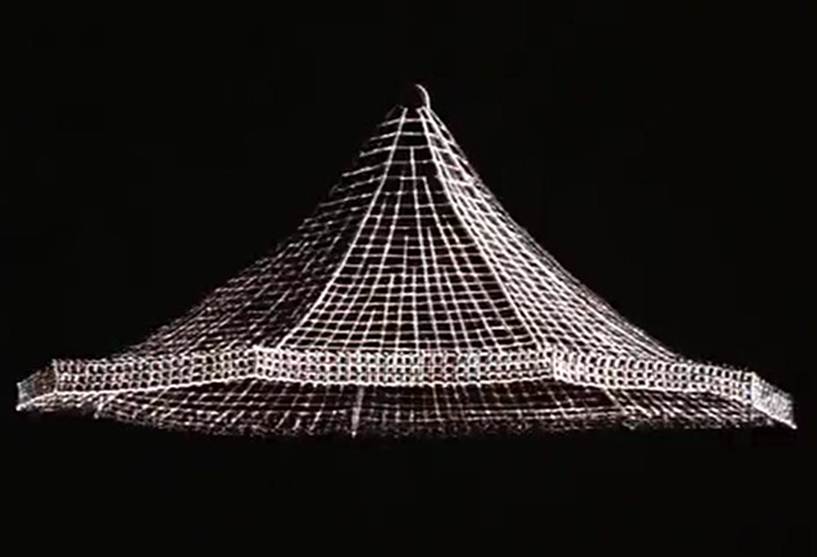
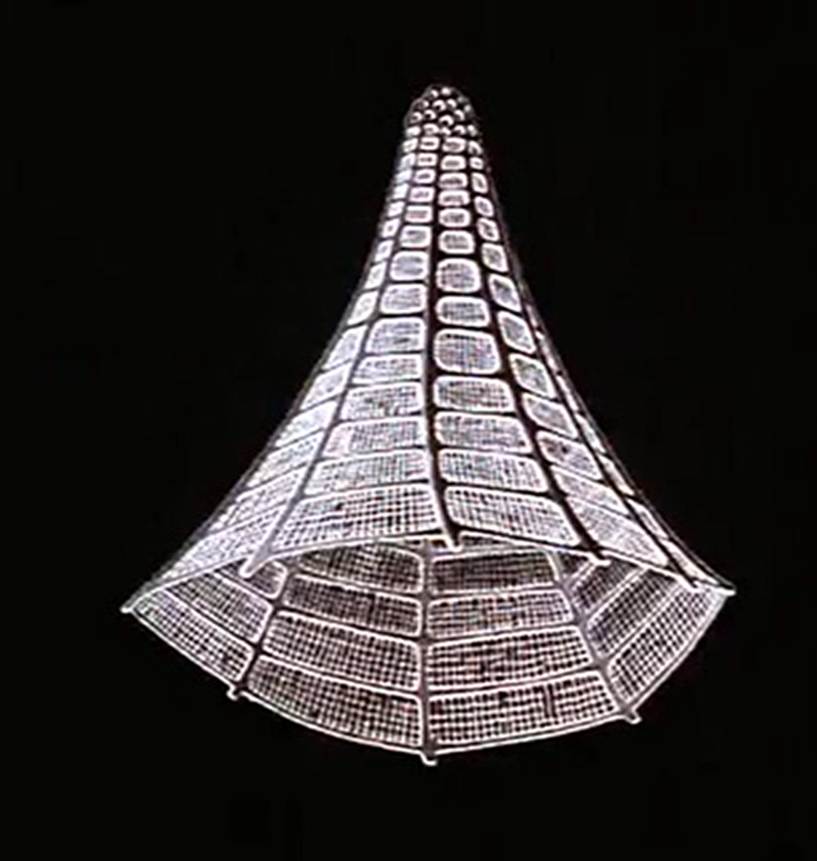
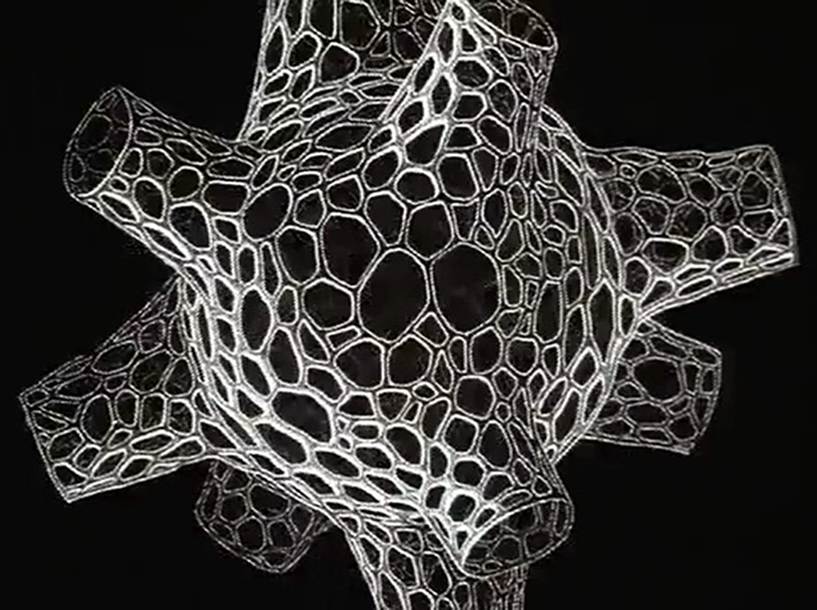
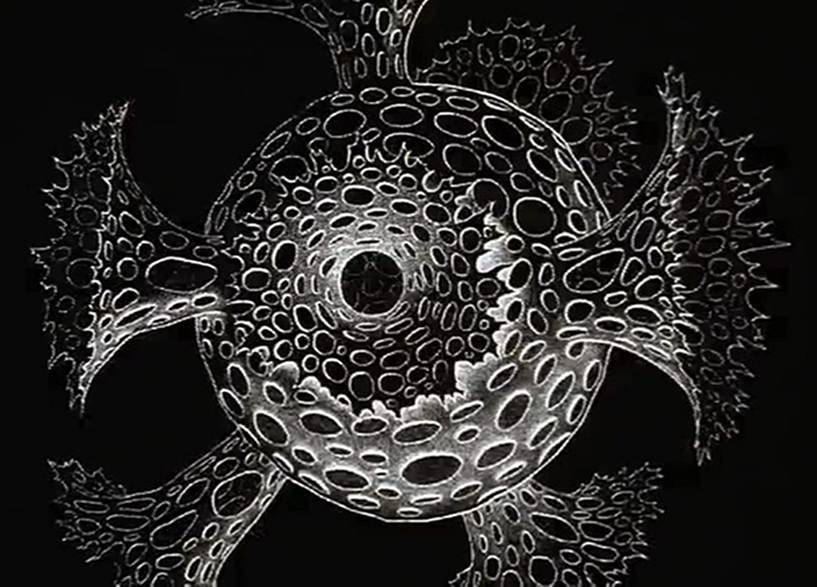
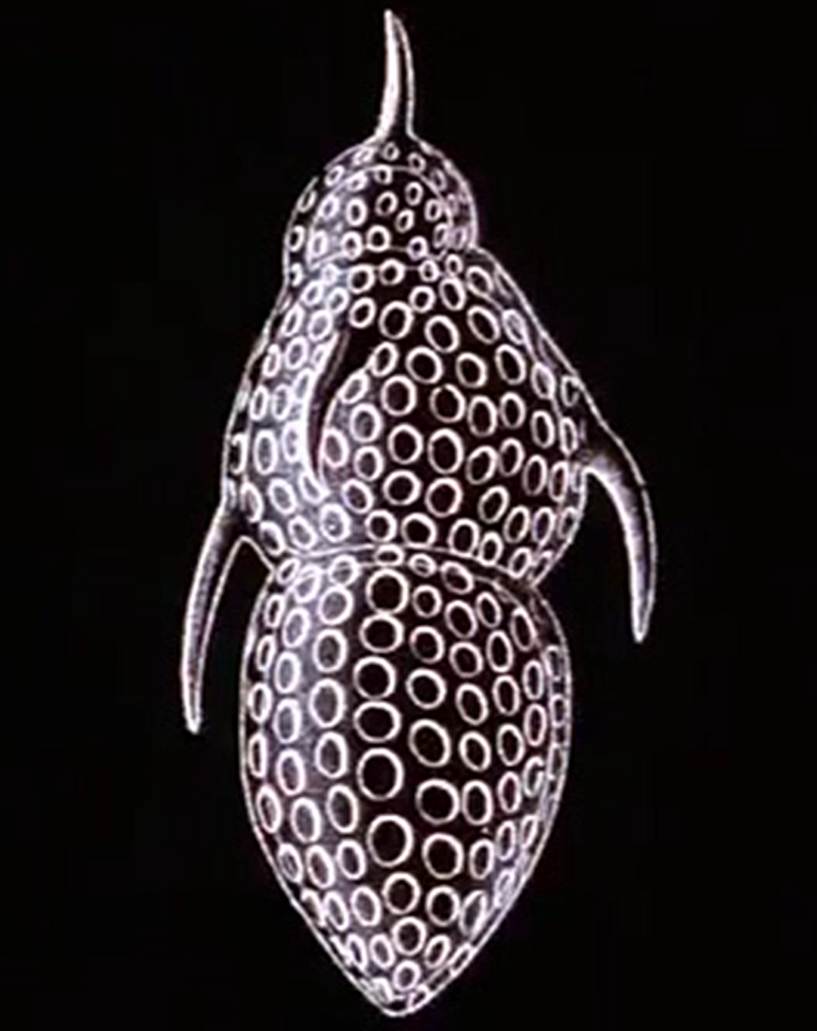
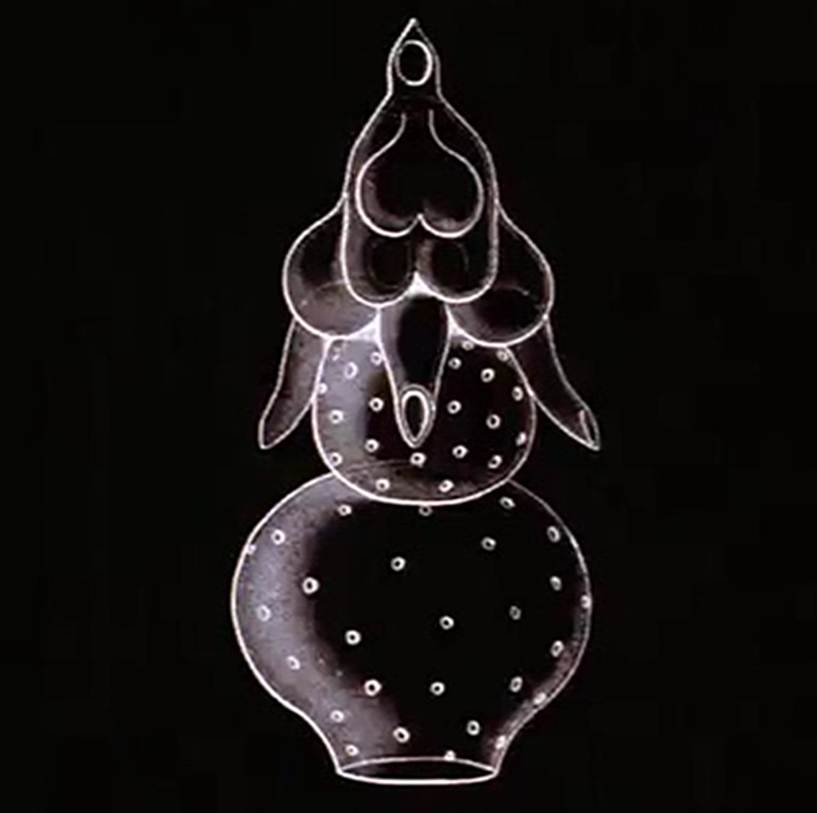
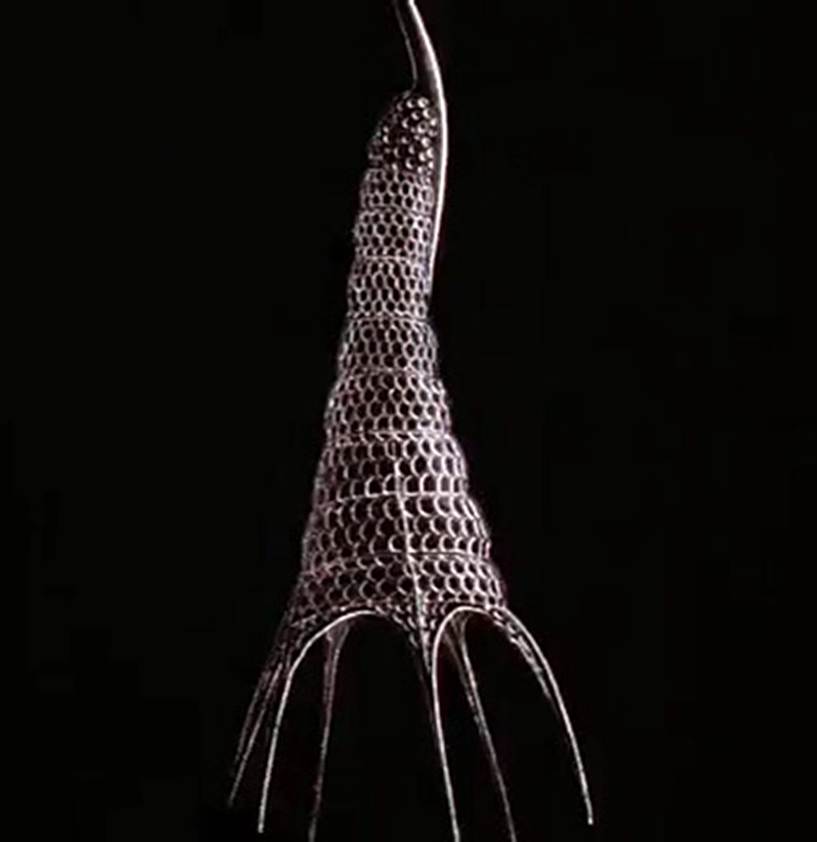
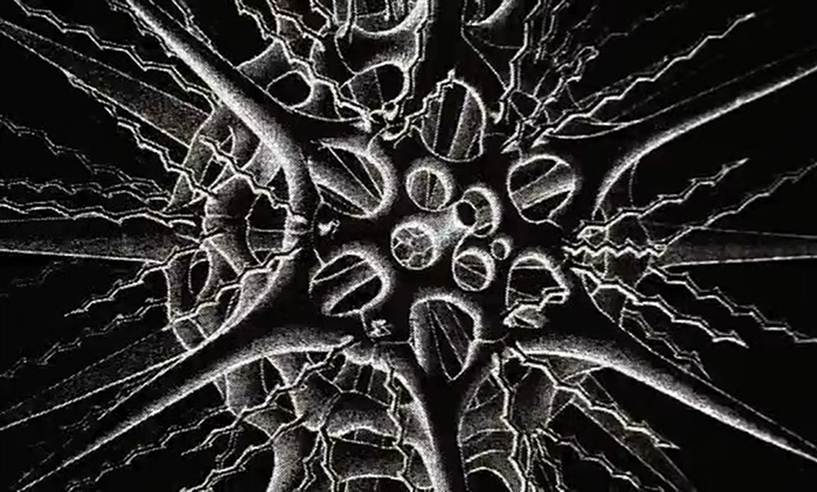
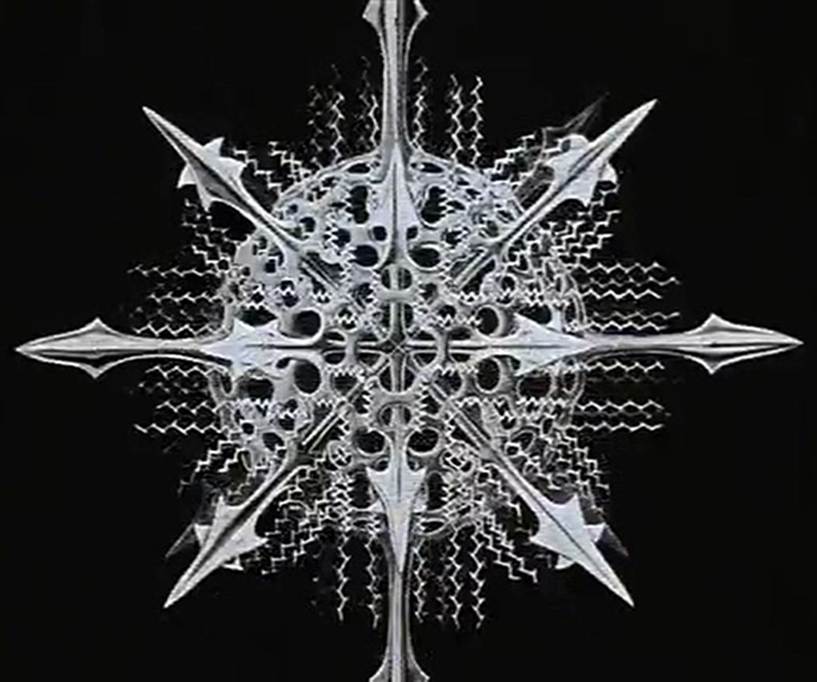
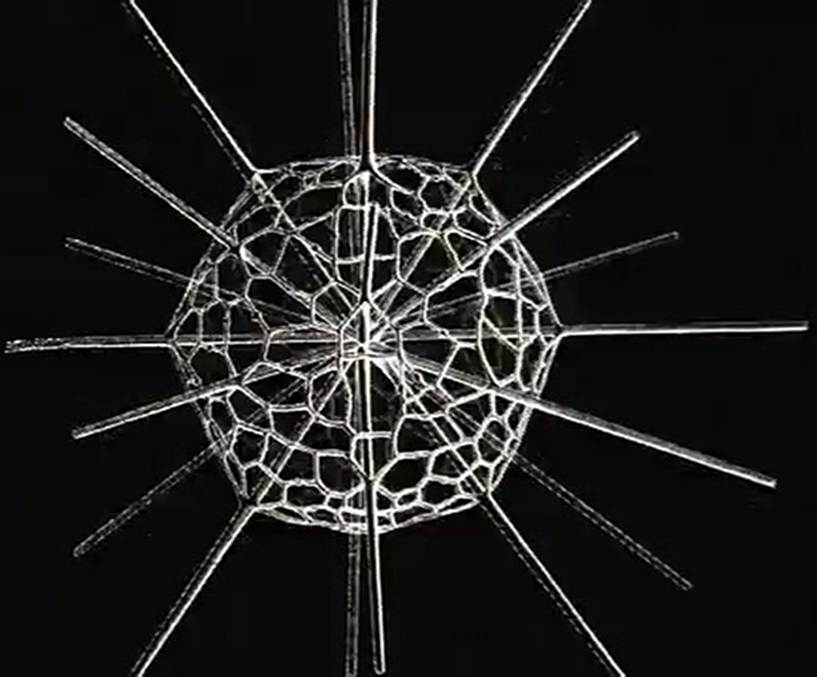
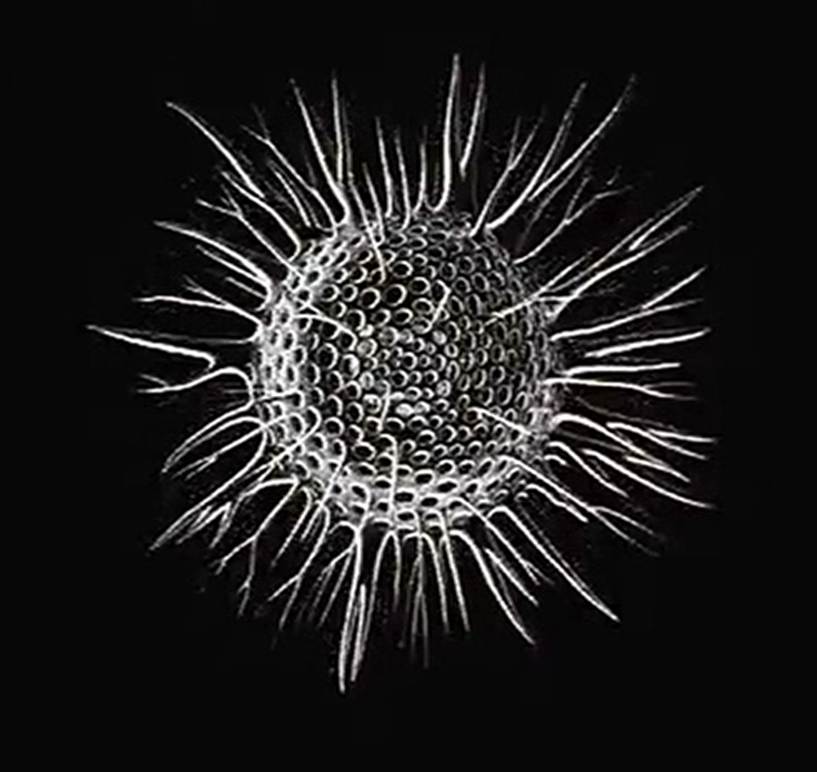
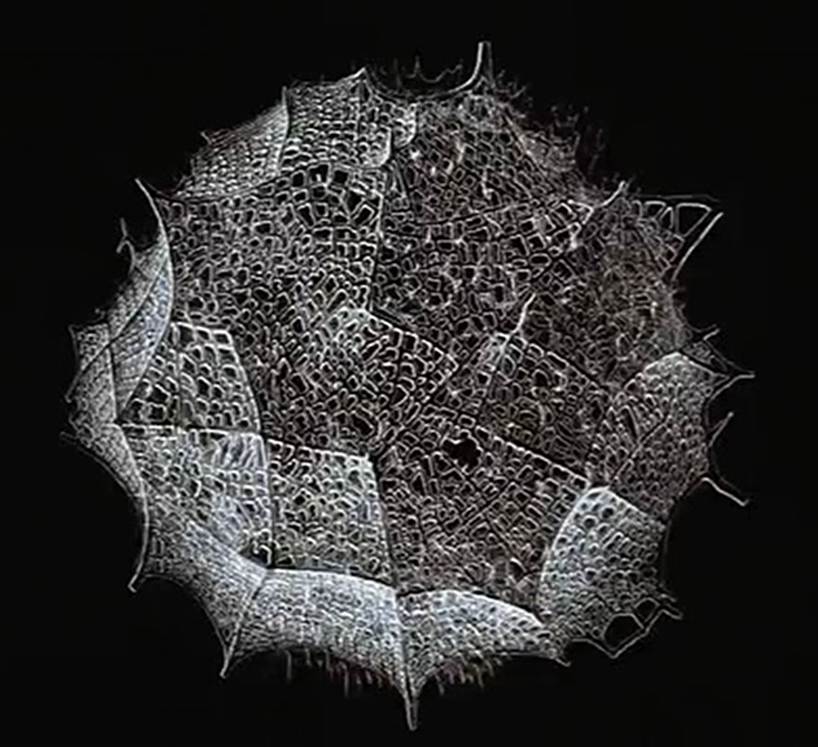
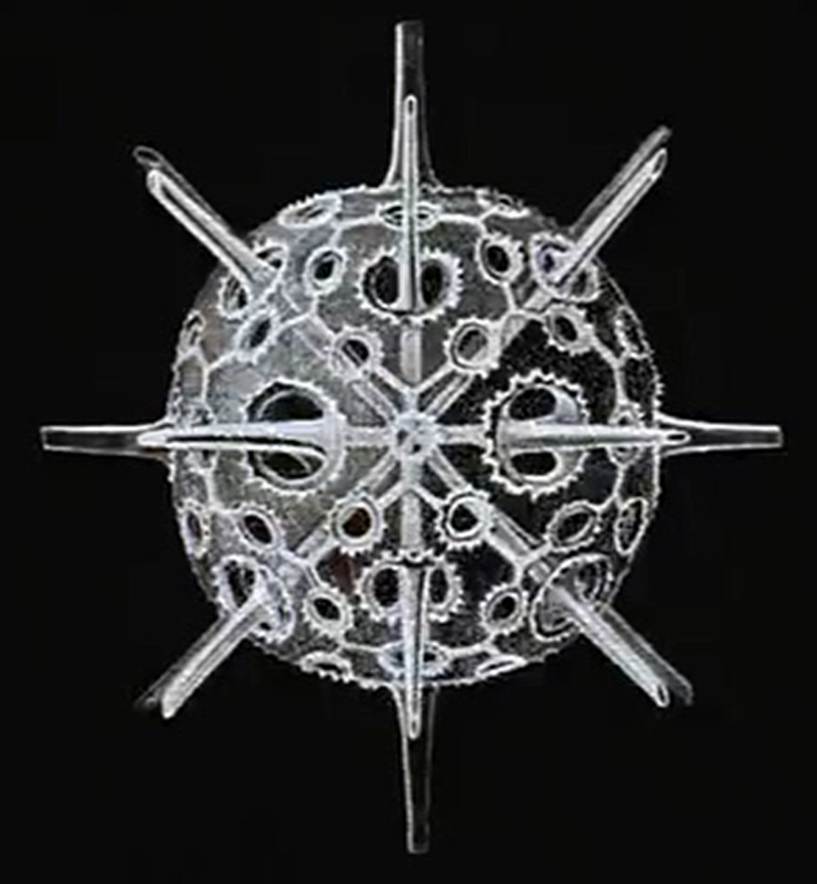
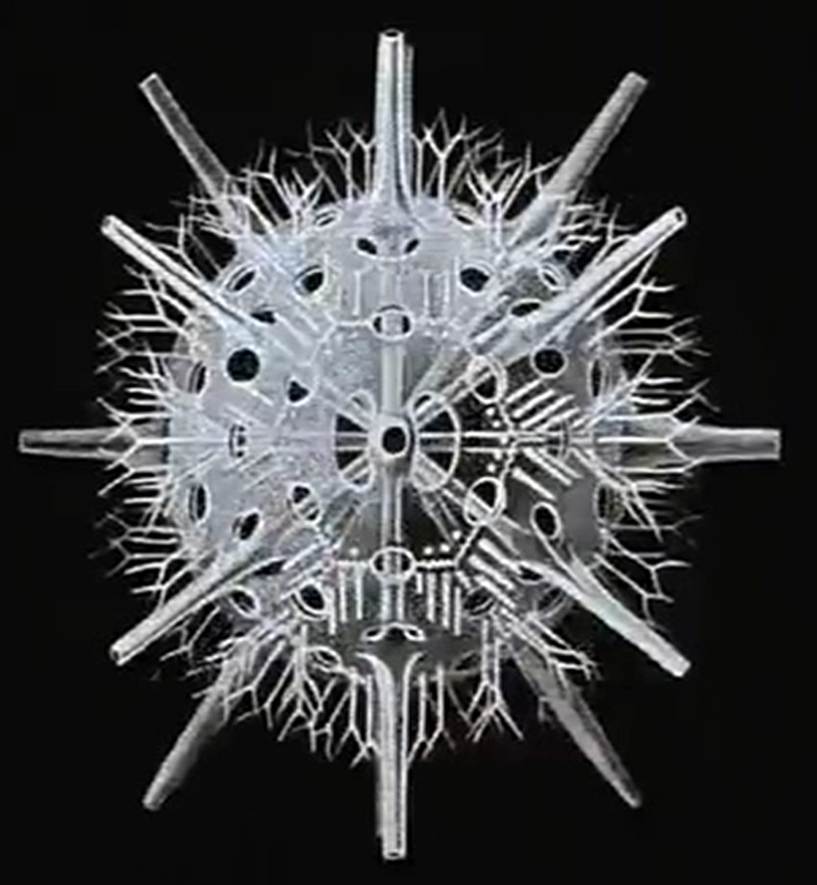
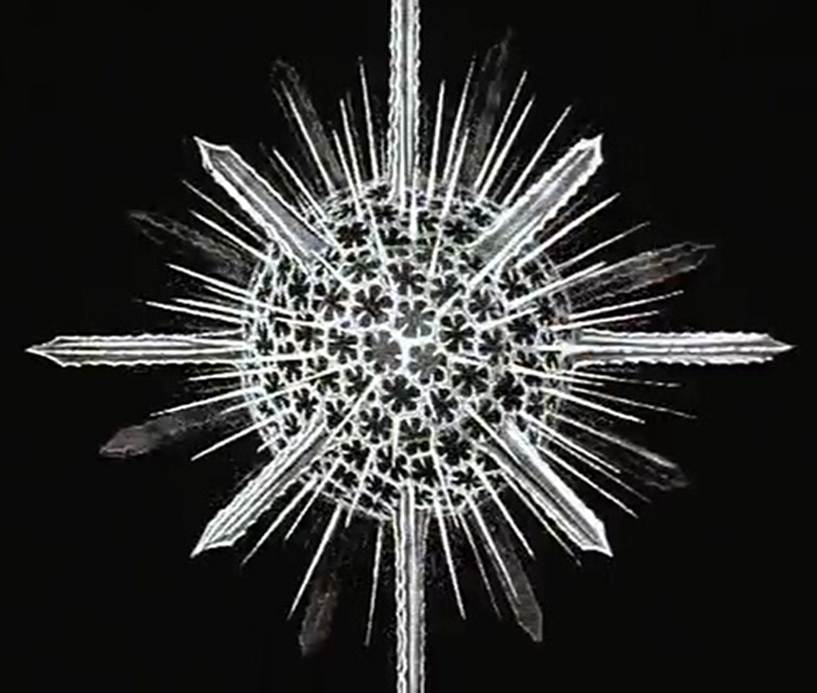
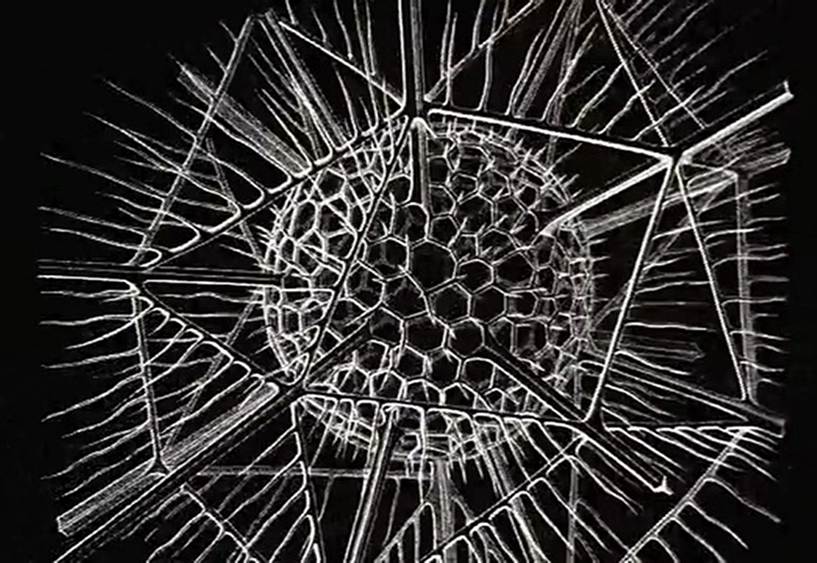
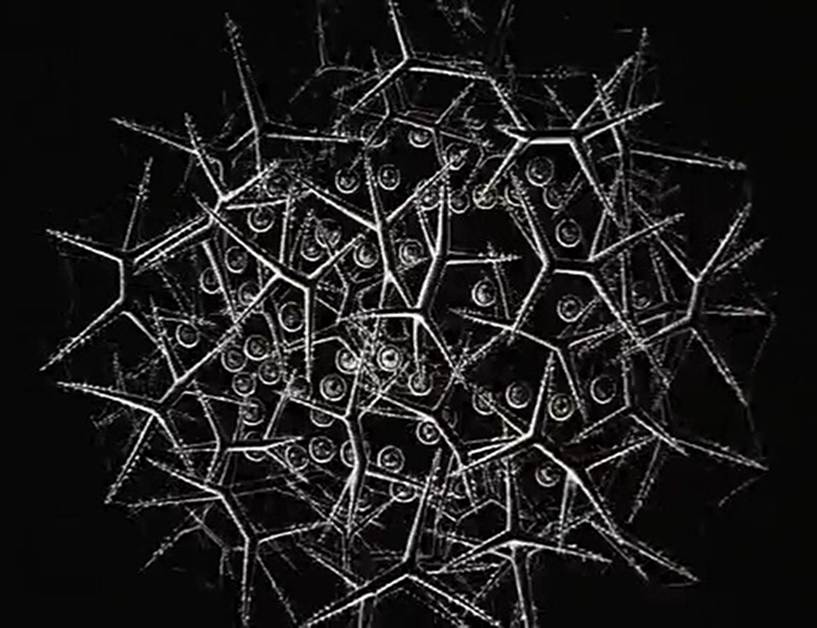
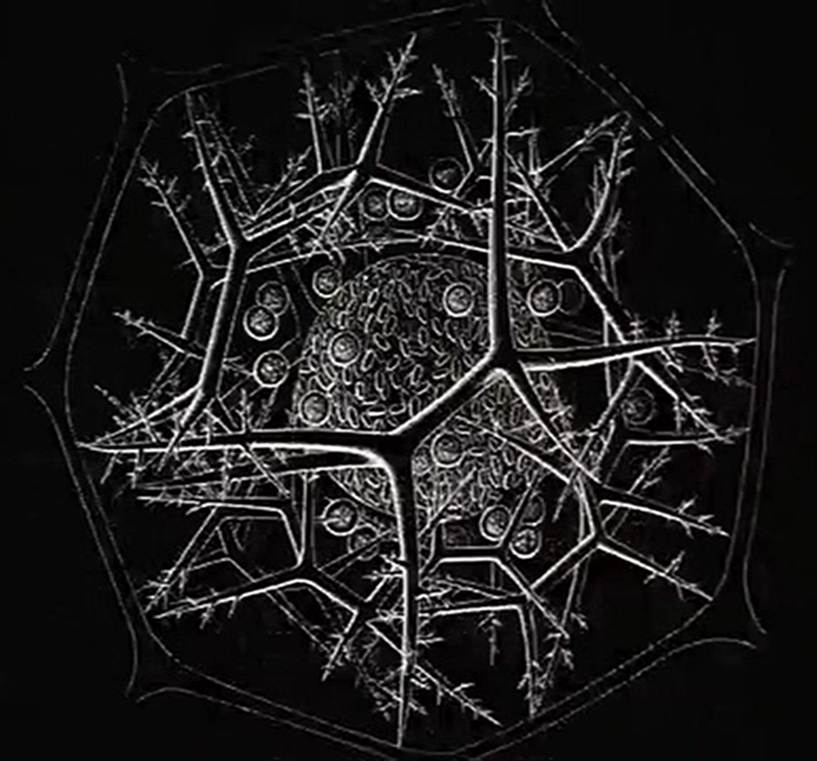
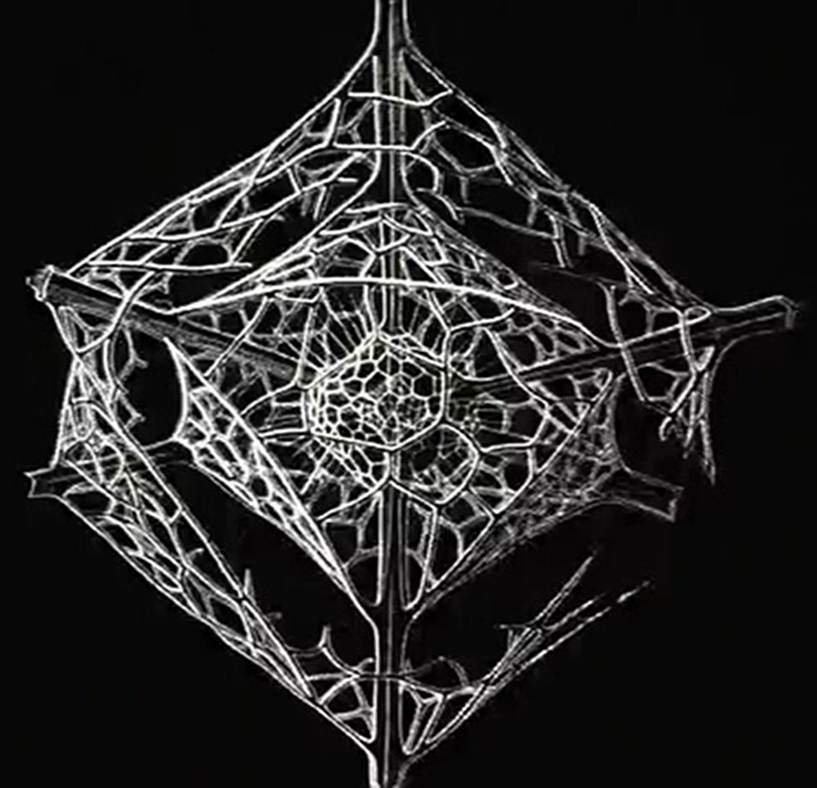
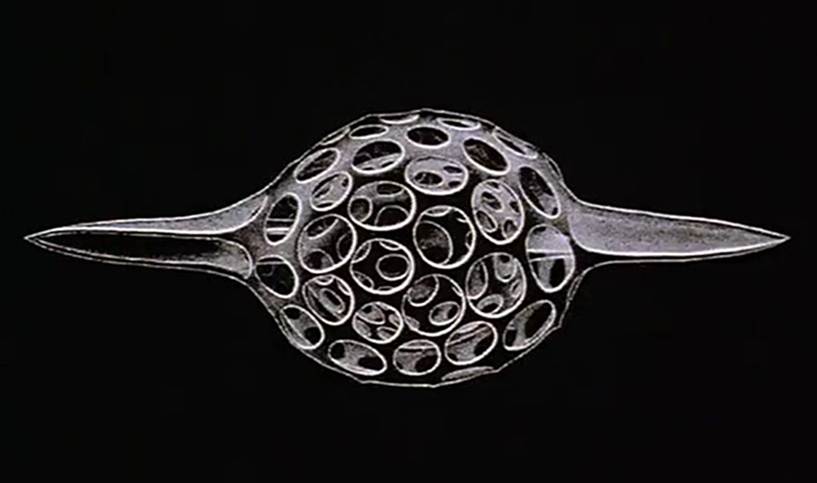
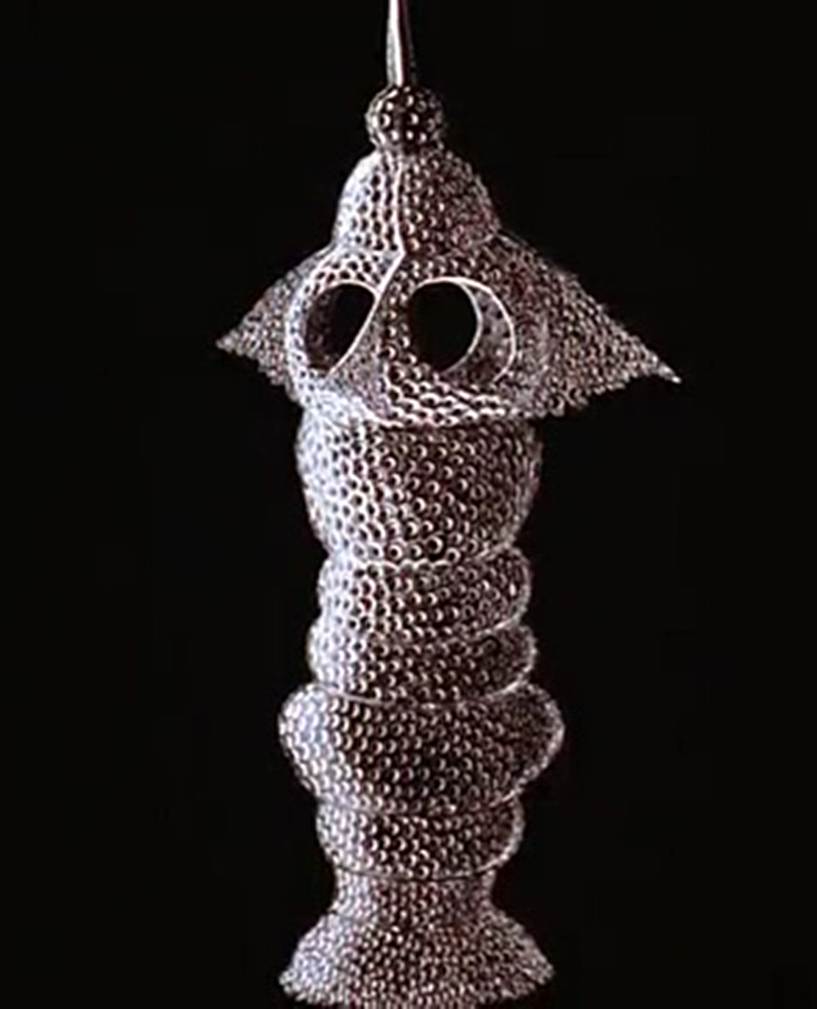
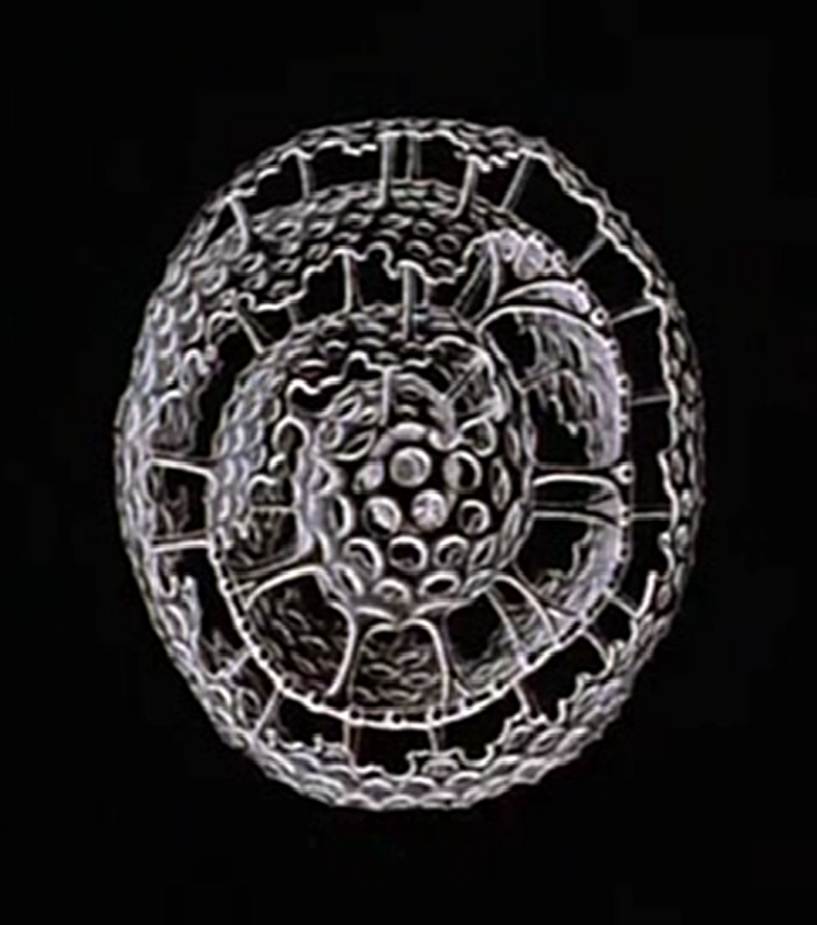
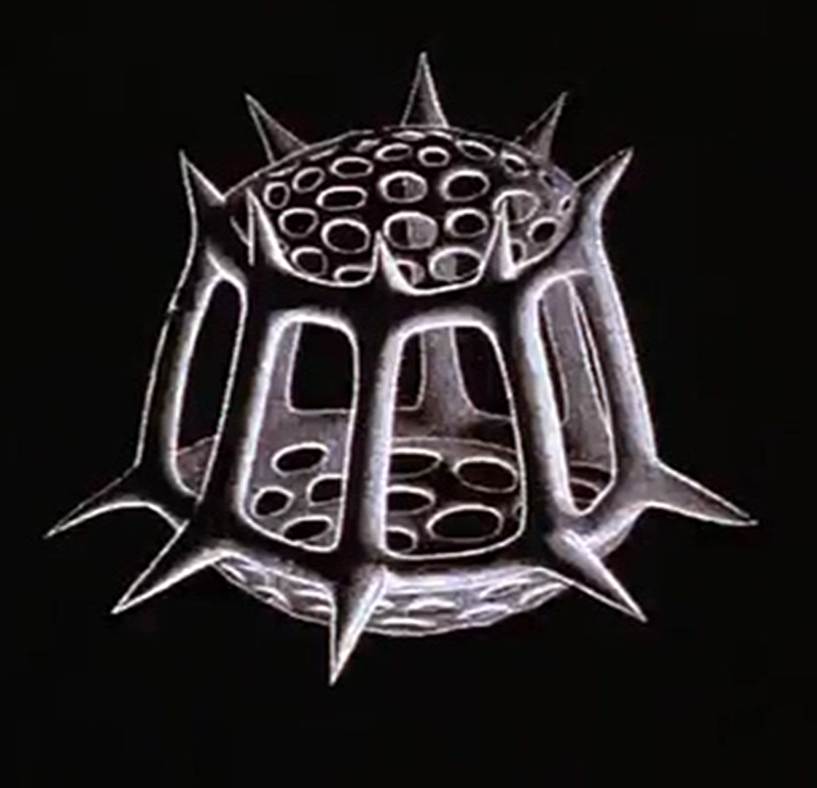
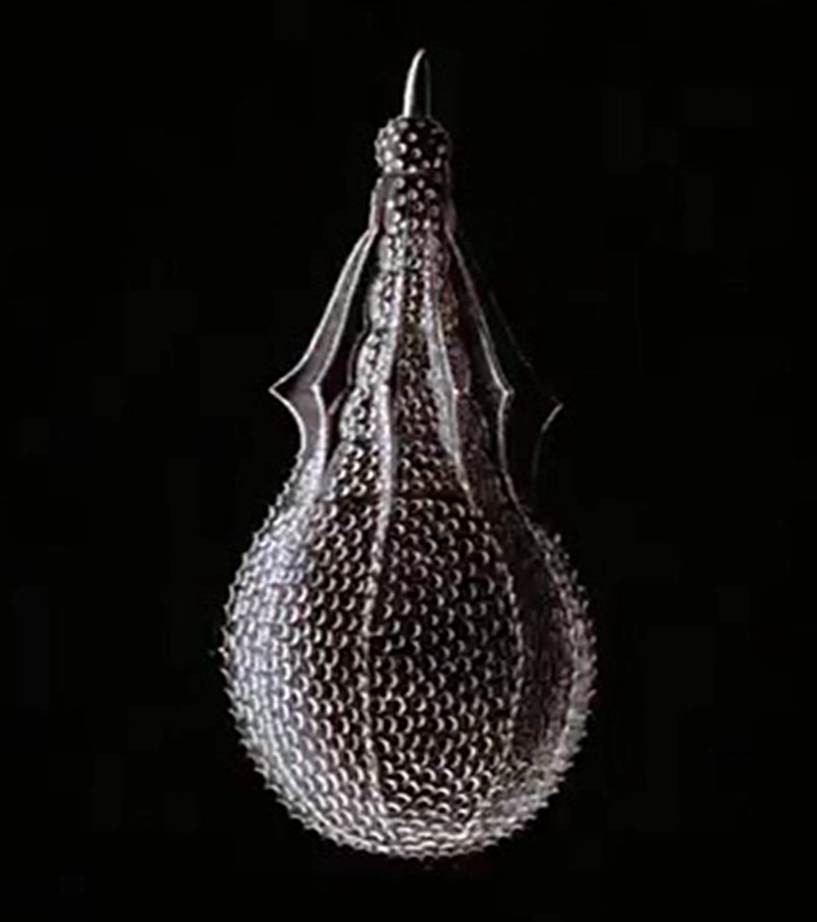
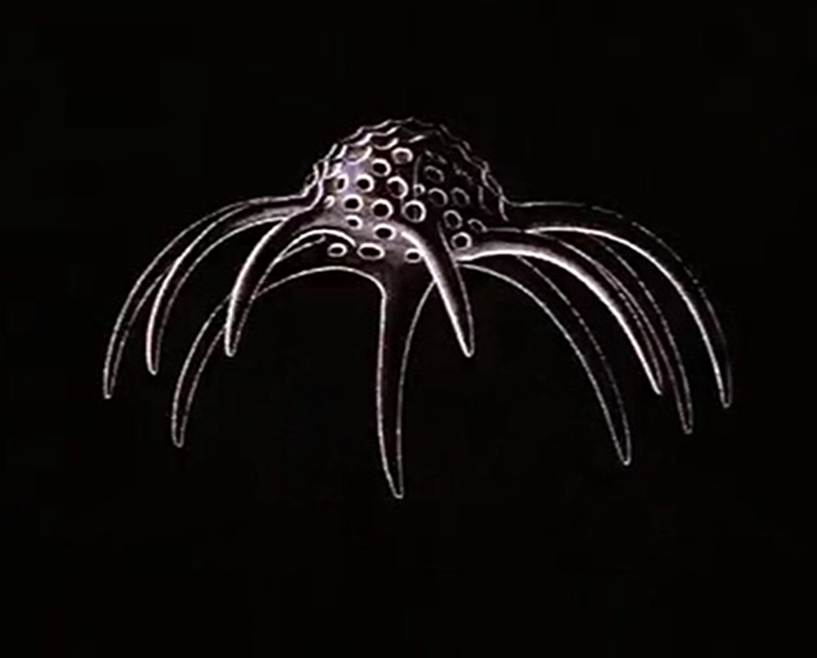
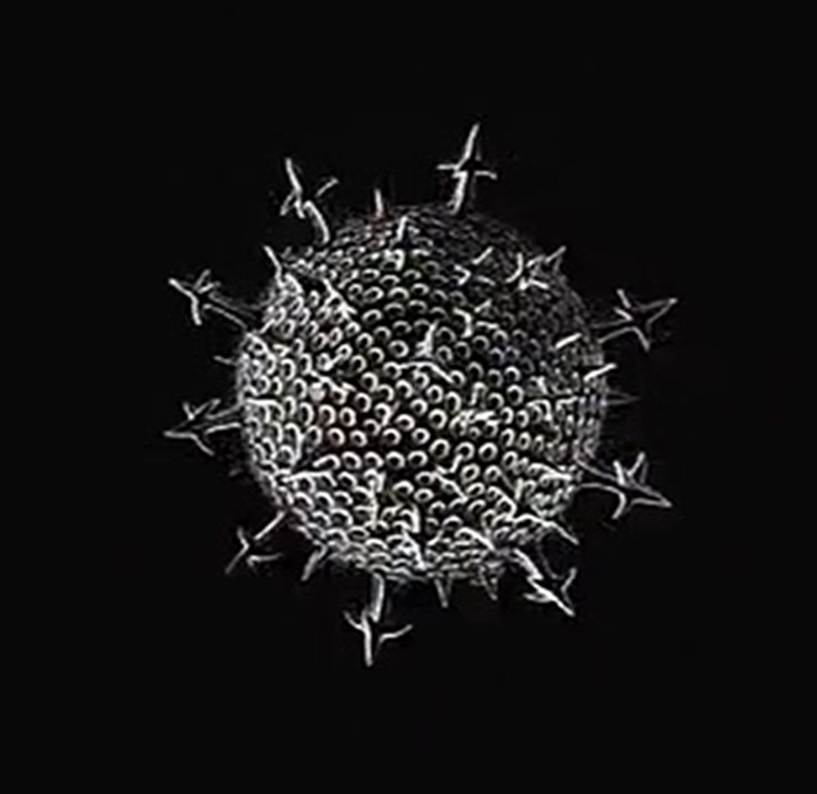
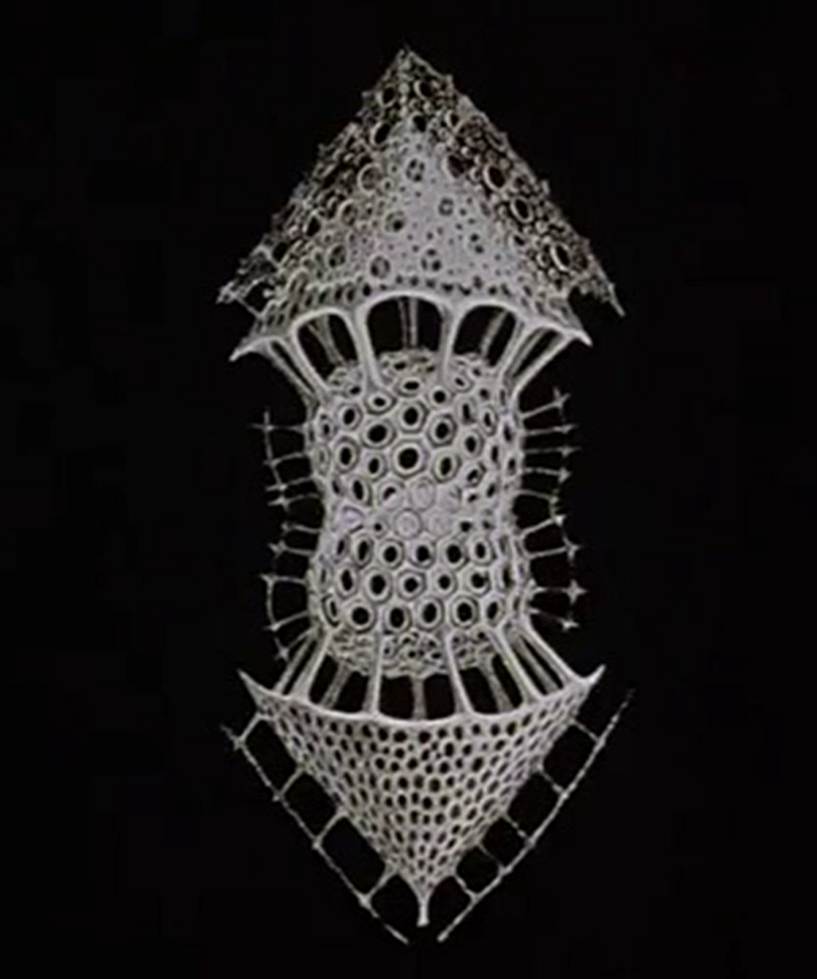
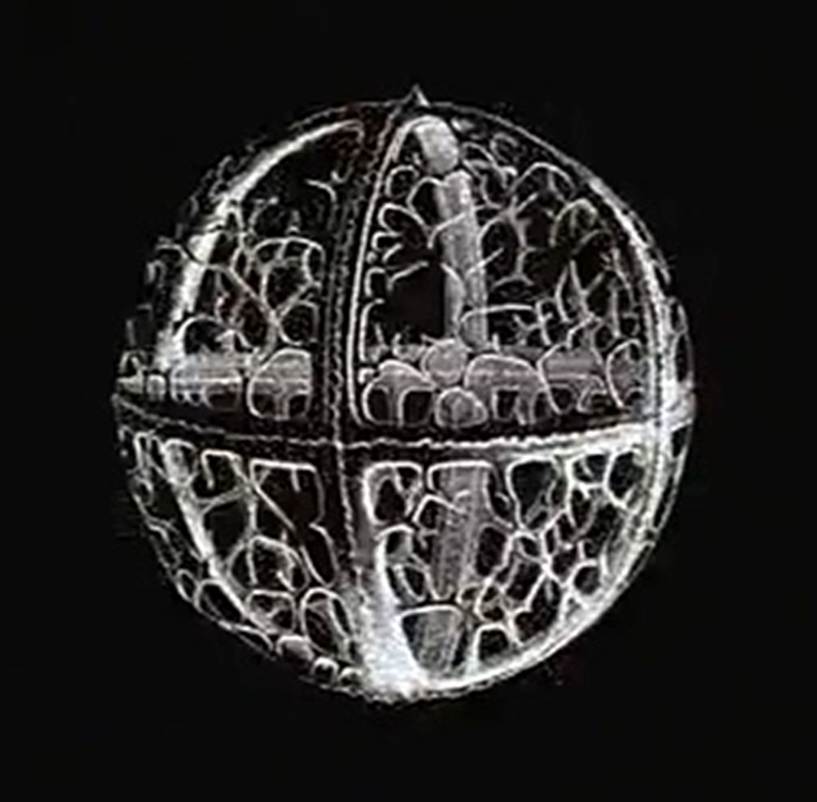
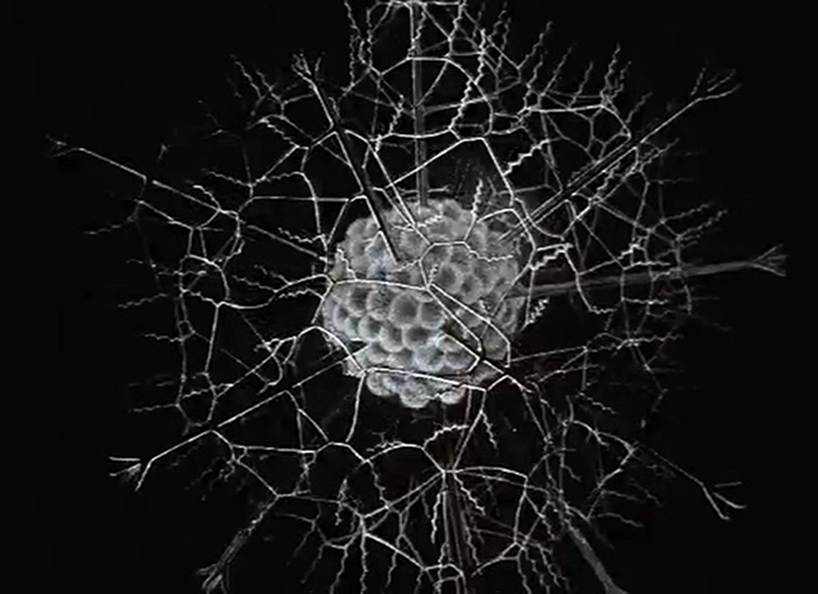
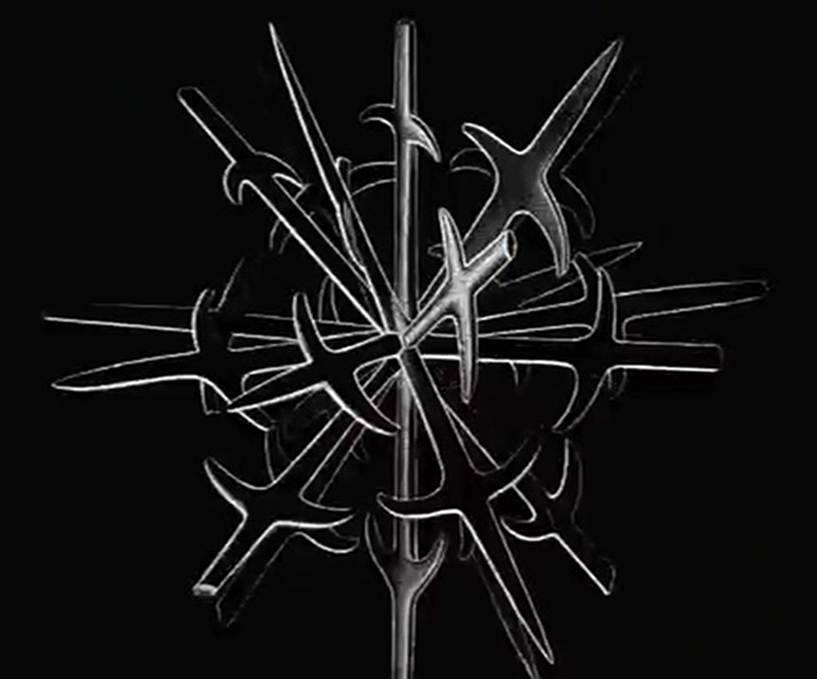
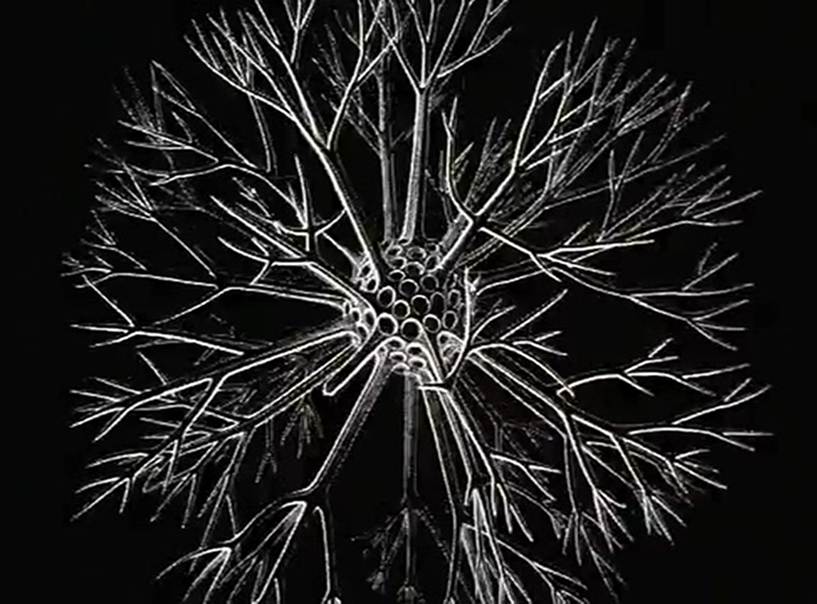
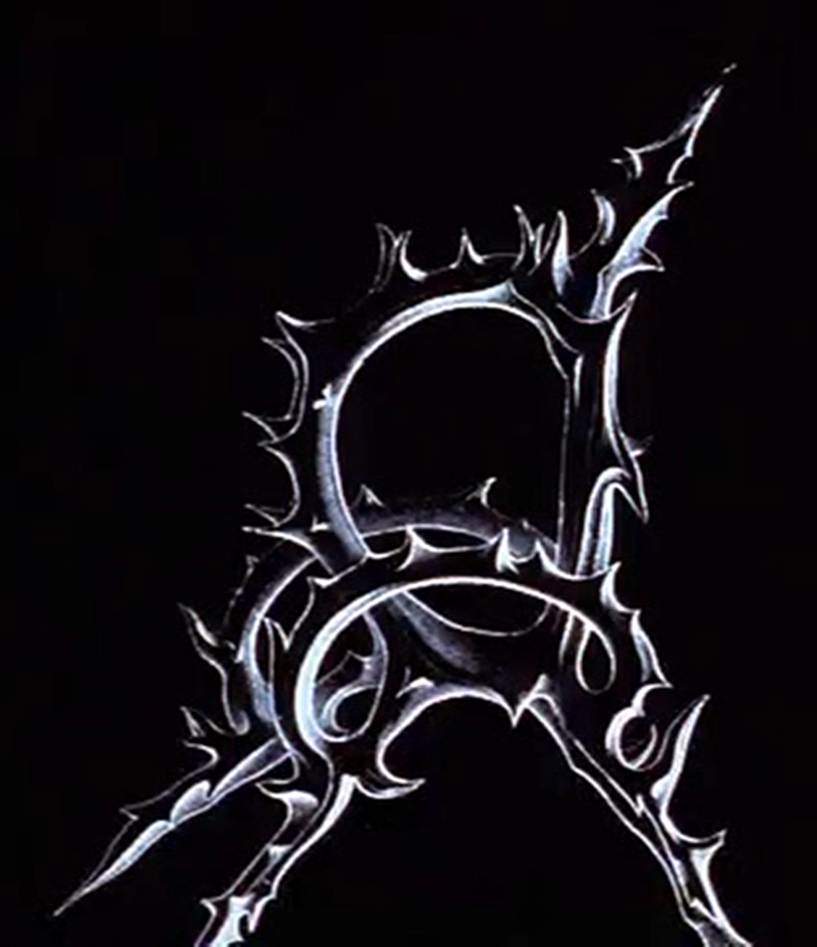
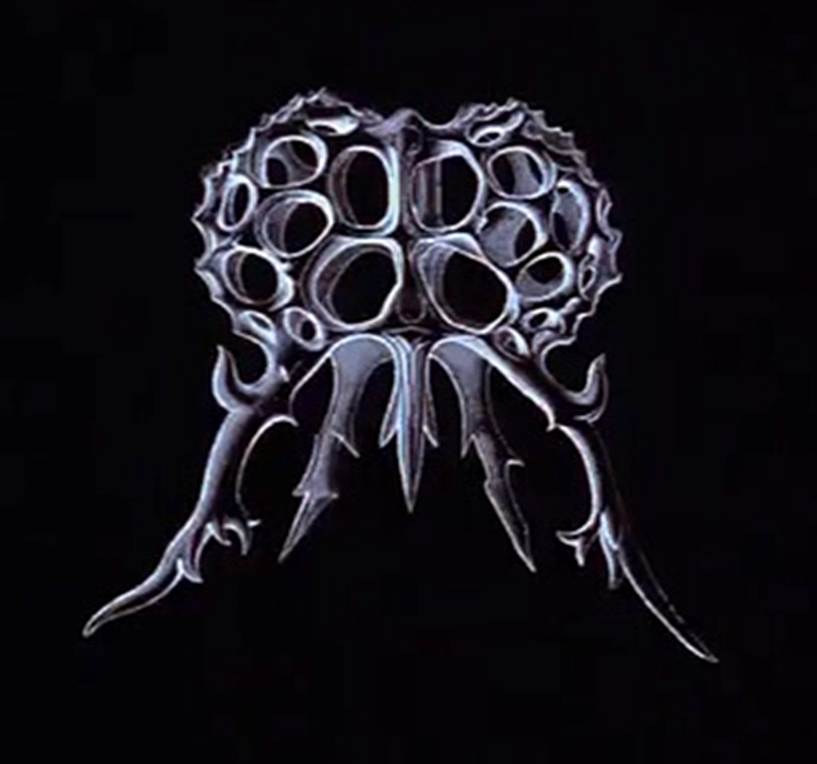
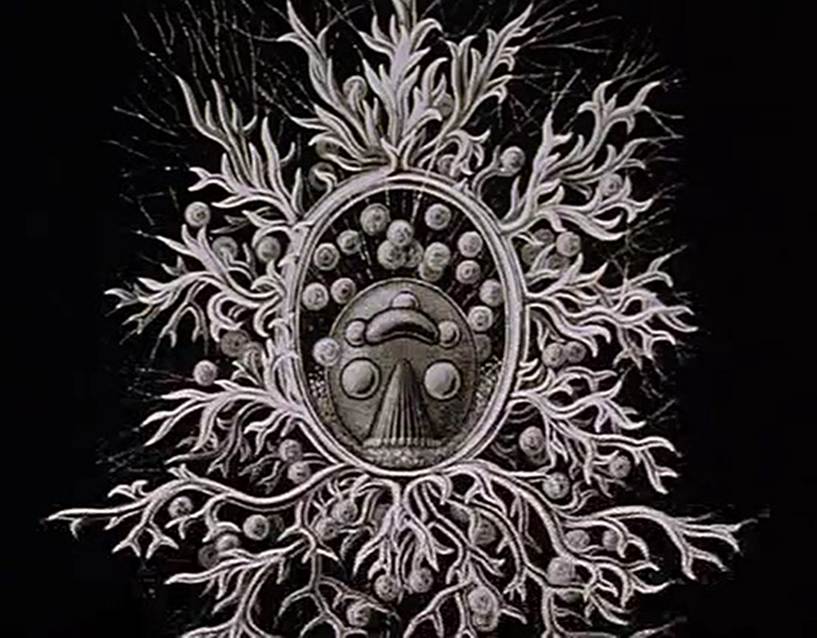
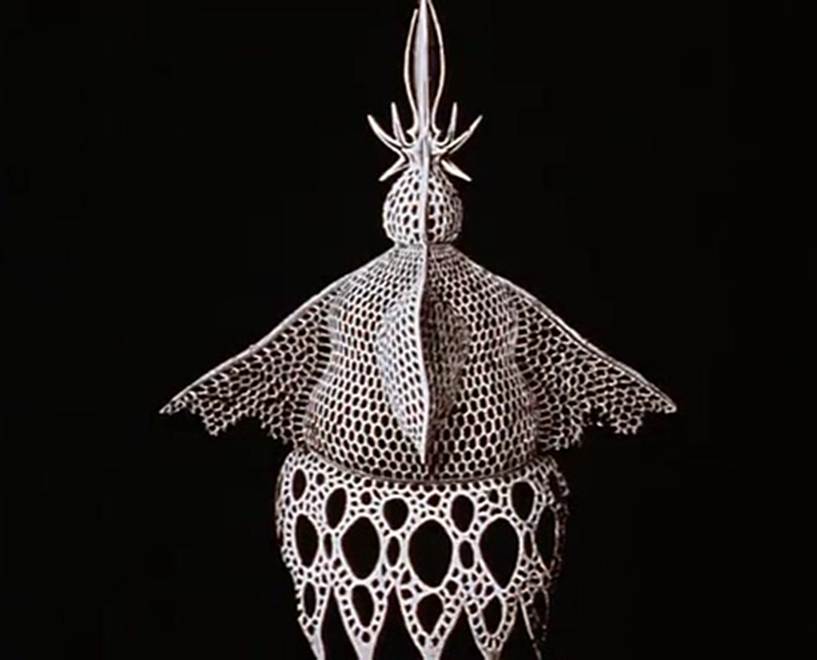
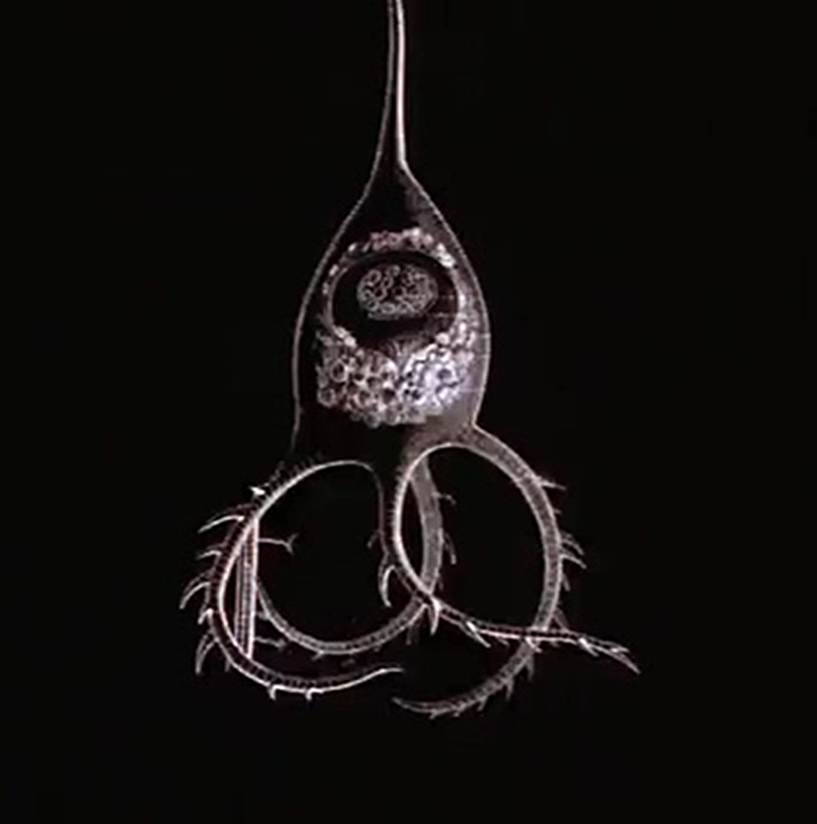
Each picture above is of a single shell of a single cell.
That’s right – the above octopus was a single cell!
The above spider – that was a single cell!!
The above squid-looking thing was just a single cell!!!
The above galaxy-looking things were each single cells!!!!
“The microscopic radiolarian is part of the floating oceanic plankton, a frothy amoeba-like drop of protoplasm, with a network of branching pseudopods to engulf and absorb tiny prey.
But the radiolarian also absorbs silica from sea-water, then extrudes it to construct a glass-like skeleton. In each species, this translucent cage assumes a unique form.
The radiolaria are over 500 million years old, among the earliest skeletonized lifeforms, they are like an alphabet of possibilities, as if the ancient sea were dreaming, in its depths, all the future permutations of organic and invented form, from backbones to bridges, and from the earth to the stars.”
This quote as well as the pictures of the radiolaria are from:
Proteus
David Lebrun, 2004
A mesmerizing well-orchestrated and deeply philosophical must-see doc for serious contemplation on these single-celled animals.
I can’t understand how this documentary isn’t widely popular and talked about.
Much seafood for thought.
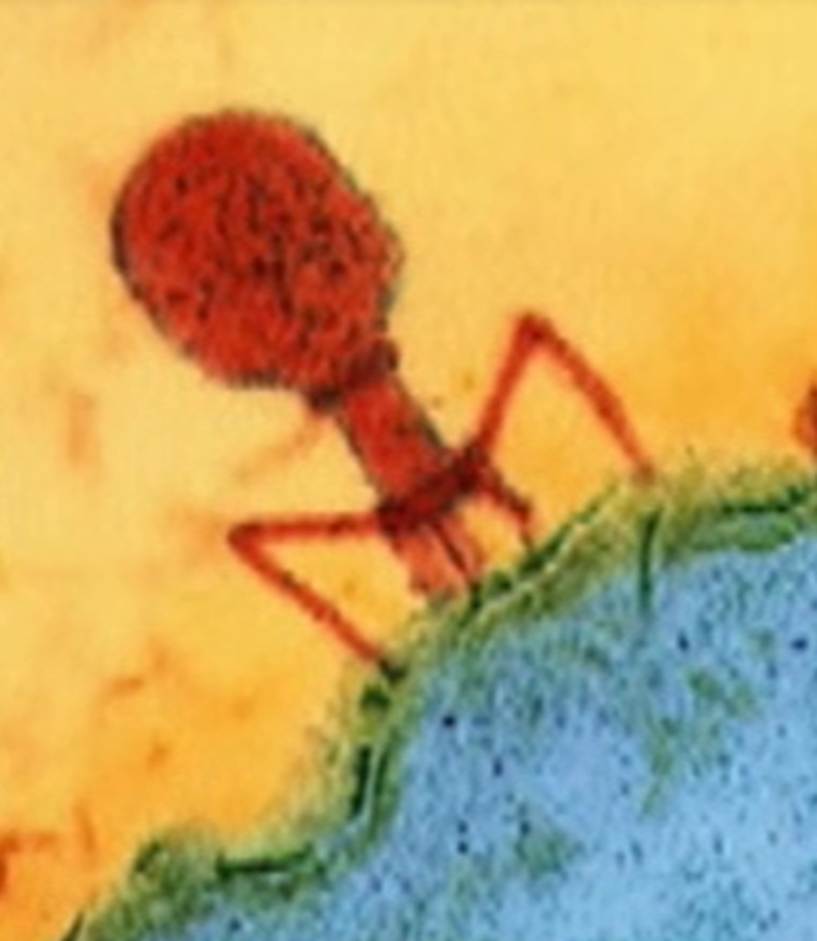
The above is a virus – basically just a small handful of molecules.
We are told that this creature cannot possibly be a creature – a living thing – because “it doesn’t reproduce outside of a host cell”. Well, we’ll see about that.
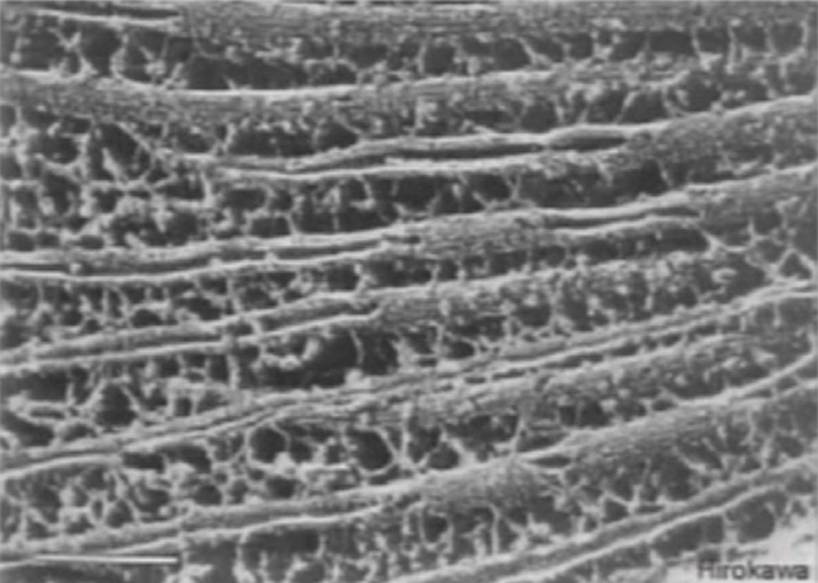
This one is a picture of the insides of a cell’s cytoplasm, which, when I was in grade school, we were taught it was all just a boring bag of water (as the next animation also falsely portrays). But, look! It is a highly ordered and textured network, and if you watch live cell footage – there is clearly more than just “artificial intelligence” animating all the cellular goings-on – there is clearly more than just inanimate unbending particle physics and chemistry equations at work. This “cytoskeleton” within the cytoplasm literally comes alive when you watch a cell move under the microscope, with things literally walking along these microtubules – delivering packages across the cell:
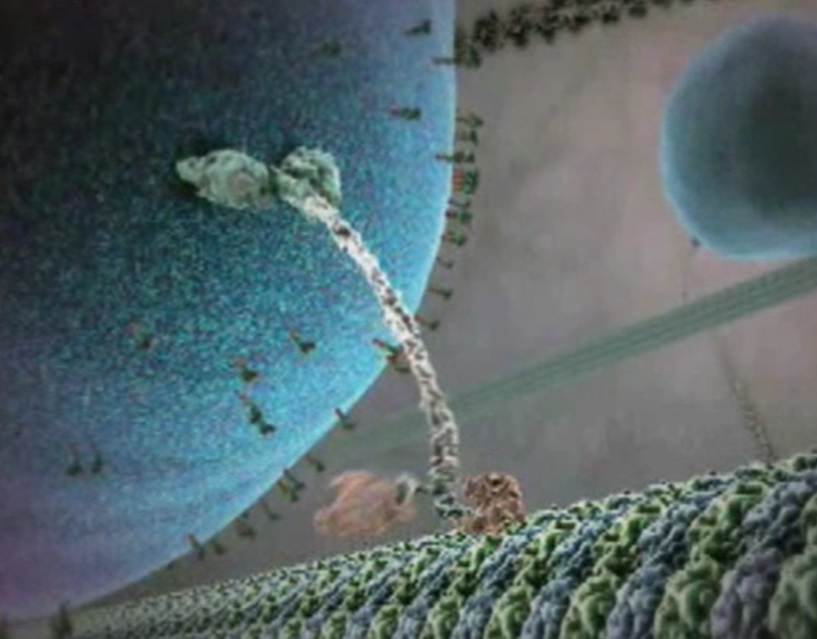
This one is a motor protein carrying a vesicle by literally walking along that microtubule.
Again, this motor protein is just a handful of molecules, but able to literally walk, in a purposeful, directed manner, to and from specific locations, delivering specific packages for specific purposes.
“Just robots”??? Well, we’ll see about that.
Galaxies, if alive (we’ve seen them giving birth…), would have such slow minds – such slower thoughts, relative to us, because a galaxy is so huge that signalling between its constituents would take a long long time. Galaxies, because of their size, seem frozen in a snap-shot. This mirrors the speed of their minds, if alive. And if galaxies are members in larger living organisms, those immense creatures would be even slower of mind (relative to us).
The mind of an electron, if alive, would have such a rapid experience of existence, that it would, within the timespan of one of our thoughts, have the opportunity to enjoy a whole bunch more thoughts.
Whereas a galaxy is super-huge, thus super-slow, thus we see them frozen, like in a still-photograph; an electron is super-small, thus super-speedy, thus we find it hard to determine its position or its motion with accuracy, because it is more fleeting – hard to keep still.
Just as if the electron were to be realized to be alive, this would grow the tree of life below us, so too would the recognition of galaxies as alive, grow the tree of life above us (in our conception of the universe).
At that point, the questions asked would be: can there be anything above or below those, and, at that point, an infinite tree of life makes the irrational finite flat-universe Big-Bang option much much much less appealing, and we can, with a little well-reasoned faith, believe with rational confidence, that, just as we are made of living sentient cells with minds of their own, so too are they made of living sentient creatures, and those creatures are made of smaller creatures… to infinity, thus populating the infinite tree of life below us; and just as we can participate in larger groups which have a mind of their own, it would conceptually be possible for these groups to participate in even larger living organisms, and so on, forming ever-larger living beings, thus allowing for the populating of the infinite tree of life above us.
The discovery of multi-cellular organisation opened up the possibility that there is an infinite tree of life, because if we are made of cooperating intelligent creatures, and they managed to make a distinct intelligent creature – you, well, that opens up the possibility that all creatures are composed of cooperating creatures (this might be a rule rather than a particular trait of multi-cellular earth-life); and if that is true then the universe is infinite in size and cannot possibly contract or expand as a whole.
If life is made of life, and more life, and more life within that, to no end; then the universe itself must be infinitely divisible.
If the universe is infinitely-divisible (each living creature can be further divided into smaller living creatures), then how can the universe have had a Beginning, and how can Life have had an Origin?
If pre-existing living creatures are (always) required to create new living organisms, then Life cannot possibly have had an Origin. Life, is always being created, by living entities (already in existence) acting together in novel ways. Life, is therefore a pre-condition for creating new life (if all life is made of smaller living things).
If Life cannot possibly have had a Beginning, and is animated by an infinite tree of life – an infinite multitude within us, then this negates the possibility that the entire universe itself could have had a Beginning.
The names of God, and many other words in Semitic scripture indicate activities of living members of groups, such as our cells acting within us, or us acting within larger living groups.
In the context of the opening of Genesis, these names reveal that in order to create life, smaller living entities (pre-existing living beings) are required. The creation is ever-present. The beginnings of creatures are always occurring, within you, and outside you. The names of the Living God themselves symbolize the pre-existing groups of living entities – indicating that the authors of the Bible understood there to be infinite ever-occurring beginnings. In other words, if the Living God was in The Beginning, then life already existed, because God represents actual living beings already in existence acting in a specific living way, so it couldn’t have been The Beginning.
We are not the first to have developed a microscope in the history of the planet.
The fact that you, a distinct whole unified creature, are made of trillions of distinct whole unified creatures making complex decisions and learning, with minds of their own, has yet to fully settle in. We have yet to fully realize how many mysteries this presents us with.
Other civilizations that have come and gone, had much greater length of opportunity to not only manufacture lenses, but also ponder upon the mysteries that lenses reveal, for generations.
My cells are not artificially intelligent.
My cells are not robots.
My cells are alive.
They each have a mind of their own.
They each have their own opinions and desires.
They can make decisions in the face of multiple conflicting signals and pressures.
They can coordinate affairs within me.
This is the only explanation for Me.
Big Bang, Relativity, Quantum Mechanics, and mainstream cosmology in general, disallows this, in many ways.
This is a massively important cosmological truth, which would help Science sell Science, instead of turning off anybody who feels they are not made of robots, and would prefer to worship a Living God, even if they believe it to be invisible.
“Yes, we have a soul, but it’s made of lots of tiny robots.
Yes, we have a soul. In what sense?
In the sense that our brains, unlike the brains of even dogs and cats and chimpanzees and dolphins; our brains have functional structures that give our brains powers that no other brains have.
Powers of look-ahead primarily.
We can understand our position in the world.
We can see our future.
We can understand where we came from.
No Buffalo knows it’s a Buffalo.
But we jolly well know that we are members of Homo Sapiens.
It’s the knowledge we have, and the can-do – our capacity to think ahead, and to reflect, and to evaluate, and to evaluate our evaluations, and evaluate the grounds for our evaluations.
It’s this expandable capacity to represent reasons that we have that gives us a soul.
But.
What’s this made of?
It’s just made of neurons!
It’s made of lots of tiny robots!”
Daniel Dennet
Author of Beyond Belief
The Science Studio - Interview with Daniel Dennett
<40:00
An audience member later asks Dennet:
“There’s just one thing you said that caused me some pause.
Your comment on the Buffalos.
Which particular brain structure or oscillations, do buffalos lack and are found in humans – which enable us to say we are Homo Sapiens, while Buffalos are incapable of knowing they are Buffalos.
You’ve said that birds have very innocent brains, well, if you spend a few years looking at those brains, even in those innocent brains you find structures which are absolutely dedicated to the bird’s own song, not others.
So how could you say such a thing?!”
Question posed to Daniel Dennet by an audience member
“Oh, let me clarify.
Um…
Buffalos, like any sexually reproducing species, know their own kind. Not perfectly. That’s why orchids can get pollinated by insects that think they’re mating with their own kind.
So… … there’s… … recognition… … of course. Of course. And so, there has to be something in the brain of every species that permits it to do something like template-matching, whether it’s done olfactorally (smell) or by visual cues or whatever. Of course that’s true.
But…. …
What…. …
So… …
Buffalos, in one sense, know what Buffalos are. They are the things they will mate with, to a first approximation.
But that’s all they know.
We know rather more. We know, for instance, that we are vertebrates and that we are mammals. We know how we are positioned with respect with the other species that are in the biosphere, and no other species knows that.”
Daniel Dennet
Daniel Dennet’s views are beyond belief.
No Buffalo knows it’s a Buffalo.
But we jolly well know that we are members of Homo Sapiens.
Buffalos, in one sense, know what Buffalos are. They are the things they will mate with, to a first approximation.
But that’s all they know.
[we exclusively have] Powers of look-ahead.
We [alone] can see our future. (“think ahead”)
We [alone] can understand where we came from. (“reflect”)
So, just to be clear, Daniel Dennet believes that the only thing a Buffalo can know, concerns procreation, and in a very narrow and automatic sense, not some deep emotional drive or anything (just pattern-recognition of your own species by “template-matching” automatically triggered by smells and sights). And that’s the entirety of what transpires between a Buffalo’s two ears:
“But that’s all they know.”
This is not necessarily the mainstream accepted view, 100%. In the audience at this symposium, 2 other attendees made excellent arguments against Daniel Dennet’s disparaging remarks against the poor buffalo’s mind. But, even if this is not what every last scholar and scientist believes, the core assumptions that he blurts out have been applied in various fields, in many ways, and are exceedingly central and important, on many levels, and even trickle into popular thought – popular assumptions about the natural world, affecting, for example, how we treat animals.
No audience member raised an objection to calling your neurons “robots”.
Your soul is simply made of lots of tiny robots???
With this, Daniel Dennett reveals that he doesn’t even know that he is human.
I wonder just how many other poor science-zombies out there see themselves and others like this? What a shame. A ridiculous and stale view of one’s own inner life.
Dennet self-righteously and very pompously speaks of changing the whole wide world by forcing curricula of his liking on your children, and on each of the billions of children on earth – just “facts” about the world’s religions; and thereby gradually rid the world of the “worst religions”.
Dennet’s bland robotic vision of our inner lives would only turn off any serious-minded religious person!
If his thinking is associated with and promoted alongside these mandated curricula across the world as he suggests, it would certainly have an effect opposite to his liking. His ridiculous views on tiny automatons within us as the seat of the soul, would only strengthen a religious person’s conviction that modern Science just doesn’t understand a goddamn thing.
When a critter stores food for later, by hiding or burying it, Daniel Dennet, those who read his works enthusiastically, and vast sordid armies of science-zombies drooling and groaning all over the world, would all frown upon us from asserting that the critter truly remembered where it was stored. We should not say (in their view) that it planned to store the food. We should not say that it thought up its plan to store food. We should not say it understands the notion of storage. We should not say that it wants to eat well and survive – we should not say it truly has a will to do so.
When a prey looks out for and fears the presence of a predator, we should not say it “perceives” the presence of a predator. We should not say it has an “understanding” of the situation. We should not say that it has “foresight”, or has “reflected” upon “memories” of previous encounters with that predator.
Scores of professionals (not all, thankfully) investigating and commenting upon the workings of nature assume that everything animals do is “instinct”, a term which is left undefined by those who employ it. They simply catalogue their repertoires of “instincts” and we then anthropomorphise these allegedly automatic functions for a laugh in nature videos of the week.
When an eagle drops a turtle onto rocks, from a great height, to crack the turtle’s shell, we should not say that the eagle can contemplate (truly think in a living way), drawing upon its truly living dynamic memory to conjure up and implement a plan to deal with the hard shell.
Peregrine falcons transfer their captured prey mid-air, to relay the prey along to the other parent who is tending to the nest, to feed their young. We should not say that they are truly communicating or truly co-ordinating this based on a common understanding of the situation. It’s all just “instincts” at work. It is just innate reflexes and habits at work. It’s just DNA. Just “template matching”.
Some jumping spiders, in particular some species of Portia, once they have spotted a tasty meal on a nearby bush, can negotiate long detours from one bush down to the ground, then up the stem of another bush to capture a prey item on a particular leaf!!! But apparently “humans are the only species with planning or foresight” (a quote from David Suzuki, and countless others, not just Dennet). We can’t even give credit to the poor spider for even simply remembering, truly remembering the critter on the other bush during its detoured trip, and acting upon this memory in an effective way – by thinking of the best route to find the prey now that it has been located, because he’s hungry (he has a will to eat).
“[Jumping Spiders] do not necessarily follow a straight path in approaching prey. They may follow a circuitous course, sometimes even a course that takes the hunter through regions from which the prey is not visible. Such complex adaptive behaviour is hard to reconcile with an organism that has such a tiny brain, but some jumping spiders, in particular some species of Portia, can negotiate long detours from one bush down to the ground, then up the stem of another bush to capture a prey item on a particular leaf.”
Tarsitano, Michael S.; Jackson, Robert R. (February 1997).
"Araneophagic jumping spiders discriminate between detour routes that do and do not lead to prey".
Animal Behaviour. 53 (2): 257–266.
A human is 2 percent brain.
A large spider is up to 8 percent brain.
A small spider is 80 percent brain.
Mystery upon mystery!!!
Every year in October, the hawks on the Galapagos eagerly await the iguana eggs to hatch in the middle of a crater. They cannot see the eggs, and could only possibly know about this from memories at least a year old. But, I’m sorry, I made a mistake, I should not say the hawks actually remembered the iguana eggs. It’s just some automatic robotic “instinctual” “template-matching” encoded in their DNA then expressed as lifeless “instincts” and “reflexes” triggered by “smells and sights”. Right. My mistake. That’s much more obvious than actual memory.
We know much less about being a buffalo than a buffalo does!
A buffalo has direct experience being a buffalo!
As it smells the morning air, chews on different delectables arrayed throughout the field, looks out on the horizon and is presented with pasture, a fight, a mate, or a fence-line; does the buffalo not have a much much much richer understanding of what being a buffalo is all about, than we do?
What do we know about buffalos? Who, in this world, has engrossed themselves in a relationship and love of buffalo to really know them? Where’s the Jane Goodall of the Buffalo? What we do know is the specifics of how we slaughtered them near to extinction, and other things like their basic biology, but really mostly from our study of cash cattle and other vertebrates. We reduced their numbers from 60000000 to 1000 head, and we now claim to understand what a Buffalo’s existence is all about, better than the surviving Buffalo themselves?!
Horned Animals understand that they have horns, even when the horns point back and away from their eyes. They know this. They can’t see their horns – they are behind their eyes – so how do they know how to fight with them so effectively? Instinct? Nonsense. “Template-matching”? Gimme a break. Howbout, they might see others of their kind, and understand that they also sport these same horns? And, howbout, they might feel their own horns, like the weight of them, and while a horn hits other things the horned animal might build an imaginary replica of the horn’s shape in its mind – like where the tip is, by rubbing the horn up on a rock or rubbing it on the ground? It must build a sense – an understanding of its horns, which it can’t see or smell (no “template-matching”), by these and many other factors. It must be able to remember all this, in order to apply this understanding in the next battle.
Let’s consider a lion fighting for his pride, literally. OK. Why? The defending dude obviously understands more than just having sex (understanding includes knowledge), he understands conjugal rights (that’s pretty darn abstract), territorial claims, the unworthiness or worthiness of each claimant, and he is most definitely angry at the invading suitor (that indicates the building of an idea of the character and intentions of the other lion). How can all this just be automatic chemicals bouncing around? “template-matching”? What? So, all these “templates” are hard-coded? All these events are pre-determined by “templates”?
“Template-matching” as explaining complex insect and animal behaviours?
Insect and animal behaviours only as automatic routines encoded in DNA??
“A buffalo doesn’t know that it’s a buffalo”???
Cells are just robots!????
What an ill-conceived un-comprehensive view of life.
When we treat plants and animals with cruelty or disregard, we in fact show our lesser nature (in that instance). We exhibit more primitive, basic, and wanton “animal”-like behaviour, in some instances, much more offensive in the eyes of God than a lion choosing the weakest of a herd and feeding her family, or an “evil” vulture cleaning up the mess afterwards, making sure nothing goes to waste. Collecting elephant skulls as trophies, and putting them on display in the foyer, lays bare our notion of intellectual/spiritual superiority (in that instance).
With every purchase of food you make, you choose to treat insects poorly or well, you choose to treat soils that sustain you poorly or well, you choose to treat plants poorly or well, you choose to treat animals poorly or well, you choose to treat farm-hands poorly or well; and with your choice of packaging and delivery, you further choose to treat critters downstream poorly or well. If you were to appreciate just how absolutely dependant we are on plants, insects and other living creatures – that you would die without them and that you cannot be understood without understanding them; and if you were to recognize that they have minds – that they think and contemplate things and have opinions of us and concepts of their fate in the world, the right decisions would come naturally.
I’m sure that an ant or a bee can come to feel strongly that his or her nest is just as “perfect”, “aligned”, “sophisticated”, “streamlined”, “well-arrayed”, “neat”, “comfortable”, and all other words that we use to describe that sort of feeling you get when you look at our accomplishments, like a clean street with glass skyscrapers and people walking in straight lines in a thoroughfare. Our sense of “civilization” – well-ordered collective streamlined efficient organisation – is only from our perspective, living our lives in well-arrayed streets, from our size.
Just because we see a beehive as messy, doesn’t mean that they see it as messy.
If you look at our hives from a just a few tens of kilometers above ground, our sprawling nests and workplaces look messy too! But we see the straight lines (or symmetric curves) up close, at street-level, and all the shiny metals and glass, so we primarily internalize and perceive our efforts in human societal accomplishments as brilliantly and gloriously advanced.
We can’t fathom the experience of an insect – of their sense of comfort or admiration of symmetry in design within their dwellings (their civilized accomplishments) and so, from afar, we judge them all as gross messy “bugs”. “They are obviously inferior – look how messy they are!” “Ewwww!” “Quick, squish it!”
“All insects think about is procreating”
This sterile philosophical position is not just repeated by soooo many professionals (not just Daniel Dennet and his hoards of A.I.-evolutionist zombie-minions), it is also promoted in countless nature videos and publications, and I haven’t heard a single statement questioning this blatant fallacy (maybe somebody has already questioned this – it’s obviously silly – it’s a no-brainer!).
Just because we see multitudes of insects within one glance, and just because they move and do things quicker relative to us (reproduce many more generations relative to our experience of life), does not indicate, at all, that insects are “obsessed with procreation” – that’s like saying elephants are not as interested in procreation as ants because they take a long time to generate and rear their offspring, and there are very few of them around within one of our glances. Saying “Elephants think too little of procreation” is just as silly as saying “insects think too much about procreation”.
“The praying mantis must mate, otherwise he won’t be able to pass on his genes”
What? As if he’s not looking to get laid – as if there is no feeling or deep desire involved!
Taken as true, this ridiculous statement would imply a deep understanding of genes and heredity on behalf of the mantis!
Maybe those writing the scripts for these nature videos have a hard time imagining a drive other than “genetic” that the praying mantis is working from. Maybe genetics is just so pervasive as a model in our current thinking that it is automatically invoked, and can be done so with assuredness, without worry of error, because: what other explanation can the narrator offer – genetics explains all – so it’s safe to say that the praying mantis cares only about the genes of the species, because genetics reigns supreme.
In Australian Geographic, @ 19:00, the same sorry line is repeated! “The female Koala chooses the strongest male as her mate, because his genes will give her young the best chance of survival”.
What?
Seriously?
What sort of evidence is there for such a deliberate and elaborate motive, and such a convoluted one, involving an understanding of how generations years down the road will unfold. (contrast this nonsense with the assertion that a buffalo “does not even know it’s a buffalo”) What about just looking for a good time with the sexiest Koala in the eucalyptus dating-range, with the largest… ears? When two humans mate, are they only thinking of the strength of their offspring, and the success of their species? If you believe this, then you need to visit Vegas.
What about the pleasure of sex? Don’t you think non-humans want to have sexual pleasures too? Do you think that 2 male rams attacking each other at top-speed, delivering splitting blows to the head, quivering and staggering to the side like drunken boxers as their heads ring and eyes shake, are just concerned with the genetic state of the species? Do you think the praying mantis is thinking of DNA recombination when he risks losing more than his shirt by copulating with his evil spouse? Do you think the drone bee is just thinking of the good of the hive when he decides to get his crotch and abdomen ripped out from him as he mates with the queen, and then die? Such a selfless act without any reward – such noble creatures – all for the good of the collective – all “for the sake of genes”! Pffffff!
Critters are conscious of themselves (they know themselves), and they know their kind, and they know they are one of that kind; and critters obviously (daily) concern themselves with and know about much more than just procreation, and this cannot be done unless they have knowledge and understanding of the situations that they find themselves in. This is exceedingly obvious. Remember the spider remembering where the lunch is to be found on the other bush! Don’t forget this!
An astrophysicist will try to prove the existence of a black hole, not by observing it directly, but by observing the effects it has on surrounding things; but they will not allow the existence of the mind of a plant or animal, by observing secondary things (indirect things), like expressions or responses, or memory, or coordinated motion, or effective decision-making in the face of many pressures or many attractors, or some other indication that there is a mind there, which cannot be determined directly (without living the life of the dog or palm tree itself directly)!
People who insist that there is clear evidence that cells, snails and cedars exhibit a mind of their own, are confronted with stern consternation from academic authorities, with statements like “just because an animal emotes pain, this does not necessarily mean it feels that pain.” What? OK By your logic, black holes will only ever be theory, because we can’t observe them directly, and therefore cannot be proven as fact.
With professionals studying emotions within non-human creatures, they never allow for the conclusion that those creatures actually have a mind to register things like pain within social or personal storylines or context (heart-wrenching spiritual discord) within their minds – there’s no soul there. For example, when two fruit flies fight each other violently over food, in an outwardly visible fit of rage, we are not allowed to conclude that they feel anger and rage internally (as complex as we experience these, spiritually). Or when a creature licks its own wounds, or grooms itself, they say we are not allowed to conclude that they are self-conscious or have a concept of their own self - of their own condition and needs and such.
They say that these are just exterior “emotions”, or exterior signs of intelligence, and that: who knows if that actually represents what we know as internal feeling/emotion and experience of mind and soul. They say that consciousness and self-consciousness are only found in mankind. They say that non-human creatures have no memory and that foresight (along with reflection) is our primary advantage over other creatures. We are told that thought and innovative action based on thought, is definitely a human-only trait.
"Even insects express anger, terror, jealousy and love by their stridulation."
Charles Darwin
The expression of emotions in man an animals.
Page 349
If your dog whimpers at an empty food bowl, and makes that sound heard “externally”, we are not allowed to conclude that Rover has an understanding of the situation, or feels betrayed by you – it’s just some process like “instinct” at work, being “expressed” externally.
By this standard, how can you be sure that any other human you know has a living mind? People you’ve known your whole life – maybe they are just “robots” animated by “instinct” or “templates” in DNA and are triggered by certain sights and sounds! How would you know? They only express emotions “externally”!!! Right? How would you know if they had a soul or not?
Aunt Sue? Stay back!!! You’re a robot?!? What?!? No!!!!!!!!!!!!!!!!!!!!
How can you be sure that Aunt Sue’s external expressions represent anything real internally? Maybe all your family, friends and coworkers, and all other acquaintances, are all just acting based exclusively on “template-matching” and other automatic functions?! Maybe, then, you are the only living creature in the whole universe with a mind?! Pffffffffffffff.
We can’t say a dog is writhing in true pain when skinned alive. The cries of pain are not cries of actual pain – they are just automatic reactions, just instincts, brought about by the situation, based on certain “templates”.
Or, maybe, the dog in fact knows this is not normal, knows that things are not getting better by the minute, knows that master has clearly abandoned him, and knows that running free in a field was so much more fun.
None of this knowledge has anything to do with procreation.
Every multicellular creature is made of individual cells just as potentially intelligent as any of your individual cells. There are oodles of ways cells can communicate and interact with one another.
Two cells, in a multicellular organism (just two cells large), can use their individual intelligence to collectively coordinate their activities, and move around and do stuff like find food.
And these two acting together as a unit would form a sort of acting mind of its own, as they communicate and coordinate their business.
Then, we immediately eliminate this intelligence – this innate intelligence of these two cooperating cells the second they decide to plant themselves in a spot in the soil? !!!
Why?
Does our form of mind in fact limit us in some ways. Can a tree contemplate matters much more patiently, comparing and contrasting issues with deliberation that may last for thousands of years in some cases? In this case, “plants do not think like we do” might in fact be a compliment for the tree – in that plants, in this case, have certain admirable advantages in the way they contemplate things and enjoy life. They might very well hold living memory of things that our living biosphere has endured or enjoyed over the centuries or millennia.
Someone somewhere once said something like “I won’t answer whether I believe in God or not, until we all agree on the definition of the term.”
We should, likewise, not rush to declare that plants, animals, single cells and viruses do not have a mind of their own, until we all agree on how exactly we define what a “mind” is, in the first place.
In order to arrive at a definition of God, as specifically understood by the authors of Semitic scripture, we would first have to come to a solid definition of Life and Mind, seeing as the letters in the names of God indicate fundamental basic concepts of lively activity occurring in specific contexts.
If we are made of living creatures communicating and acting together, might this be the case with all living creatures? Is the cell also made of living creatures? Why not? If nature reveals that we are made of living constituents, and that this is a possible arrangement, then the cell might not be the “basis of all life”, but it might also be “based” on smaller lifeforms! The reason why this is not allowed by modern science is that:
If we stay within the current model of a finite universe, this is impossible, because there would be nothing smaller than electrons and their friends. If an electron has no parts, it has no organs, and cannot be an organism. And so, professionals are constrained to offer up definitions of Life by only being allowed to invoke unbending (lifeless) physics equations concerning atoms, molecules, and sub-atomic particles to explain the entire gamut of behaviours and complex designs we see in ecosystems big and small. Having already declared these bits to be simplistic, machine-like, and lifeless, professionals then resort, in grave error and with 0 evidence, to theories such as the “emergence” of complex “network” behaviours from trillions of simplistic machine-like rules, as defined by unbending physics and chemistry equations, magically producing things like you reading and comprehending this sentence and producing everything else that you are. You are allegedly just a group of lifeless bits and bobs bouncing about, producing your consciousness, your thoughts, and all your desires, by oodles of random interactions between lifeless “point particles”, and when considered together, these simplistic interactions produce the entirety of your thoughts, feelings, desires and intentions? So then, we are Artificial and Intelligent? So what’s all the fuss about discovering AI? Has not Science already proven that we in fact are only animated by artificial bits?!
Our efforts to search for life outside of our familiar realm is curiously limited to a specific search for living entities like us, living on other planets like ours, playing around with radio dishes like we do.
The very questions we ask ourselves about the nature of our lives, about how our minds work, and how the minds of plants, animals and single cells work, and how the minds of other creatures we have yet to encounter would work, and where we should look to find unique forms of life that we haven’t yet witnessed, and which tool to use – the telescope or the microscope; all of these questions, and many more, are severely limited in their scope and variety, due to the fact that modern science insists on notions such as electrons and the other sub-atomic entities as being indivisible, or that nothing in celestial realms is alive, say, galaxies, perhaps? Some scientists even claim that smaller levels of things are more simple, so a cell, it is alleged, is a simpler form of life than us, with neurons for example acting as simple transistors; and molecules are simple machines, and even electrons, some allege, are 1-dimensional (literally – we take dimensions away from these alleged smallest parts to the universe). The smaller the parts, the simpler they get, until, they insist: indivisible or 1-dimensional entities are all that can be found if you manage to rummage around the bottom layer of the universe. So, our notions of the very nature of life have to conform to this very narrow view of the very fabric of the universe.
There is no way we can address the question of how lifeforms arise, or what is the nature of Life itself, or what is an adequate definition of the minds of living entities; there is no way to address these questions without first realizing that the universe must, by logic and reason, be infinite – that there is infinite detail animating any lifeform. Infinite traits. Infinite one-time unique actions occurring all the time. Infinite opinions and infinite discussions on what to do. Infinite projects and purposes put into action, every moment. You are infinitely hard to understand.
Within the well-sealed bubble of the finite-universe model, it might have seemed enough to ask how it is that a living cell comes to life, by tinkering with and combining molecules or boiling them, mixing them about, cooling them, and zapping them with electricity, trying to simply kick-start the cellular machine.
OK Great.
How does this frankensctience help us explain the living nature of a living cell, making decisions? Eh? I thought electrons, protons, atoms, and molecules and thus cells, are all just mindless bits that will act and react in only a single possible way, right? Just robots – right?
We see the cell through the eyes of modern unbending mechanistic physics and chemistry. We see sub-atomic particles as machine-like inanimate bits acting in a single possible way pre-determined by the laws of physics and chemistry. And so, we see any cell as a mere conglomeration of smaller inanimate entities, just bouncing around, flying around, bumping into each other, cementing together, breaking apart, etc.. ; and all this just so happens to produce a conscious cell that can remember, learn, communicate with other cells, make complex decisions, and act deliberately and in a unified way in the face of multiple signals pressuring it?
If you are just a collection of particles which only act in a single possible way, according to the immutable laws of chemistry and physics, and these are grouped into cells, and you are just a grouping of cells; then do you actually ever make any decisions? Do you choose anything? If you do wrong, could you just plead yourself as a victim of the inevitable single possible way your particles and chemicals and cells and organs could have possibly acted? You had no choice, other than what all of the mathematically predictable particles were pre-destined to do, in each moment? You are just a bag of lifeless particles and molecules bouncing around in a single possible physical way as described by modern chemistry and physics equations? Should anybody be culpable of wrong-doing then? Should anybody celebrate an achievement then? If we are all just walking bags of tiny absolutely predictable machines that act in a single possible way, then each thought you have and each action you take is the single possible outcome from previous conditions, completely out of your control, so we could save lots of money and close all the courthouses, and cancel all the award ceremonies?!
“Artificial intelligence”?
“Intelligence” is a term reserved to judge the quality of the minds of living beings. If something “artificial” starts acting in a living way, it would no longer be artificial, by definition.
If the explanation of the living nature of a cell is that its behaviour is the product of lifeless bits bouncing around aimlessly and interacting without purpose, as defined by physics and chemistry equations, then this is a claim of artificial intelligence, a logical impossibility – a contradiction in terms.
Whatever you bring forth as an example of artificial intelligence, as a test, would have to, by definition, either be alive and sentient and therefore not artificial; or it is not really truly intelligence that is being demonstrated and more a product of pre-programmed behaviours. It is: either / or. No mix n’ match!
Chemicals can be routinely combined to produce reactions, predictably. Molecules and atoms can be routinely made to produce predictable effects.
If you smash atoms, the resulting particles exhibit predictable and repeatable effects as a result.
This repeatability – this seemingly absolute predictability of chemicals and particles, can give the sense that chemicals and particles are not alive – that they are just mechanical or simple bits that act and react in a single possible way, as defined by static inanimate chemistry and physics equations.
There are plenty of examples of living creatures doing things predictably and repeatedly, even though they may seem random and unpredictable.
A restaurant on a busy street, will basically see a predictable number of guests, and can order a particular amount of food supplies for the week, while the customers will change from day to day, pretty much the same number of guests will eat each week; but each guest decides to eat by totally unique circumstances – these are living decisions, some random, some regular, which, considered over greater time, are predictable and mathematically reducible. So, each customer, as a living creature, makes a decision to eat, which can be dynamic and unpredictable; but even getting a random taste for lasagna, could be predictable and mathematically reducible, when you consider large populations choosing meals over the week – the chef knows pretty much how many lasagnas need to be baked for the week.
When you fall in love, everything seems fresh, unique, special, different, indescribable, and full of unique experiences that only you and your interest share and understand. To an old experienced matchmaker, all of what happens in your new relationship is very much predictable, and she can tell if the relationship will work or fail, with a bird’s eye view of hundreds of relationships throughout a lifetime of matchmaking. To the matchmaker, the wild new random living relationship is simple mathematics.
Road vehicles are governed by people, making decisions, but overall, it can be predicted how many people will attempt to speed, how many people will fail at the tricky on-ramp merge, how many people will fill a certain parking lot, day to day, generally. Mathematics can be applied to these predictable values, but they are animated by decisions made by living creatures, often random.
So. Predictability and repeatability and regular similar actions and reactions, statistically occurring in a population of entities over time, is not evidence that these entities are not alive! Therefore:
The statistically predictable nature of chemistry and particle physics – where you are causing (or observing) similar actions and reactions, in a mathematically consistent way, does not exclude the possibility that the chemicals or particles are alive!
Imagine a time-lapse video of Grand Central Station, with an array of doors or turnstiles, with people streaming through, and you see rush hours fly by quickly with each passing day of time-lapse footage. The sped-up footage would produce regular streams – paths of people moving in consistent patterns, with a consistent proportion of them ordering a coffee, a consistent proportion of them ordering a sandwich, a consistent proportion of them are lost and found claimants, a consistent proportion of them go to the loo, a consistent proportion of them look lost, a consistent proportion of them are on the phone, and so on. From this perspective, we all seem like a bustling beehive, with identical concerns and group mentality and clockwork coordination (absolutely predictable).
Now, slow the same footage way down, to super slow-mo, and pay attention to a few individuals. The decisions they make will seem way more random, like suddenly realizing something new and changing direction, or suddenly deciding to place a phone call, or just randomly deciding to have a coffee as a rare treat.
Individually, our variable living selves (I hope you agree we are not Artificial), our living minds, often temperamental, often driven by wild ideas, often spontaneously deciding on doing something different; close-up, slow-mo – examined individually – we can easily see our living uniqueness. At the very same time, as part of the hive, considering greater spans of time, examined as a group – we can easily see just how much we conduct ourselves in mathematically predictable ways, although not absolutely predictable.
Just because a particular radioactive atom decays at a predictable rate within a population of oodles of atoms of its kind, it doesn’t tell you which atom will randomly decide to do so. Just because you’ve discovered, measured, and defined a rate of similar activities, in a huge population, considered over vast amounts of time, this does not allow you to declare that the items are lifeless, or that the activity is absolutely predictable.
Just because you take a snapshot of the spirals and spins that “point particles” exhibit when you destroy their larger groupings with an accelerator, does not allow you to declare that these are absolutely predictable consequences of you smashing atoms, much less does this allow you to declare these to be featureless 1-dimensional indivisible “point-particles”. All you see is “point-particles”, because: that’s all you can see with current resolution. You haven’t yet taken a full-sized detailed image of an electron (which is a current impossibility), yet you declare these to be simple “point-particles” that act and react in a single pre-determined way, with our modern physics equations alone sufficing for an explanation for their behaviour, and thus the behaviour of molecules, and thus the behaviour of organelles, and thus the behaviour of cells, and thus the behaviour of your organs, and thus your behaviour as a whole. What if an actual photograph (full-sized) of a sub-atomic particle, reveals it to be alive, with many functioning parts? An electron microscope cannot be used to take a full detailed photograph of an electron with enough detail to determine whether it is just a “point-particle” or a living creature; therefore, with current technology, there is no evidence for the crap assumption that these are just indivisible 1-dimensional featureless lifeless “point-particles” spinning and spiralling around mindlessly!!!
“Point Particles” is a Poo-Poo and Pee-Pee philosophical blunder. It is a simple misunderstanding: just because we see only points with current resolution, does not prove that these “point-particles” are indivisible. That is really not hard reasoning – this should’ve been obvious – this is not hard philosophy. “Point-Particles” cannot be proven as a correct working model, because there is currently no test – no technology available to disprove it. “Point-Particles” is a ridiculous unfathomable unworkable constraint on the “bottom of the universe” – the very fabric from which your life arises.
Cells, even when their DNA is removed, continue to function as living organisms, albeit with limited ability and lifespan afterwards, except, of course, for mammalian red blood cells, who eject their nucleus early on in life (so as to be able to fit through tight squeezes and carry more haemoglobin), and they then live up to 4 months, with the ability to actively wriggle, fold or flip around as needs arise in life – in a living purposeful manner.
While, at the same time, DNA (and RNA) can function as living organisms outside of the cell! That’s what we call viruses.
A virus is basically just a molecule.
A molecule of Nucleic Acid.
This molecule builds a body for itself with a few more molecules like fats and proteins.
In other situations (inside a cell), this same type of molecule (DNA) has been observed to see to its own repairs, and can even change its own code – as in the case of Somatic HyperMutation.
Only 1 percent of the diverse variety of viruses is estimated to be known.
Metagenomics and future perspectives in virus discovery
John L Mokili, Forest Rohwer, Bas E Dutilh
Current Opinion in Virology
Volume 2, Issue 1, February 2012, Pages 63-77
Most people think of viruses only as evil pathogenic intruders, but, some viruses live within us and help us function - commensal viruses. Virus species are found in nearly every tissue in your body.
A tissue level atlas of the healthy human virome
Ryuichi Kumata, Jumpei Ito, Kenta Takahashi, Tadaki Suzuki and Kei Sato
BMC Biology #18, article 55, 2020
The human virome: The trillions of viruses inside your body keeping you alive
Tom Oliver. BBC ScienceFocus 2021
Yes, you have cultures of viruses within you, right now, barely understood, helping you in your day-to-day existence. We are almost entirely blind to what these living molecules are up to within us (we know of bacteriophages and certain viruses in our guts, but, that’s pretty much it). We don’t even know how much we don’t know about our viruses. There are viruses in your brain and in your spleen. What are these guys up to? Eh?
“A virus is not alive because it doesn’t reproduce outside of a host cell.”
Some organisms are alive but will not reproduce, for whatever reason - sterile breeding, or reproductive organs not functioning, castration, or for whatever reason. How then, can we define Life and Mind by “a living entity must be able to reproduce”. Why would this matter, in defining life, when there are perfectly sentient and sterile horses, cattle and humans, perfectly alive, with functioning minds? By this official definition of Life, a mule is not alive.
First, we should ascertain whether or not there is a friggin’ whole order of life within us and outside of us, of which we only have rudimentary understanding. If molecular life is a thing, then innumerable important discoveries are just waiting to be made, in various fields.
If you deny molecular life, outright, as an outrageous wild-eyed hippie new-agey ridiculous notion, then you have essentially declared an absolute answer, all by yourself, to the question of whether or not viruses are alive and can make decisions. You have declared viruses to be dead – not a chance of any life within. If it turns out, at the end of the day, that viruses are alive and can make decisions (something pretty darn reasonable to expect), you have grossly underestimated and misunderstood viruses and their abilities, and the functions of the various species of virus that coexist within you.
Basic research can be benefited by basic logical deductions. Well-reasoned cosmology could be the bedrock of research. It’s not really about finding answers. It’s about finding the right questions. If the questions we continuously ask ourselves are limited to “how do we colonize Mars?” - an absolutely barren, inhospitable and worthless place to colonize, or “where is the dark matter hiding?” or “where is the dark energy hiding?” or “when exactly did the universe begin?” or “what would it feel like to go into a black hole?” or “how do we tap into a wormhole?” or “when will this virus randomly mutate into a new form next – from random changes to its inert (lifeless) programming code instruction-set”. If these are the sorts of questions we continue to ask ourselves, repeatedly, ad nauseum, at professional and personal levels, History will laugh at our generation(s), for sure, and will disregard our “Science”, and just pick through our raw observations for what they might have actually been worth. But, that’s my opinion, because I already have my answer regarding this question. If these few words haven’t convinced you that molecules (and therefore: viruses) are alive, hopefully you can see how the question is well worth asking, and well deserving of an answer.
The fact that we can’t even appreciate the living nature of some of our worst foes (and numerous companions) – viruses – molecular creatures, plainly reveals how little we understand the workings of our cells and their living constituents (molecules); and how much would be possible if we were to awaken to the fact that molecules obviously exhibit clear living behaviour, even if “they don’t reproduce outside of a host cell” – an outlandish and ridiculous constraint on this important question.
The way in which geneticists, throughout the history of genetics research, make proclamations about what DNA molecules means, cosmologically, like whether or not they can be exploited for profit, without harm, for example, by smashing foreign genes into so-called “junk” regions which they didn’t understand at all and have yet to fully understand – the way in which they have promoted their opinions, is imbued with witless baseless philosophical notions – yes – many notions promoted in genetics have been philosophical – not scientific. You read that right. “Junk DNA” was an opinion, a crap philosophical opinion. Another philosophical blunder: just tens of thousands of lifeless genes is all you need to make you work.
The gmo crops grown now, were modified when science proclaimed our known tens of thousands of genes as an explanation of all cellular and multicellular function within us, and the “junk” regions in plant DNA were then quickly and crudely blasted with crude pesticide-producing instructions.
When Science is showered with way too much undeserved authority!
When Science is confused with technology/lab-work – technology for profit!
It is the general public, more importantly, that generally consanted to this monstrosity.
We allowed a billion-dollar fertilizer company to sell us their philosophical opinion that the regions they blasted their genes into had no function, and the genetically-mutated plants should be just as happy in life, and just as adept at, say, water-management as its properly bred genetically-unmutilated progenitor cultivar.
Ph. D.s – Doctorers of Philosophy employed crap philosophy to aid and abet crimes against Nature, all while hiding behind an illusion of being non-philosophical – empirical, factual, solid, evidence-based, peer-reviewed, reasonable, rational, closest to the truth, on the good side of Science – the best understanding of Nature we have. And we went along for the ride with blinders on.
We built our first generation of nuclear power plants before plate tectonics was even accepted, much less developed as a mature science.
Likewise, we blasted “Junk” regions of DNA before even the scope of subtleties and complexities had yet to fully be ironed out (which remains the case), let alone all the details of all the aspects of encoding biological traits, even if we ever do fully iron out the full scope of aspects of genetics. Heck, we hadn’t even fully sequenced the human genome yet. We declared 98 percent of the code to be unimportant, just a short while after discovering the basics of the molecule of DNA. And then, boom! Let’s treat these creatures like machines – and mess around with their useless “junk” code, and start forcing people to not even save the seeds from this plant, because we now own this mutilated monster.
Lab-grown genetic monster-animals are clearly an abomination, because we can see that it just ain’t right. A frog with an eye at the bottom of its back, or a hideous cross between two disparate creatures not enjoying life at all. It’s fucking obvious, when it comes to animals. We just shouldn’t do that. It is more subtle in plants, but the lack of wholesome integrity is evident there too. Even in the basic yield, per acre, of the mutilated crop compared with un-engineered un-modified true-bred parent cultivars. Our hand at playing God (and patenting the creation) was not only a bad idea for the souls of these deeply fundamentally mutilated living creatures, we don’t need this GMO silage to farm properly in this day and age. We have plenty other ways of producing crops bountifully and profitably – heaps more ways.
How would you feel if you were part of a test generation for a genetic modification whereby your skin oozes an insecticide, like against mosquitoes. We would never consider it. The idea would be very repellent. That toxic crap always being produced, and the drain on our metabolism, and other possible side-effects, and blasting “junk-DNA” regions to insert this code – with all the possible developmental abnormalities that might ensue. We would feel the drain on our regular function, and the pain of the toxin on our skin. But: Plants are not sentient, they don’t feel pain, they are just machines to produce for our consumption, so who cares about GMO. Who cares about the life of a mindless jumble of roots, twigs and leaves.
If viruses are alive then DNA and RNA are alive!
These are living molecules!
Leave them the fuck alone!
When an amoeba is confronted with two morsels of food, on either side of itself, at equal distances, it does not extend itself to both morsels at the same time like an incompetent fool; it instead tackles one piece of food, then another. The amoeba is not drawn to the food by some lifeless chemical interaction between it and the food. It is not going to move toward both food morsels at the same time, stretching two legs in both directions, unable to reach either morsel, like a moron. It is alive. It has a mind. It understands what eating is all about.
If an amoeba-eating predator is nearby, it would abandon both morsels of food and run away instead.
So too do our single cells make individual decisions. We each have trillions of minds within. Each cell may be receiving tens of different kinds of chemical and electrical signals, all the time, but chooses only to do specific things, one at a time, deliberately, in a unified fashion.
Single cells are conscious of their environment and of their own selves.
Single cells remember.
Single cells learn.
Single cells adapt to unforeseen circumstances.
Some single cells fashion weapons and tools.
Some single cells hunt specific prey.
Some single cells fashion homes for themselves.
Some single cells can seek out a mate and have sex.
Single cells are each independent living creatures, with a mind of their own.
Single cells can fight with other cells. For this to occur, they must be conscious of one another and of their changing position, they must be able to remember one another between hits, they must have thought about the matter in some way (although maybe not all that wisely), each must have some sort of opinion of the other, each must have a will to attack (or to defend if that is the case).
You consist of 37 trillion of these unique distinct living souls.
You are a vast network of trillions of microscopic living creatures, tiny octopuses, tiny amoeba, interacting together, each with their own bewildering intricacies, which nobody will ever fully understand, and whose behaviour nobody will ever be able to fully predict.
Your cells each have a mind of their own. And you have a mind of your own. Yet, “you” are “your” cells. Your distinct mind is the result of the common experience and common activity of a group of cells – a group of distinct minds. You, are thinking about “your” cells, with your cells.
What are goosebumps?
Where’s the DNA code for goosebumps?
Eh?
What is a hiccup?
Where’s the DNA code for hiccups?
Eh??
Now count for yourself all of your unique behavioural traits like these.
How many do you figure you may be able to exhibit?
How many of your behaviours do you think have been pre-coded for?
Do you think your DNA has these all hard-coded?
When plants were first blasted with foreign genes into their “junk DNA” regions, we were told the tall tale that all it took was tens of thousands of genes to make You. And all of your cells too.
Now, after all the modification, they at least realized that not all “Junk DNA” was junk after all:
“The total number of noncoding genes in the human genome is controversial. Some scientists think that there are only about 5,000 noncoding genes while others believe that there may be more than 100,000.”
Ponting CP, and Haerty W (2022).
"Genome-Wide Analysis of Human Long Noncoding RNAs: A Provocative Review".
Annual Review of Genomics and Human Genetics. 23: 153–172.
Sounds like a lot, right?
So, even today, it is claimed that maximum 25,000 protein encoding genes and maximum 100,000 non-protein-encoding genes, are all that are needed to explain how you work. Similar numbers are given for modified plants and their genomes.
Recent work on epi-genetics (tiny individual molecules adhering to the DNA molecule – modifying its expression) which is very interesting in of itself, might add many thousands more traits to the official total, but let’s use this high-ball figure of 125,000 genes (sequences of codons in DNA) to govern the development and function of all of you and all of your myriad cells.
(Remember, when plants were modified in the last millennium, epigetics was barely understood and those 100,000 non-encoding genes were thought to all be “junk” and were used as the blasting-regions for our foreign genes, so 25,000 genes – 25,000 traits were declared to be enough to make you you!)
Just tens of thousands of traits?
Are you nuts?
OK then, go ahead and count all of the traits you have:
Count all of your organs (79). At least one gene for each right?
At least one gene to at least instigate the creation of each organ, right?
At the very least. Now count your muscles (600), and your lymph nodes (500). Now
count all your bones (206 + 32 teeth).
Now imagine each organ, bone, muscle or lymph node individually – each trait it has. All of the sub-systems within each one of your major parts – and all the various activities it conducts, and all its interactions with other parts!
Your brain has hundreds of distinct regions called ‘nuclei’. But, you have to take up at least one of your tens of thousands of genes for not just each of these nuclei, but all of the sorts of interactions between them, and all of the particulars within each nuclei as well – clumps or layers of function-specific neurons. Like, your thalamus has, among its 60 nuclei – 7 flat ones stacked in a heap (very interesting), along with many more features, as well as being connected with every other nuclei in the brain! That’s just one structure in one organ!
Now add all the traits that develop over time – so like when and how cells form the 6 layers of the cortex, or the fact that your pre-frontal cortex doesn’t fully develop until you’re 25 years of age. How many genes for just that single development routine? Just one gene for that one development process? I doubt it. Then we need to add things like Apoptosis – cell suicide – that all has to be coded for too – like when your hands first formed they were webbed – and then, to form your fingers, the cells in between committed suicide – to form the gaps between your thumb and fingers! Well – how many genes for all this now?
Each cell type within you conducts more than just one unique process. For example, glial cells:
Surround and hold neurons in place, and provide structural support,
Supply neurons with oxygen and nutrients,
Insulate one neuron from another,
Destroy and remove dead neurons,
Maintain the ionic environment of nerve cells,
Modulate the rate at which nerve signals propagate,
Control the uptake of neurotransmitters to modulate synaptic action,
Aid in recovering from, or preventing, neural injury,
Form the blood-brain barrier, which filters substances that are allowed into the brain,
Recycle neurotransmitters,
Regulate blood flow to the brain so that active regions receive more blood,
Synchronize the activity of axons,
Line fluid-filled spaces in the central nervous system and help form and transport cerebrospinal fluid,
Regulate extracellular fluid transport, also known as the glymphatic pathway.
Etc… etc… etc…
Now, for each of these functions of just this single cell type – if this were all “automatic” – written in code, do you honestly think that this represents only a single trait – a single bit in code, for each process? I don’t think so. Not if we explain everything away as genetic in origin! Each one of these are elaborate processes, and might simply be the expression of life of the cell – the cell understanding its job and not requiring these all to be hard-coded functions, in the first place!
If you hire an assistant and there’s a thousand things that need doing along with needs that arise spontaneously – does all your assistant do stem from you writing down all these functions on paper beforehand: “This is how you fetch me my coffee – first you find some coffee beans, then you grind them, then you find some hot water, then…” No! We are alive! We are not stupid! We are not robots! We learn things – things outside of our genetic code! We adapt to life, day to day, without changing our friggin’ code!!!
Same with cells! They are alive! They are not stupid! They are not robots! A glial cell understands all these various complicated functions and maybe DNA has essentially squat to do with any of these functions, other than offering the basic building blocks to accomplish these functions!!!
Some cells in the cortex are in charge of specific things in their layer. Like, some lower-level visual processing cortex cells will be in charge or assessing the verticality of what is being viewed – well, ask yourself: how many of these function-specific cells are there? That’s a type of cell (with a unique trait) within one of our 200 types of cells! How many “types” are within each of the 200 types? Eh? Go ahead and do the sums – if you think you can hold on to your notion that DNA codes for every last trait. You have to prove your case!
Now add all the unique vascular structures that are not organs.
Now add all the unique lymphatic structures that are not organs.
Now add all connective tissues – and all of the functional relationships between bones, skin, skeleton and all other parts in your body.
Now add all of the intercellular matrices (the stuff your cells produce in between tissues) – and all of the instances of these – specific arrangements of intercellular spaces with specific substances to fill these spaces.
Now add all the unique molecules that your body produces – all of the enzymes (75,000), hormones (50) and their receptors, etc… and add to this all of the context-specific applications of each of these. Here we need to add in things like sleep-wake cycles and digestion-sequence timing.
With all this, keep in mind that most of these traits would require multiple genes (if genes explain everything)!!!
Now add all of the other things that individual cells do. Remember – the meagre tens of thousands genes within our cells also have to code for all the bewildering complexity of everything within each cell too!!! All the microtubules – and the code to construct and break them down. All the organelles and their interconnections. All the tissues and the cytoplasm itself – which, it turns out, is not just a bag of water, as we were taught.
Has anybody ever done the sums?
It’s not up to me to disprove your theory.
In trying to process the grand total, my calculator would explode anyways.
Where is the map of all these traits laid out on the human genome?
Is this an unreasonable thing to require of modern biology?
If it is, then, stop modifying what you do not understand.
You were blasting genes into plants when you claimed tens of thousands genes – tens of thousands traits – was all that was required to make you you – and you barely understood those genes at the time.
!!!
How many genes do you think you need for hearing, for example – all of the tiny tricky development and calibration routines between all the parts in the ear – and all of the associations between the ear and the cortex and various nuclei in the brain. I would think, just for hearing, the number of distinct traits would be at least in the thousands, if not in the tens of thousands. If you think this is outrageous, then explain yourself – provide a reasonable number – a ball-park figure. Only tens of traits for hearing? Are you nuts? Only hundreds of traits? There are well-over hundreds of connections involved in hearing in the brain alone! There must be thousands of traits for hearing – at the very least, probably hundreds of thousands of traits!!!!
How many genes do you think the design and development of the heart requires? There are four chambers multiplied by all of the various structures within each chamber. And, remember, each connection between parts in the vascular system – each working relationship, is yet another trait you must include in your total count of traits! And, again, each trait may require multiple DNA genes (if genes explain everything)! And then the timing and calibration of your heartbeat and all its valves – well, that’s not just a few traits – that’s a heck of a lot of traits!!!
How in the world did anybody ever take seriously the notion that protein-coding DNA is solely responsible for the development of a multi-cellular creature along with all cellular organelles and functions as well? How was this ever accepted, in the first place? On top of all this, modern science had declared most of your genetic code to be worthless junk! (while having modified plants for commercial purposes – blasting foreign genes into “junk” regions.) (that’s the point here – even if today we add non-coding regions (max 100,000), and epigenetic markers, back then, we were sold the idea that just 25,000 genes is all it takes to explain all of you, and similar numbers to explain all of a plant’s living existence). But, even if you take the modern figure of max 125,000 genes and poorly understood epigenetic markers, how in the world can the number of traits you exhibit be reconciled with the very limited number of known hard-coded traits?
When it comes to elaborate states of mind like Jealousy, Nostalgia, Exuberance, etc… These, according to the real hard-core A.I.-obsessed science-zombies, are all just DNA-coded – it’s all just automatic chemistry – your cells are “just robots”.
Since DNA has been discovered, its interpretation offered by mainstream scientists has overshadowed any serious contemplation of the nature of the minds of living beings – and this has dampened our ability to fully appreciate what DNA is and what it is not.
A gene is just a trait.
Darwin never said “a gene is a series of codons within DNA”. Heck, at the time, molecules were only theory. So, epigenetics – the molecules attached to the codons – are, in truth, just genes, not epi-genes. And, here’s the larger point: in an infinite tree of life, there are infinite genes – infinite traits! That’s the hard part that modern science cannot comprehend in its current finite-universe model. This is a key point that explains the deficient cosmological view of life in the universe, along with modern mainstream cosmology being completely incapable of explaining the minds of living beings without resorting to A.I. – “emergent properties” of lifeless particles, atoms and molecules.
A popular misconception among both scientists and consumers of science, is that we only use a small portion of our brains, and if we could only boost our brain-power closer to 100 percent, all the world’s problems will be solved.
A single cell, acting alone, in nature, without sending electrical signals to others, is still working and thinking and accomplishing things!
Just because somebody is not constantly conversing or otherwise signalling others in a group, does not mean they are not working to contribute later! When cellular communication/interaction doesn’t show up on the MRI scan, this does not prove that the cells are not individually busy thinking things through, maybe preparing for future contributions, or maybe just tending to its own needs, so that it may be able to contribute later.
Even in the most complex co-ordinated living project or activity, like the NASA moon-landing program, for example, involving hundreds of thousands of people, even in this multi-year intensely-concerted and inter-disciplinary effort, you didn’t have every scientist and engineer constantly communicating and working with every other scientist and engineer, every moment of every day, all the time. That’s silly. So too with all of your cells, even during a concerted effort, they don’t necessarily all have to be talking and interacting with all other cells, each moment, for there to be a concerted effort at play! In fact, that would just be a lot of noise! When a solitary engineer, designing a particular gadget for the space capsule, sitting in a room, drawing on a drafting table, in isolation at that moment, without communicating at the moment, is still contributing to the group – still contributing to the NASA mission, at that moment, even though it would only later be evident. If he were pestering every other person concerned with the capsule, on his phone, at all hours, constantly, he would quickly become a pariah among the team. So why do we yearn to have all our cells shout out signals all the time to all other cells, like in the mind of a schizophrenic? How will this solve all the world’s problems??? When a single cell is contemplating, individually, the business of the day, and how to solve issues, without communicating at that moment, if it figures things out, it is contributing to you as a whole, but this would only be visible on the MRI scan later, when it communicates the ideas to others. Our MRI scans in fact reveal perfectly healthy brain-function (not all regions lit up like a Christmas tree all the time)
One thing at a time please!
Our minds cannot possibly be defined by brain signalling alone.
More brain signalling does not necessarily mean more elaborate or effective brain function.
Less can be more.
The mind is not merely found within the brain alone.
MRI surely does not reveal all forms of signalling.
MRI surely does not reveal all forms of active life within.
Modern science has yet to offer a satisfactory explanation and definition of Life or Mind.
With individual cells having a mind of their own, when 2 or more cells get together, their communication and interaction involves the minds of those individuals. Therefore, even if this group of cells decides to plant itself in one spot in the soil, becoming what we call a “plant”, it still, at the very least, has the minds of the individual cells animating it, even if you can’t accept that the two-cell plant has a distinct unified mind as a whole.
There are over 100 million cells in the retina of each of your eyes. So, that’s 100 million “pixels”. Let’s assume that each cell only transmits a simple one-color signal at a time, although they might in fact send more detail than this individually. So, that’s at least 100 million distinct electrical signals being relayed to other cells in your body.
Now, it cannot possibly be that all of those 100 million bits remain separate and it then it takes 100 million cells to reproduce the image in your memory. Like, when you see a dog, and then recall the sight of the dog in memory, when you recall that image, it cannot possibly be that 100 million cells are each re-broadcasting individual pixels again. Surely multiple signals between cells, like a visual, are combined into single images – single streams that can be transferred between and stored within cells.
When a particular neuron is processing your vision to determine if an object is horizontal, for example, surely it is not receiving 100 million pixels from 100 million cells! Your visual stream is processed by countless cells each second, to assess all sorts of things like immediate threats or specific directionalities of motion over time. Surely each of these cells is receiving a combined signal – where the pixels have been combined into discrete images, if not a well-ordered stream like a television signal.
By the simple fact that you have 2 eyes, combining to form a single cohesive image, proves, at the very least that 200 million pixels get combined into something much more unitary and more easily transferable than the disparate and misaligned incoming streams from each of your two eyes. The disparate images formed by both eyes need to be reconciled (matched up) before broadcasting.
Some plant cells are known to communicate between each other using the same electrical signals our cells use – through the same chemical pathways (neurotransmitters).
Plant cells are masters at capturing single photons and manipulating them to wind up sugar molecules.
What if a plant cell can inform adjacent plant cells of the current color and intensity of light waves coming in from a particular direction?
What if plants are able to build a 360-degree field of view, with multiple overlapping signals producing a real-time view of the world around them? What if leaves double as cameras, in a particular direction of view, which is then stitched to images from other leaves, to provide a somewhat coherent 360 view around the plant? (Quivering Aspen must be a really dizzy creature then… :)
If our cells can combine signals into packets which a single cell can store and distribute, maybe plant cells can do the same. If this is so, broadcasting a single TV signal to all cells within a plant, via a combined single stream, might not be such a big deal to pull off.
Cell walls are see-through.
The insides of a cell is not just an empty boring bag of water and molecules. It is an intricately ordered and textured network, which looks more a like a beehive of structured and ordered molecules, rather than a wandering disordered bag of water and molecules.
What if the point at which two cells touching each other, like at a synapse or where two plant cells using neurotransmitters between themselves meet, what if this point between cells is in fact where broadcasting discrete/combined images and other signals is most efficiently transferred between cells, and the neurotransmitter is just a mundane trigger to get the other cell to pay attention? If cell walls are see-through, then maybe any cell can send an image to any other adjacent cell.
If synapses and neurotransmitters are not required to send signals between cells and are rather just more efficient means of communication between cells, then any cell would potentially be able to interact with any other cell to form a new unified multi-cellular creature, by projecting light signals through its see-through walls, along with other types of signals.
Even though we don’t give credit to individual plant cells as being anything like our majestic neurons, we admit, begrudgingly, that some of them use the same neurotransmitters as do our neurons! How dare they confuse the issue of our intellectual superiority by employing the very same chemical pathways our brain cells use to produce things like you comprehending this paragraph.
When two or more cells begin to communicate and do things together, they inherently form a new living entity, with a mind of its own.
When two or more people begin to communicate and do things together, they inherently form a new living entity, with a mind of its own.
I distinctly remember getting hiccups just thinking of eating McDonalds – several times. I clearly remember, initially, getting hiccups after eating big mac combos with soda pop. Then, after a while, when I returned to McD’s, my stomach was clearly against more such abominable treatment – several times, with hiccups erupting pre-emptively before the chicken McNuggets. When I was trying to be “healthy” by making strong green drinks – just greens like lettuce and herbs, my stomach hiccupped just thinking of making this after having many rounds without hiccups. Clear signs! We have sent you clear signs!
Hiccups are not an “automatic” reflex!
It is the stomach in protest against your eating habits!
Not everything can be explained away with genetics and the current very limited view of evolution on offer! Not everything a creature or its organs do is because of an automatic template in code!
If a hiccup is just an automatic reflex – then, what exactly is the trigger? Eh?
Where’s the DNA code for hiccups? Where is this coded for in the tiny human genome? Eh? Is this an unreasonable question to ask?
For another great example, it is claimed that facial gestures “evolved”.
What?
Who came up with this nonsense?
Parts of your brain contract when in use. Your brain is a convoluted muscle-like thing that wraps in on itself in many convoluted folds. This can cause twisting and contortions in all sorts of convoluted ways when certain parts of the brain are active; and when they relax, the opposite effects are also clearly visible.
When I look surprised, that’s because my amygdalae are firing up – opening my eyes up and increasing levels of chemicals that heighten attention. You could hire an actor to portray various states of mind, and map them to various regions of the brain going to work or relaxing. This should be obvious. We do not need to invoke Darwin, at all, to explain an expression of fear.
When you shake your head left and right, meaning “no” – in disagreement with the current conversation, the current notion on your mind, well, the root of this gesture probably comes about when your corpus collosum plays an inhibitory role – one hemisphere rejecting what the other hemisphere is considering. Being the largest fiber pathway in the body, there’s a lot of neurons acting in unison at the same time.
Some individuals might not have yet experienced active amygdalae – opening their eyes wide in fear, apprehension or excitement, and some people may not have yet seriously rejected notions being considered –– so they have yet to experience their corpus collosum shaking their head left and right. In these cases, they may simply copy the gestures of others; but, the gestures are not without a physical basis in the brain – the gestures were initially the product of thinking, and not hard-coded pointless contortions of your eyebrows and lips for communicating how you feel to others, mapped onto your DNA molecule, conceived by random mutations. This should be exceedingly obvious to anyone who seriously considers how multi-cellular creatures function.
If your theory is that all human facial gestures are hard-coded templates in DNA – then, go ahead and map them all to DNA! There aren’t that many genes to choose from – so, if you’re right, then go ahead and show me the genes baby! It should be really easy to search the tens of thousands of genes we have – that should be a simple study. Is this unreasonable to ask?
A lot of things we do have essentially nothing to do with DNA, like laughing and smiling. As cells get the information about the world, outside or inside, they pass along these signals. As your cells pass along a joke or good news – they share these signals and may converse amongst themselves (cells talking to their neighbours about the matter) – they might get close to one another to talk about it excitedly – maybe discussing the implications or the nuance of the matter – thereby tightening various organs – like the cells in your face getting excited, talking to one another about the hilarious thing, pondering about it with one another, getting close to one another to do so – temporarily tightening your facial cells (not just your skin), and cells may get up close to each other all over your body to produce a rolling laugh as your entire body contracts as your cells pass along and talk about the funny thing.
That’s not DNA!
Not at all!
And, in the opposite situation, when you hear disappointing news or get frustrated with someone’s speech, your body languishes, you sigh, and your cheeks droop instead of contracting into a smile. Cells not wanting to hear about what all the other cells are talking about – “leave me alone with all that sour news” – “get away from me with that bad news”. Again, this did not “evolve”! This is the life of your own cells – animating you – this is an interaction between cells! Where’s the DNA code for languishing in despair?! Absolute nonsense!
If you think this is wrong – then, with all of your modern superior genetics understanding – apparently so well advanced that we can blast entire regions with modifications of our choosing – because we apparently understand the code so well – OK, if you understand the DNA code so well to allow yourself to modify plants into monstrosities – if you are so well advanced – show me the DNA code for Smiling and Laughing! Eh? That’s a perfectly reasonable question to ask, with the tall claims being made about our understanding of human development and human behaviour.
This concept – “the evolution of facial gestures” is the embarrassing culmination of decades of DNA-obsessed scientists explaining everything away with their trite notions of genes and development, along with their dry witless unconvincing formulations of what Life is and what a Mind is.
What does “evolve” (or simply change) over time, is things like, the size or efficacy of your amygdalae – this might make your bloodline more apprehensive or more alert, or more hyper, or more impatient – bringing about dedicated artists as well as maniacal tyrants (no trait is inherently “good”). Or maybe your ancestors ate strange things like tree bark or gnawed on weeds and nettles or other unpleasant things during times of scarcity – so you might not hiccup as much as others – because your stomach has a stronger constitution already. Or, you might be part of a bloodline that is ready to produce a certain set of hormones prolifically – having been advantageous in previous situations, but, your actions – who you are – cannot simply be reduced to hormones.
There are infinite factors, outside, inside and moving through you, that affect how you act. Discovering DNA has blessed us with a lot of knowledge of how we work, while at the same time, this discovery has been clouded by countless ill-conceived philosophical assumptions, which obscure the topic of how our minds work, while allowing corporate interests to blast DNA regions, even before having sequenced the human genome, even before ever having understood, even crudely, the human genome, and well before epigenetics was understood chemically.
A soy plant has over 3 times the number of genes we do. Did we sequence and understand all of these before modifying them? Even after decades after deforming this crop’s basic code, do we even understand the full sequence now? Even now?
It seems that the interpretation of genes and evolution has become dominated by secretive corporate lab technicians (true scientists share their findings) – everybody seems to be following the party line established in the last millennium by corporate interests, who claim to just be working to “feed the world” and “add nutrition to crops”. Outrageous nonsense!
Just because you wear a lab coat and make use of the efforts of countless other scientists, does not necessarily make you a scientist. If you are not sharing your findings, then are you really a scientist at all? If you are just looking to mutilate living things for profit, and don’t share your findings and understanding with other scientists, then does this not offer a very narrow view of science – everybody developing their own technical understanding, in isolation, within the confines of corporate headquarters, and hide results in order to protect trade secrets. What a shitty view of Science!
Modern science claims that nearly all diseases have some sort of genetic component. If we define a coded or otherwise persistent trait only as DNA, then this completely misses the mark, on a fundamental level. Just because some truly genetic diseases have been discovered to be directly (entirely) due to a DNA code mishap, this does not then allow you to declare that nearly all diseases must have some sort of genetic basis.
Just because you share a trait with your ancestors, does not mean that hard-coded genes are responsible! The culture of your family – like whether you throw regular barbeques with fatty cuts of meat every weekend – this might be the trait that causes heart disease to run in your family – and nothing else. Some traits are clearly just perpetuated behaviours. The behaviour is being passed down, from child to parent, for generations, by actions, not bloodline, in some cases.
It’s not just DNA and its environment that makes you you!
The myriad living creatures inside and outside you all affect you!
There are countless traits that you carry forth!
And, sometimes, DNA-genes don’t help to explain anything at all!
Sometimes, DNA-genes are not the dominant important traits to consider!
And, most definitely, there are not enough known genes (including “epi”genes) in our cells to explain all of human development and all of human behaviour and all of cellular development and all of cellular behaviour! Not by a long shot! You disagree? OK then: how many traits does a human and all its various cells exhibit? Where are your sums? Also: where is your map of all human traits – like facial gestures, in DNA? This is not unreasonable to demand.
Where’s the DNA code for dreaming?
The question itself demonstrates a ridiculously narrow appreciation of the living things active within us – our organs, tissues and most importantly: our individual cells, and how and why they go about communicating between each other.
0 genes conduct or give rise to the ability to dream. Sure, related things, like sleep-wake cycles are governed by hormones, which are coded for in DNA, but dreaming is (often purposeful and symbolic) communication between living things within you, often scripted and repeated, which is telling in of itself, and often trying to prove a significant point.
Often a dream that seems to make no sense when you wake up, after just a bit of reflection you realize: “oh, that’s what the dream meant”. There’s tons of mystery in this! “You” didn’t get what “you” were dreaming! “You” needed to think about what “you” dreamt up, in order to understanding “your own” message! Well, this indicates that some cells within you are trying to make a point that not all of your other cells necessarily would understand right away. In other words, there are cells broadcasting a prescient idea – that they came up with individually or with just a few other cells, and it is only through the dream that all your other cells can get the message. So, a few cells communicating with each other, or even just a single cell putting on a dream production – that’s a subconscious thought – which your other cells might not appreciate and decode without effort.
If cells are “just robots”, and are animated only by lifeless particles and chemicals bouncing around, and neurons are only triggered by previous electrical pressures, then dreaming is just artificial. A dream just so happened to make a damn good case about changing your life or habits as a whole? Well that’s just random. Cells don’t have intentions or opinions. It was all just noise that just so happened to hit an important point home.
Is Jealousy hard-coded in DNA? I have been told that it is (by a hard-core science-zombie). I totally disagree. Jealousy is the result of communication between cells.
Nostalgia? Hard-coded in DNA as templates? Are you friggin’ kidding me?
Despair? That’s conducted by DNA? No!
Innumerable states of mind can be listed that have absolutely frack-all to do with DNA! These states of being – these internal deliberations – like what to expect of the future – or what to think of the past – these are the result of conversations between your living constituents.
People seeking to find a perfect mathematical equation to govern the whole universe have yet to realize that cells are not robots and cannot be reduced mathematically. Neither can you, as a whole multi-cellular organism, be reduced mathematically. Neither can any electron or any of their friends.
Assigning every last human trait to a mathematically reducible template in DNA code is a way for people to look for simple answers about life – to avoid any hard contemplation of the definition of Life and Mind. It is a lazy way of dismissing any philosophical examination of these exceedingly complex questions.
In order to understand ourselves, in a deep and significant way, and in order to understand our societies, in a deep and significant way, before even attempting to employ the Bible and the Qur’an to do things like avoid evil and war and promote peace and prosperity, we must first disabuse ourselves of the countless fabrications that modern Science has imposed, with unjustified authority, on the minds of men and women, because: the Bible and the Qur’an refer to very fundamental things, at their core; and the symbols employed can only organize our thoughts if we free our minds of stagnant fictions first, such as all those derived from the assumption of a finite universe, which are not few in number. If the Bible were to have a term like “living cell”, and we define a “living cell” as a lifeless chemical robot-zombie-machine, then the rest of the text cannot possibly make any sense, or be of any value to us, and it will be up to another generation to enjoy the fruits of the labours of countless ancient authors.
No student mind full of Einsteinian space-time curvature equations, will ever get it.
No 1-dimensional-string-theorist will ever benefit from the Bible and Qur’an. Nor will his students.
Understanding of the infinite universe, and of the ever-recurring processes of finite things within it, can only be conveyed if the reader isn’t already full of narrow pre-conceived notions about things like how to define terms such as Life and Mind.
If a pale-skinned patient, with dark bags under his eyes, walks into a medical clinic, smoking nervously, looking unsettled and agitated, feeling like somebody is following him, looking over his shoulder when anything moves, with a twitch in his eye, and starts whispering to the doctor that he can: see parallel universes, travel through time, go through “wormholes” through the very fabric of space and time, and that time is a separate physical dimension, and that the universe will have a grandiose final End Day to it, and that his electrons are entangled with other electrons with creatures on other planets, and that a cat in a closed box is both dead and alive until you open the lid to observe it, and that he can interact with unseen forces that permeate the whole universe – a very dark matter indeed, for which he has no evidence to present to the doctor, and then he says that there exists an even greater power in the cosmos than this, and to respect its will, because it occupies 70 percent of the energy-density of the whole universe – in “the power of the vacuum of empty space”, which is accelerating everything apart from everything else - the patient, the doctor, and all the furniture in the office, apart from each other, and might be the cause for the final demise of the entire universe, being torn to bits in a Big Rip!
OK
As a trained medical doctor, what would you do? Straight jacket? Drugs? Psychotherapy? Pat on the back? Glass of cold water splashed on the face? Complimentary stick of deodorant? All of the above?
A trained physicist, on the other hand, would look at the same individual, and would hire him on the spot, praising him for his vast correct understanding of Science and Nature, offering the seat at the telescope!
When you watch an old movie, and marvel at the difference in society, and maybe you look down on people in those days as being much less informed, much less knowledgeable, much less advanced, and less sophisticated than we are today; what makes you think that 100 years from now, people will watch newsreels from our time, and wont deem us to be completely nutters.
Space-time, dark-energy, dark-matter, time-travel, big-bang, 1-dimensional building blocks, life from lifelessness, we are artificial robots determined by chemistry and physics equations, and buffalos only know 1 thing – how to “template-match” their own kind – but only for reproduction, etc…
Maybe people 100 years from now will be amazed at just how well incomprehensible notions are able to survive, and look down upon our fascination with wormholes and time travel. Maybe they would equate the science-zombies of our time with mindless churchgoers. Maybe this will be taught as a great example of the pitfalls of the promotion of Science as this absolutely perfect a-political non-economic, objective, be-all end-all, panacea for all our problems, and as the final arbiter and guardian of truth.
Modern proud “educated” people dismiss and ignore ancient mythology as pure invented fantasy, and dismiss advanced symbolic ancient scripture as borne from the minds of the weak and superstitious and inept; while at the very same time forcibly promoting a truly incomprehensible, incongruous, fantastical, certifiably insane (time travel, for example), and wildly illogical view of the universe, which is in fact more outrageous than the themes and notions described in ancient mythology or high-level works of symbolic scripture, all over the world, read literally.
E = mc?
Just because a theory predicts an observation, does not necessarily mean that if you then make that observation, it proves your theory!
I can claim, let’s say, that the gravity of the sun is caused by: variously-sized sentient fairy-like energy-globule-like creatures, flying around, collectively constituting the soul of the sun, who work to fish for passing electromagnetic foodstuffs and therefore drag them toward the center of the sun as they move near the sun. I can plot a mathematical algorithm, and predict the rate of the bending of the stream of lightwaves.
Now, if we then measure this bending of the stream of lightwaves, and we find the precise predicted mathematical value – the rate of pull of light around the sun, it does not prove that sentient fairy-like energy-globule-creatures exist! Your math might be accurate, and the prediction that the light waves will bend because of the gravitational pull of the sun might be accurate, but it does not prove that time exists as a “dimension” separate from space, much less does it prove that this magical “space-time” can be “warped” in the strange way described.
There are no Dimensions.
There are infinite ever-changing directions.
No part of the infinite universe stays the same from one moment to the next, so whatever direction you point toward in one moment, will disappear the next.
Imagine a perfect pair of dice, with smooth polished sides, sitting on a table. Even if you conjure up, in your mind, the three dimensions of a 6-sided die, as pointing to specific directions (in your room); in relation to the earth, the planes of the die are always pointing to new directions in the sky, as the earth spins. Also, if you had a strong enough microscope, you would be able to notice imperfections on the seemingly smooth surfaces of the die, and at the molecular/atomic level things are ever-jostling (bouncing around), so there is never truly a flat surface pointing in a single direction in the first place.
If you think this example is unfair, then: where is your magical static unchanging frame of reference in the universe to which your alleged 3 Dimensions are aligned?
3D is a useful figment of our minds, helping us to pinpoint things in space.
2D is also a useful abstract concept, but there is no such thing as a truly flat entity that disappears completely when seen on edge, as was promoted in an unwatchable Star Trek episode.
Concepts such as 1-dimensional things, and 12-dimensional things, are wild fantastical embarrassing mythical fabrications of our modern mathematically-centered myopic career-driven theoretical physics.
Other fictions are also cooked up and served forcefully by the church of mathematics, such as the notion of the value of Pi as being an example of proof that math is the ultimate method to understand the universe. Math is the “language of the universe” they allege. They proclaim: “Behold! We know and understand any and every circle in the universe, in any realm. We have found a universal truth!”
There is no such thing as a perfect circle in an infinite universe. There is infinite detail to any circle, where at some point the value of Pi will not be the same. No two circles are the same, and are all constantly changing. Zoom into the edge of any “perfect” circle, made from whatever materials, and you will eventually find (if you had a strong enough microscope), that your perfect circle has imperfections, which become more and more exaggerated the more you zoom in.
All of the infinite number of entities in the universe are in constant motion, in infinite different ever-changing ways. Nothing ceases to move, ever. Even when things are hitting other things – they remain in motion – just changing direction. Even when things are imperceptibly still, if you were to zoom in with enough magnification, you would eventually notice some sort of motion. Even if you strap something down tight and deep-freeze it to an immobile state, the earth is still spinning and it is moving along with it, and the solar system is on the move within the galaxy, and the galaxy is on the move… and so on.
All of the infinite number of entities in the universe never cease to encounter other entities, and never cease to change in their motion and resistance. There is nowhere to hide. There is no vacuum where you can avoid encountering things. No area can possibly be truly void. There is no such thing as nothingness. There is nowhere to avoid bumping into other things.
There is even a constant stream of an infinite number and variety of entities moving right through you, at all times.
1 plus 1 cannot possibly ever equal 2
No two entities are identical.
No two events are identical.
No 1 can ever remain the same.
No two activities that you perform are exactly duplicate. Each time you do something, it is unique, even if you cannot discern the difference.
The life and mind of any and all living creatures, changes constantly – it unfolds in a different way from one moment to the next. Even though Life, in the universe cannot be extinguished, by any means, individual living entities shed their existing nature every moment, and act and react and enjoy life in a different way, from moment to moment, from event to event.
Even if you take a very high-resolution snapshot of a moment in time, that memory – each time you look at the photograph, will change. The way you see the photo in your 20’s will be radically different than the way you perceive it in your 50’s, and moreso if you get to enjoy your golden years.
Each entity in the universe, alive or not, is the result of infinite other entities, inside and outside of it. You cannot understand any single entity fully without understanding all these other entities, so you will never understand any single entity fully, because you cannot understand all infinite entities. Even if you were to try to fully understand an entity, it is constantly changing, so you’d need to constantly update all this infinite information, which is even more impossible.
Every event is preceded by infinite events, and is the result of infinite other entities who have affected the event.
There are no perfectly equal actions.
There are no perfectly opposite actions.
There are no perfectly equal and opposite reactions.
If there is infinite detail in every finite thing or event and if every thing and event is constantly changing, then how can any two things be perfectly equal or duplicate, how can any event be exactly repeated? If you cannot absolutely repeat or duplicate a thing or event, how can you count more than one of them? If you cannot count things and events, then what is math?
Math uses symbols to represent finite similar things and finite patterns of similar action. And once the similar things or patterns of similar action are no longer similar, then the math has to be changed or it faces uselessness (the things represented by math are always finite in existence, even if they exist beyond our existences).
When math encounters entirely unique things or one-time events, it can only refer to them with the number 1, which is essentially useless by itself in terms of mathematics.
No two events are simultaneous. No matter how short an interval between two events may seem to be to our eyes, these differences magnify when perceived from very small vantage points. Buy yourself a good enough high-speed camera, and any two events will be revealed to be happening at different times. What may seem like synchronous moves in a ballet routine to you, would seem to fall at very different times if you were an amoeba watching the show. And the amoeba’s living constituents, if they were to be able to, would enjoy a very long and boring ballet show, with seemingly terrible coordination between the dance moves. Their reviews would be horrendous.
There is no absolute copying or duplication or repeating or habituation. Even when you remember a specific thing over and over and over and over again, each time you bring that thing back into consciousness, each instance of remembering it, is unique – not just in its perception in context with other things – but it is physically different – the echoes are re-instigated in a slightly different way and travel throughout your consciousness in a slightly different way each time.
No two beats of your heart are the same.
The same heart cell never truly remains exactly the same from moment to moment.
Each cell sees the world, and its place within it, from a unique vantage point within you, and each cell’s opinion can change over time, just like yours can.
Each cell receives the echoes from events in a unique way.
Each cell's contribution to your coordinated activity is different from the contribution of other cells.
Each cell within you is unique from other cells, just as you are unique from other people around you.
Some cells might have a hard time to listen to other cells.
Some cells might be trying to tell your other cells something important, but they never get around to listening.
Some cells might repeat a scripted theatrical production to prove a political point with symbolism. Even with nightly performances of the same script, your other cells might not get the symbolism, or might not even pay attention.
Every decision you make and every action you take is the combined “result” of the activities of infinite entities within you, infinite entities outside of you, and infinite entities moving through you.
Every decision you make and every action you take is preceded by infinite events, and will cause infinite after-effects.
There are infinite moments in every moment.
If the universe is infinite in size and will never cease to exist, then there are absolutely no predictable, definable, precise, repeatable absolute cause and effect relationships.
If there are infinite entities involved in every event, then each event has infinite unique detail, and causes infinite unique aftereffects.
There are absolute truths, but one can never say that if something occurs, then some other thing will occur, with absolute certainty. One thing cannot be said to absolutely cause another thing. One event cannot be said to produce another resulting event, with absolute certainty.
For example, "what goes up, must come down". What if, while coming down, the apple is met with an explosive which launches it back vertically into the air? What if, while coming down, a volcano erupts, and flings the apple to the stratosphere, and beyond the pull of gravity? What if, when the apple is coming down, a comet strikes and launches the apple into outer space? What if, while the apple is falling, it is caught by a branch and sits there, until it disintegrates, instead of falling as a whole apple.
There are absolutely no absolute cause and effect relationships.
There are only absolute truths about the nature of nature.
One can study the most predictable effects of a cause (the apple will almost certainly fall down), but nobody can predict, with absolute certainty that if one event happens, another event will follow suit.
Absolute reality does indeed exist, contrary to what many hypnotising new-age gurus might sell you. It’s just that no creature can witness the full extent of the infinite universe – all of its limitless detail, much less predict how it will unfold from one moment to the next.
Earth-creatures, such as ourselves, in as much as we interact together and coordinate our activities, and in as much as we work to protect and work with the natural world in various healthy relationships of give and take, we form living entities – on large scales. Human groups, whatever the merit of their intentions or the value of their efforts, no matter how fleeting or distant the coordinated activity may be; human groups are living entities, in of themselves, with minds of their own.
It’s hard to call a network of interacting humans a living “creature” or a living “thing” or a living “organism”. These words conjure an image of a solid continuous body of constituents – wrapped in the same skin. Multi-human networks, and multi-human-ecology networks (or networks in non-human ecological systems) are less corporeal, more ethereal.
That’s why the more loose term living “entity” has to be resorted to. The term “entity” sounds new-agey and pie-in-the-sky, but it is the only term that works as a universal descriptor for life (in the English language).
At the beginning of every living entity’s existence, multiple smaller living entities start acting together in a coordinated way. Some groups might just act once, and then may cease and may disband, but some may repeat their activity, which might become regular, producing similar activity.
If every living entity initially starts out as a combination of existing smaller living entities, then there is no beginning to Life, capital “L”.
One can only talk of a finite origin of a particular form of life, or of a particular individual creature.
One can never talk of the origin of Life as a new development at some point in the history of the universe, or as coming out of nothingness or out of non-living stuff.
Life arises only out of smaller, pre-existing, living entities acting together in a coordinated way.
Life, in the universe, had no Origin. It has always existed, and will forever exist. It is constantly being created within infinite beginnings.
wxqcav wxq qdtaf qv tcfaf yqv tqxl
In the beginning God created the heavens and the earth.
Earth, the world.
Hebrew - Biblical - qxl
Hebrew - Biblical - qxl
Ground, floor.
Hebrew - Biblical - qxl
Hebrew - Biblical - qxl
Land, piece of land, territory, region, country, countryside.
Hebrew - Biblical - qxl
Hebrew - Biblical - qxl
Hebrew - Biblical - qxl
Hebrew - Biblical - qxl
Hebrew - Biblical - qxl
Hebrew - Biblical - qxl
Dust.
Hebrew - Biblical - qxl
Common (people) (people of the earth).
Hebrew - Biblical - qxl
Wild (beasts) (beasts of the earth).
Hebrew - Biblical - qxl
Open (fields).
Hebrew - Biblical - qxl
Sarcophagus.
Aramaic - Official Aramaic - qxlt
With, together, with (the help of), within.
Hebrew - Biblical - qv
Hebrew - Biblical - qv
Hebrew - Biblical - qv
Hebrew - Biblical - qv
Proximity, near, toward others.
Hebrew - Biblical - qv
Hebrew - Biblical - qv
Hebrew - Biblical - qv
Beneath.
Aramaic - Mandaic - qvyva
Concerning.
Hebrew - Biblical - qv
By, at the side of, in the presence of, beside another, before (one's presense before another), against, along with, including, among.
Hebrew - Biblical - qv
Hebrew - Biblical - qv
Aramaic - Jewish Babylonian Aramaic - qva
Hebrew - Biblical - qv
Hebrew - Biblical - qv ( + qyv)
Hebrew - Biblical - qv
Hebrew - Biblical - qv
Hebrew - Biblical - qv
Hebrew - Biblical - qv
Hebrew - Biblical - qv
One who has come.
Aramaic - Syriac - qva
A stranger, or a man not of one's own people, or not of one's own kindred, or a man who asserts his relation to a people of whom he is not, or a stranger who is not in his own country or home.
Arabic - Lane's Lexicon - qvy (qvq) ( + qvqyq) ( + qvqyayg) ( + qvqyav) ( + qvqyaqv)
Arabic - Lane's Lexicon - qvy (qvq) ( + qvqyq)
Arabic - Lane's Lexicon - qvy (qvq) ( + qvqyq)
Arabic - Lane's Lexicon - qvy (qvq) ( + qvqyq)
Arabic - Lane's Lexicon - qvy (qvq) ( + qvqyq)
To come, come with, come to, arrive, approach, bring, fetch, give, convey, transmit, aid.
Arabic - Lane's Lexicon - qvq
Arabic - Lane's Lexicon - qvq (qvqt) ( + qvqv) ( + qavq)
Arabic - Lane's Lexicon - qvq (qvqt) ( + qvqv) ( + qavq)
Arabic - Qur'an - qva ( + qv) ( + qyv)
Arabic - Lane's Lexicon - qvq
Aramaic - Syriac - qva
Aramaic - New testament - Peshitta - qvq ( + qav) ( + qvy) ( + qva)
Aramaic - Old Testament - qvt - qvq (tava)
Hebrew - Biblical - qvt (tvay)
Aramaic - Common - qva
Aramaic - Syriac - qva
Arabic - Qur'an - qva ( + qv) ( + qyv)
Arabic - Lane's Lexicon - qvq
Aramaic - New testament - Peshitta - qvq ( + qav) ( + qvy) ( + qva)
Arabic - Lane's Lexicon - qvq (fqvq) - qvy ( + qvq) ( + aqvy) ( + qvyvt) ( + qvyt) ( + qvyv)
Hebrew - Biblical - qvt (avq)
Aramaic - New testament - Peshitta - qvq ( + qav) ( + qvy) ( + qva)
Arabic - Lane's Lexicon - qvq ( + aqvq) ( + aqv) ( + qvavt) ( + qvat) ( + qvaqg) ( + fqvqv) - qvy ( + qvq) ( + aqvy) ( + qvyvt) ( + qvyt) ( + qvyv)
Aramaic - Old Testament - qvt - qvq ( + qvy) ( + fvq)
Hebrew - Biblical - qvt ( + qvay) ( + qvgy) ( + qvag) ( + aqv) ( + avq)
Aramaic - Common - qva
Arabic - Qur'an - qva ( + qv) ( + qyv)
To come to mind, to bring to mind, recall, consider.
Aramaic - Syriac - qva
Aramaic - Syriac - qva
Aramaic - Syriac - qva
Aramaic - Galilean - qva
Aramaic - Syriac - qva
To come with a legal opinion, to bring (a proof), bring forth (an argument), to allege.
Aramaic - Syriac - qva
Arabic - Qur'an - tqv
Aramaic - Judean - qva
Aramaic - Syriac - qva
Arabic - Qur'an - tqv
Aramaic - Galilean - qva
To annoy.
Aramaic - Syriac - qva
Things to come, (years) that have passed, to endure, to pass (time).
Aramaic - Syriac - qva
Aramaic - Syriac - qva
Hebrew - Biblical - qvt (qvay)
Hebrew - Biblical - qvt (qvayv)
Invasion.
Aramaic - Syriac - fqva - fqvaq
To reach, to reach the point that, to succeed, accomplish, to produce fruit, to turn into something else, to be derived.
Aramaic - Syriac - qva
Aramaic - Syriac - qva
Aramaic - Syriac - qva
Aramaic - Syriac - qva
Aramaic - Syriac - qva
Aramaic - Syriac - qva
Aramaic - Syriac - qva
Butter: (milk - when agitated - whose) butter has COME, milk having butter.
Arabic - Lane's Lexicon - qvy (dwg my qvq)
Arabic - Lane's Lexicon - qvy (zr eq qvyt)
Arabic - Lane's Lexicon - qvy ( + qvq)
Advantage, progress, advance.
Aramaic - Syriac - fqva - fqvaq
Aramaic - Syriac - fqva - fqvaq
Aramaic - Syriac - fqva - fqvaq
Increase, or produce, or net produce (of land).
Arabic - Lane's Lexicon - qvy (qvq) ( Like: svqw) ( Synonymous with: gfq) ( Synonymous with: wxsv)
Arabic - Lane's Lexicon - qvy (qvq) ( Like: svqw) ( Synonymous with: gfq) ( Synonymous with: wxsv)
Arabic - Lane's Lexicon - qvy (qvq) ( Like: svqw) ( Synonymous with: gfq) ( Synonymous with: wxsv)
A gift.
Arabic - Lane's Lexicon - qvy
A tax, tribute, or an impost, such, for instance, as is levied on land, or such as is imposed on a slave, or any tax or other exaction that is taken by compulsion, or against the will, or that is apportioned to a people or to a place; also - a bribe, (particularly) a bribe for water.
Arabic - Lane's Lexicon - qvy (qvqyv) ( + qvqyt) ( Same as: nxqe) ( + qvqyq)
Arabic - Lane's Lexicon - qvy (qvqyv) ( + qvqyt) ( Same as: nxqe) ( + qvqyq)
Arabic - Lane's Lexicon - qvy (qvqyv) ( + qvqyt) ( Same as: nxqe) ( + qvqyq)
Arabic - Lane's Lexicon - qvy (qvqyv) ( + qvqyt) ( Same as: nxqe) ( + qvqyq)
Arabic - Lane's Lexicon - qvy (qvqyv) ( + qvqyt) ( Same as: nxqe) ( + qvqyq)
Arabic - Lane's Lexicon - qvy (qvqyv) ( + qvqyt) ( Same as: nxqe) ( + qvqyq)
Arabic - Lane's Lexicon - qvy (qvqyv) ( + qvqyt) ( Same as: nxqe) ( + qvqyq)
Arabic - Lane's Lexicon - qvy (qvqyv) ( + qvqyt) ( Same as: nxqe) ( + qvqyq)
Arabic - Lane's Lexicon - qvy (qvqyv) ( + qvqyt) ( Same as: nxqe) ( + qvqyq)
Arabic - Lane's Lexicon - qvy (qvqyv) ( + qvqyt) ( Same as: nxqe) ( + qvqyq)
Arabic - Lane's Lexicon - qvy (qvqyv) ( + qvqyt) ( Same as: nxqe) ( + qvqyq)
Arabic - Lane's Lexicon - qvy (qvqyv) ( + qvqyt) ( Same as: nxqe) ( + qvqyq)
To take away.
Aramaic - Syriac - qva
To have (in one's possession).
Hebrew - Biblical - qv
To have (a dream or a word), kept at one's side?
Hebrew - Biblical - qv
To be gifted, or endowed, with such a thing.
Arabic - Lane's Lexicon - qvq (qyvq smq)
Arabic - Lane's Lexicon - qvq (qyvq smq)
Arabic - Lane's Lexicon - qvq (qyvq smq)
Granted, bestowed, gifted, conferred upon.
Arabic - Qur'an - qva ( + qv) ( + qyv)
Arabic - Qur'an - qva ( + qv) ( + qyv)
Arabic - Qur'an - qva ( + qv) ( + qyv)
Arabic - Qur'an - qva ( + qyv) ( + qyva)
Arrival, presence, a coming, future, advent, to be in the future, a comer, an angel.
Arabic - Lane's Lexicon - qvq (qv)
Arabic - Lane's Lexicon - qvq (qv)
Aramaic - Official Aramaic - qva
Aramaic - Judean - qva
Aramaic - New testament - Peshitta - fqvaq ( + fqvat) - fqvavq ( + fqvavt)
Arabic - Lane's Lexicon - qvq (qv)
Aramaic - New testament - Peshitta - fqvavq ( + fqvavt)
Arabic - Lane's Lexicon - qvq (qvav) ( + qvyv) ( + qvaqg) ( + qva) ( + qv) - qvy (qvyv) ( + qvav)
Aramaic - Syriac - fqva - fqvaq - qvaq
Aramaic - Common - fqva - fqvaq
Arabic - Qur'an - qva
Aramaic - New testament - Peshitta - fqvaq ( + fqvat)
Arabic - Lane's Lexicon - qvq ( + aqvq) ( + aqv) ( + qvavt) ( + qvat) ( + qvaqg) ( + fqvqv)
Aramaic - New testament - Peshitta - fqvaq ( + fqvat)
A place of coming, a road or way by which one comes, a way of access, an approach, a means of coming.
Arabic - Lane's Lexicon - qvq (fqvqv) ( + fqvq)
Arabic - Lane's Lexicon - qvq (fqvqv) ( + fqvq)
Arabic - Lane's Lexicon - qvq (fqvqv) ( + fqvq)
Arabic - Lane's Lexicon - qvq (fqvqv) ( + fqvq)
Arabic - Lane's Lexicon - qvq (fqvq)
A rivulet for which a man makes a way or channel, or an easy course or passage, to his land.
Arabic - Lane's Lexicon - qvy (qvq) ( + qvqyq)
Arabic - Lane's Lexicon - qvy (qvq) ( + qvqyq)
Arabic - Lane's Lexicon - qvy (qvq) ( + qvqyq)
A conduit of water, and any channel in which water is made to have an easy course, or any rivulet.
Arabic - Lane's Lexicon - qvy (qvq)
Arabic - Lane's Lexicon - qvy (qvq)
Arabic - Lane's Lexicon - qvy (qvq)
A torrent, or flow of water, from another region or quarter.
Arabic - Lane's Lexicon - qvy (qvq) ( + qvqyq)
Arabic - Lane's Lexicon - qvy (qvq) ( + qvqyq)
Arabic - Lane's Lexicon - qvy (qvq) ( + qvqyq)
A way, course, mode, or manner, (of speech or language or of a speaker or reciter).
Arabic - Lane's Lexicon - qvy
Arabic - Lane's Lexicon - qvy
Arabic - Lane's Lexicon - qvy
Arabic - Lane's Lexicon - qvy
Arabic - Lane's Lexicon - qvy
The way or manner by which an affair or matter is to be entered into, engaged in, done, executed, or performed.
Arabic - Lane's Lexicon - qvq (fqvq qdqfx) ( + fqvqvt qdqfx)
Arabic - Lane's Lexicon - qvq (fqvq qdqfx) ( + fqvqvt qdqfx)
Arabic - Lane's Lexicon - qvq (fqvq qdqfx) ( + fqvqvt qdqfx)
Arabic - Lane's Lexicon - qvq (fqvq qdqfx) ( + fqvqvt qdqfx)
Arabic - Lane's Lexicon - qvq (fqvq qdqfx) ( + fqvqvt qdqfx)
To enter into, engage in, or occupy oneself with a thing or affair.
Arabic - Lane's Lexicon - qvq (qvq qdqfx)
Arabic - Lane's Lexicon - qvq (qvq qdqfx)
Arabic - Lane's Lexicon - qvq (qvq qdqfx)
To lay with (a woman or wife).
Arabic - Lane's Lexicon - qvq (qvqtq) ( + qvaqg) ( + Synonymous with: eqfjtq)
To do, execute, or perform a thing or affair.
Arabic - Lane's Lexicon - qvq (qvq wt)
Arabic - Lane's Lexicon - qvq (qvq wt)
Arabic - Lane's Lexicon - qvq (qvq wt)
A man who is sharp, energetic, vigorous, and effective, in affairs; who applies himself to them with gentleness, and enters into them, or performs them, by the way, or manner, proper, or suitable, to them.
Arabic - Lane's Lexicon - qvq (xed qvq)
Arabic - Lane's Lexicon - qvq (xed qvq)
Arabic - Lane's Lexicon - qvq (xed qvq)
Arabic - Lane's Lexicon - qvq (xed qvq)
Arabic - Lane's Lexicon - qvq (xed qvq)
Arabic - Lane's Lexicon - qvq (xed qvq)
Arabic - Lane's Lexicon - qvq (xed qvq)
Arabic - Lane's Lexicon - qvq (xed qvq)
Arabic - Lane's Lexicon - qvq (xed qvq)
Arabic - Lane's Lexicon - qvq (xed qvq)
Arabic - Lane's Lexicon - qvq (xed qvq)
Arabic - Lane's Lexicon - qvq (xed qvq)
Arabic - Lane's Lexicon - qvq (xed qvq)
Well, proper.
Aramaic - Judean - aqyv
Aramaic - Christian Palestinian Aramaic - aqyv
Aramaic - Judean - aqyv
Aramaic - Christian Palestinian Aramaic - aqyv
Aramaic - Late Jewish literary Aramaic - aqav
To pursue a right, direct, straight, or even course, (in going or pace).
Arabic - Lane's Lexicon - qvy ( + qvq)
Arabic - Lane's Lexicon - qvy ( + qvq)
Arabic - Lane's Lexicon - qvy ( + qvq)
Arabic - Lane's Lexicon - qvy ( + qvq)
Arabic - Lane's Lexicon - qvy ( + qvq)
To be fitting.
Aramaic - Syriac - qva
To hasten, or speed, or be quick, rapid, swift, or fleet.
Arabic - Lane's Lexicon - qvy
Arabic - Lane's Lexicon - qvy
Arabic - Lane's Lexicon - qvy
Arabic - Lane's Lexicon - qvy
Arabic - Lane's Lexicon - qvy
Arabic - Lane's Lexicon - qvy
The act of impelling, or propelling, (particularly of an arrow from a bow); an impulsion, a propulsion, an act of shooting.
Arabic - Lane's Lexicon - qvy
Arabic - Lane's Lexicon - qvy
Arabic - Lane's Lexicon - qvy
Arabic - Lane's Lexicon - qvy
Arabic - Lane's Lexicon - qvy
Arabic - Lane's Lexicon - qvy
A vehement sickness or disease, or the fracture of an arm, or of a leg.
Arabic - Lane's Lexicon - qvy
Arabic - Lane's Lexicon - qvy
Arabic - Lane's Lexicon - qvy
Death, or a trial, or an affliction (befalling someone).
Arabic - Lane's Lexicon - qvy
Arabic - Lane's Lexicon - qvy
Arabic - Lane's Lexicon - qvy
To bring upon, inflict.
Aramaic - Judean - qva
Aramaic - Judean - qva
To befall, to occur.
Aramaic - Qumran - qva
Aramaic - Judean - qva
Aramaic - Qumran - qva
Aramaic - Judean - qva
Accusative particle, particle, untranslatable mark of the accusative case: the same, especially (this one), even (those ones).
Hebrew - Biblical - qv
Hebrew - Biblical - qv
Hebrew - Biblical - qv
Hebrew - Biblical - qv
Aramaic - Syriac - qvy - qvyvq
Aramaic - Palestinian Targumic Aramaic - qv
Aramaic - Late Jewish literary Aramaic - qv
Yourself, you (feminine singular), you (masculine singular), yourselves (masculine plural).
Hebrew - Biblical - qvf
Hebrew - Biblical - qvt
Hebrew - Biblical - qv - qvt
Hebrew - Biblical - qv - qvt
Question, preposed interrogative indicator, postpositve interrogative indicator.
Aramaic - Galilean - qvftq
Aramaic - Galilean - qvftq
Aramaic - Galilean - qvftq
Mark, trace.
Aramaic - Syriac - qv - qvq
Hebrew - Biblical - qyv
Plowshare, mattock.
Hebrew - Biblical - qv
Hebrew - Biblical - qv
A sign, signs, banners, standards, omens.
Hebrew - Biblical - qyv (qvyv)
Hebrew - Biblical - qyv (qyvv)
Hebrew - Biblical - qyv (qvv)
Hebrew - Biblical - qyv (qvv) ( + qvyv) ( + qyvv)
Hebrew - Biblical - qyv
Pledge (of truth), witness.
Hebrew - Biblical - qyv (qvv)
Hebrew - Biblical - qyv
To consent, agree.
Hebrew - Biblical - qyv (qv)
Hebrew - Biblical - qyv ( + qv)
Letter, letter (of the law), letter (of alphabet).
Aramaic - Samaritan (Originally Hebrew) - qyv
Aramaic - New testament - Peshitta - qvyvq
Aramaic - Judean - qv - qvq
Signs ( -- and wonders), wondrous (acts), miracle, miraculous token, wonder.
Aramaic - Samaritan - qyv
Aramaic - New testament - Peshitta - qvq ( + qvt) ( + qvy)
Aramaic - Common - qv - qvq
Hebrew - Biblical - qyv
Aramaic - Old Testament - qv - qvq
Aramaic - Qumran - qv - qvq
Aramaic - Judean - qv - qvq
Aramaic - Syriac - qv - qvq
Aramaic - Mandaic - qv - qvq
Hebrew - Biblical - qyv
Aramaic - Samaritan (Originally Hebrew) - qyv
Aramaic - New testament - Peshitta - qvq ( + qvt) ( + qvy)
Ursa major.
Aramaic - Jewish Babylonian Aramaic - qvq
Distinctive characteristic of somone or something.
Aramaic - Syriac - qv - qvq
Example.
Aramaic - Syriac - qv - qvq
Celestial sign.
Aramaic - Syriac - qvy - qvyvq
Divine symbol.
Aramaic - Hatran - qv - qvq
Monument.
Aramaic - Syriac - qv - qvq
Sign of object.
Aramaic - Official Aramaic - qav
Aramaic - Nabatean - qav
Aramaic - Palmyrean - qav
Rent.
Aramaic - Official Aramaic - qv
Heaven(s), sky.
Hebrew - Biblical - cfaf ( + cfa)
Aramaic - New testament - Peshitta - cfaq
Aramaic - Old Testament - cfag (cfaq)
Hebrew - Biblical - cfaf ( + cfa)
Aramaic - New testament - Peshitta - cfaq
Aramaic - Common - cfag - cfaq
Aramaic - Old Testament - cfag (cfaq)
Celestial (bodies).
Aramaic - New testament - Peshitta - cfagq
Heaven as a divinity.
Aramaic - Common - cfag - cfaq
Aramaic - Official Aramaic - cfag - cfaq
Heavenly.
Aramaic - Syriac - cfag
Aramaic - New testament - Peshitta - cfagq
Highest heaven.
Aramaic - Syriac - cfag - cfaq (cfa cfaq)
Hebrew - Biblical - cfaf (cfa)
Pride.
Aramaic - Syriac - cfag - cfaq
Horizons.
Hebrew - Biblical - cfaf
(Points of the) compass.
Hebrew - Biblical - cfaf
(Ends of the) earth.
Hebrew - Biblical - cfaf
Queen of heaven.
Aramaic - Official Aramaic - fdsv cfag
Top of mouth behind teeth, palate, upper palate.
Aramaic - Christian Palestinian Aramaic - cfa is - cfa isq
Aramaic - Syriac - cfa is - cfa isq
Aramaic - Syriac - cfag - cfaq (cfa isq)
Aramaic - Christian Palestinian Aramaic - cyfa ias
Aramaic - Syriac - cfag - cfaq (cfa kyfq)
Roof.
Aramaic - Syriac - cfag - cfaq
Siege engine.
Aramaic - Syriac - cfag - cfaq (cfa edrq)
With, together, with (the help of), within.
Hebrew - Biblical - qv
Hebrew - Biblical - qv
Hebrew - Biblical - qv
Hebrew - Biblical - qv
Proximity, near, toward others.
Hebrew - Biblical - qv
Hebrew - Biblical - qv
Hebrew - Biblical - qv
Beneath.
Aramaic - Mandaic - qvyva
Concerning.
Hebrew - Biblical - qv
By, at the side of, in the presence of, beside another, before (one's presense before another), against, along with, including, among.
Hebrew - Biblical - qv
Hebrew - Biblical - qv
Aramaic - Jewish Babylonian Aramaic - qva
Hebrew - Biblical - qv
Hebrew - Biblical - qv ( + qyv)
Hebrew - Biblical - qv
Hebrew - Biblical - qv
Hebrew - Biblical - qv
Hebrew - Biblical - qv
Hebrew - Biblical - qv
One who has come.
Aramaic - Syriac - qva
A stranger, or a man not of one's own people, or not of one's own kindred, or a man who asserts his relation to a people of whom he is not, or a stranger who is not in his own country or home.
Arabic - Lane's Lexicon - qvy (qvq) ( + qvqyq) ( + qvqyayg) ( + qvqyav) ( + qvqyaqv)
Arabic - Lane's Lexicon - qvy (qvq) ( + qvqyq)
Arabic - Lane's Lexicon - qvy (qvq) ( + qvqyq)
Arabic - Lane's Lexicon - qvy (qvq) ( + qvqyq)
Arabic - Lane's Lexicon - qvy (qvq) ( + qvqyq)
To come, come with, come to, arrive, approach, bring, fetch, give, convey, transmit, aid.
Arabic - Lane's Lexicon - qvq
Arabic - Lane's Lexicon - qvq (qvqt) ( + qvqv) ( + qavq)
Arabic - Lane's Lexicon - qvq (qvqt) ( + qvqv) ( + qavq)
Arabic - Qur'an - qva ( + qv) ( + qyv)
Arabic - Lane's Lexicon - qvq
Aramaic - Syriac - qva
Aramaic - New testament - Peshitta - qvq ( + qav) ( + qvy) ( + qva)
Aramaic - Old Testament - qvt - qvq (tava)
Hebrew - Biblical - qvt (tvay)
Aramaic - Common - qva
Aramaic - Syriac - qva
Arabic - Qur'an - qva ( + qv) ( + qyv)
Arabic - Lane's Lexicon - qvq
Aramaic - New testament - Peshitta - qvq ( + qav) ( + qvy) ( + qva)
Arabic - Lane's Lexicon - qvq (fqvq) - qvy ( + qvq) ( + aqvy) ( + qvyvt) ( + qvyt) ( + qvyv)
Hebrew - Biblical - qvt (avq)
Aramaic - New testament - Peshitta - qvq ( + qav) ( + qvy) ( + qva)
Arabic - Lane's Lexicon - qvq ( + aqvq) ( + aqv) ( + qvavt) ( + qvat) ( + qvaqg) ( + fqvqv) - qvy ( + qvq) ( + aqvy) ( + qvyvt) ( + qvyt) ( + qvyv)
Aramaic - Old Testament - qvt - qvq ( + qvy) ( + fvq)
Hebrew - Biblical - qvt ( + qvay) ( + qvgy) ( + qvag) ( + aqv) ( + avq)
Aramaic - Common - qva
Arabic - Qur'an - qva ( + qv) ( + qyv)
To come to mind, to bring to mind, recall, consider.
Aramaic - Syriac - qva
Aramaic - Syriac - qva
Aramaic - Syriac - qva
Aramaic - Galilean - qva
Aramaic - Syriac - qva
To come with a legal opinion, to bring (a proof), bring forth (an argument), to allege.
Aramaic - Syriac - qva
Arabic - Qur'an - tqv
Aramaic - Judean - qva
Aramaic - Syriac - qva
Arabic - Qur'an - tqv
Aramaic - Galilean - qva
To annoy.
Aramaic - Syriac - qva
Things to come, (years) that have passed, to endure, to pass (time).
Aramaic - Syriac - qva
Aramaic - Syriac - qva
Hebrew - Biblical - qvt (qvay)
Hebrew - Biblical - qvt (qvayv)
Invasion.
Aramaic - Syriac - fqva - fqvaq
To reach, to reach the point that, to succeed, accomplish, to produce fruit, to turn into something else, to be derived.
Aramaic - Syriac - qva
Aramaic - Syriac - qva
Aramaic - Syriac - qva
Aramaic - Syriac - qva
Aramaic - Syriac - qva
Aramaic - Syriac - qva
Aramaic - Syriac - qva
Butter: (milk - when agitated - whose) butter has COME, milk having butter.
Arabic - Lane's Lexicon - qvy (dwg my qvq)
Arabic - Lane's Lexicon - qvy (zr eq qvyt)
Arabic - Lane's Lexicon - qvy ( + qvq)
Advantage, progress, advance.
Aramaic - Syriac - fqva - fqvaq
Aramaic - Syriac - fqva - fqvaq
Aramaic - Syriac - fqva - fqvaq
Increase, or produce, or net produce (of land).
Arabic - Lane's Lexicon - qvy (qvq) ( Like: svqw) ( Synonymous with: gfq) ( Synonymous with: wxsv)
Arabic - Lane's Lexicon - qvy (qvq) ( Like: svqw) ( Synonymous with: gfq) ( Synonymous with: wxsv)
Arabic - Lane's Lexicon - qvy (qvq) ( Like: svqw) ( Synonymous with: gfq) ( Synonymous with: wxsv)
A gift.
Arabic - Lane's Lexicon - qvy
A tax, tribute, or an impost, such, for instance, as is levied on land, or such as is imposed on a slave, or any tax or other exaction that is taken by compulsion, or against the will, or that is apportioned to a people or to a place; also - a bribe, (particularly) a bribe for water.
Arabic - Lane's Lexicon - qvy (qvqyv) ( + qvqyt) ( Same as: nxqe) ( + qvqyq)
Arabic - Lane's Lexicon - qvy (qvqyv) ( + qvqyt) ( Same as: nxqe) ( + qvqyq)
Arabic - Lane's Lexicon - qvy (qvqyv) ( + qvqyt) ( Same as: nxqe) ( + qvqyq)
Arabic - Lane's Lexicon - qvy (qvqyv) ( + qvqyt) ( Same as: nxqe) ( + qvqyq)
Arabic - Lane's Lexicon - qvy (qvqyv) ( + qvqyt) ( Same as: nxqe) ( + qvqyq)
Arabic - Lane's Lexicon - qvy (qvqyv) ( + qvqyt) ( Same as: nxqe) ( + qvqyq)
Arabic - Lane's Lexicon - qvy (qvqyv) ( + qvqyt) ( Same as: nxqe) ( + qvqyq)
Arabic - Lane's Lexicon - qvy (qvqyv) ( + qvqyt) ( Same as: nxqe) ( + qvqyq)
Arabic - Lane's Lexicon - qvy (qvqyv) ( + qvqyt) ( Same as: nxqe) ( + qvqyq)
Arabic - Lane's Lexicon - qvy (qvqyv) ( + qvqyt) ( Same as: nxqe) ( + qvqyq)
Arabic - Lane's Lexicon - qvy (qvqyv) ( + qvqyt) ( Same as: nxqe) ( + qvqyq)
Arabic - Lane's Lexicon - qvy (qvqyv) ( + qvqyt) ( Same as: nxqe) ( + qvqyq)
To take away.
Aramaic - Syriac - qva
To have (in one's possession).
Hebrew - Biblical - qv
To have (a dream or a word), kept at one's side?
Hebrew - Biblical - qv
To be gifted, or endowed, with such a thing.
Arabic - Lane's Lexicon - qvq (qyvq smq)
Arabic - Lane's Lexicon - qvq (qyvq smq)
Arabic - Lane's Lexicon - qvq (qyvq smq)
Granted, bestowed, gifted, conferred upon.
Arabic - Qur'an - qva ( + qv) ( + qyv)
Arabic - Qur'an - qva ( + qv) ( + qyv)
Arabic - Qur'an - qva ( + qv) ( + qyv)
Arabic - Qur'an - qva ( + qyv) ( + qyva)
Arrival, presence, a coming, future, advent, to be in the future, a comer, an angel.
Arabic - Lane's Lexicon - qvq (qv)
Arabic - Lane's Lexicon - qvq (qv)
Aramaic - Official Aramaic - qva
Aramaic - Judean - qva
Aramaic - New testament - Peshitta - fqvaq ( + fqvat) - fqvavq ( + fqvavt)
Arabic - Lane's Lexicon - qvq (qv)
Aramaic - New testament - Peshitta - fqvavq ( + fqvavt)
Arabic - Lane's Lexicon - qvq (qvav) ( + qvyv) ( + qvaqg) ( + qva) ( + qv) - qvy (qvyv) ( + qvav)
Aramaic - Syriac - fqva - fqvaq - qvaq
Aramaic - Common - fqva - fqvaq
Arabic - Qur'an - qva
Aramaic - New testament - Peshitta - fqvaq ( + fqvat)
Arabic - Lane's Lexicon - qvq ( + aqvq) ( + aqv) ( + qvavt) ( + qvat) ( + qvaqg) ( + fqvqv)
Aramaic - New testament - Peshitta - fqvaq ( + fqvat)
A place of coming, a road or way by which one comes, a way of access, an approach, a means of coming.
Arabic - Lane's Lexicon - qvq (fqvqv) ( + fqvq)
Arabic - Lane's Lexicon - qvq (fqvqv) ( + fqvq)
Arabic - Lane's Lexicon - qvq (fqvqv) ( + fqvq)
Arabic - Lane's Lexicon - qvq (fqvqv) ( + fqvq)
Arabic - Lane's Lexicon - qvq (fqvq)
A rivulet for which a man makes a way or channel, or an easy course or passage, to his land.
Arabic - Lane's Lexicon - qvy (qvq) ( + qvqyq)
Arabic - Lane's Lexicon - qvy (qvq) ( + qvqyq)
Arabic - Lane's Lexicon - qvy (qvq) ( + qvqyq)
A conduit of water, and any channel in which water is made to have an easy course, or any rivulet.
Arabic - Lane's Lexicon - qvy (qvq)
Arabic - Lane's Lexicon - qvy (qvq)
Arabic - Lane's Lexicon - qvy (qvq)
A torrent, or flow of water, from another region or quarter.
Arabic - Lane's Lexicon - qvy (qvq) ( + qvqyq)
Arabic - Lane's Lexicon - qvy (qvq) ( + qvqyq)
Arabic - Lane's Lexicon - qvy (qvq) ( + qvqyq)
A way, course, mode, or manner, (of speech or language or of a speaker or reciter).
Arabic - Lane's Lexicon - qvy
Arabic - Lane's Lexicon - qvy
Arabic - Lane's Lexicon - qvy
Arabic - Lane's Lexicon - qvy
Arabic - Lane's Lexicon - qvy
The way or manner by which an affair or matter is to be entered into, engaged in, done, executed, or performed.
Arabic - Lane's Lexicon - qvq (fqvq qdqfx) ( + fqvqvt qdqfx)
Arabic - Lane's Lexicon - qvq (fqvq qdqfx) ( + fqvqvt qdqfx)
Arabic - Lane's Lexicon - qvq (fqvq qdqfx) ( + fqvqvt qdqfx)
Arabic - Lane's Lexicon - qvq (fqvq qdqfx) ( + fqvqvt qdqfx)
Arabic - Lane's Lexicon - qvq (fqvq qdqfx) ( + fqvqvt qdqfx)
To enter into, engage in, or occupy oneself with a thing or affair.
Arabic - Lane's Lexicon - qvq (qvq qdqfx)
Arabic - Lane's Lexicon - qvq (qvq qdqfx)
Arabic - Lane's Lexicon - qvq (qvq qdqfx)
To lay with (a woman or wife).
Arabic - Lane's Lexicon - qvq (qvqtq) ( + qvaqg) ( + Synonymous with: eqfjtq)
To do, execute, or perform a thing or affair.
Arabic - Lane's Lexicon - qvq (qvq wt)
Arabic - Lane's Lexicon - qvq (qvq wt)
Arabic - Lane's Lexicon - qvq (qvq wt)
A man who is sharp, energetic, vigorous, and effective, in affairs; who applies himself to them with gentleness, and enters into them, or performs them, by the way, or manner, proper, or suitable, to them.
Arabic - Lane's Lexicon - qvq (xed qvq)
Arabic - Lane's Lexicon - qvq (xed qvq)
Arabic - Lane's Lexicon - qvq (xed qvq)
Arabic - Lane's Lexicon - qvq (xed qvq)
Arabic - Lane's Lexicon - qvq (xed qvq)
Arabic - Lane's Lexicon - qvq (xed qvq)
Arabic - Lane's Lexicon - qvq (xed qvq)
Arabic - Lane's Lexicon - qvq (xed qvq)
Arabic - Lane's Lexicon - qvq (xed qvq)
Arabic - Lane's Lexicon - qvq (xed qvq)
Arabic - Lane's Lexicon - qvq (xed qvq)
Arabic - Lane's Lexicon - qvq (xed qvq)
Arabic - Lane's Lexicon - qvq (xed qvq)
Well, proper.
Aramaic - Judean - aqyv
Aramaic - Christian Palestinian Aramaic - aqyv
Aramaic - Judean - aqyv
Aramaic - Christian Palestinian Aramaic - aqyv
Aramaic - Late Jewish literary Aramaic - aqav
To pursue a right, direct, straight, or even course, (in going or pace).
Arabic - Lane's Lexicon - qvy ( + qvq)
Arabic - Lane's Lexicon - qvy ( + qvq)
Arabic - Lane's Lexicon - qvy ( + qvq)
Arabic - Lane's Lexicon - qvy ( + qvq)
Arabic - Lane's Lexicon - qvy ( + qvq)
To be fitting.
Aramaic - Syriac - qva
To hasten, or speed, or be quick, rapid, swift, or fleet.
Arabic - Lane's Lexicon - qvy
Arabic - Lane's Lexicon - qvy
Arabic - Lane's Lexicon - qvy
Arabic - Lane's Lexicon - qvy
Arabic - Lane's Lexicon - qvy
Arabic - Lane's Lexicon - qvy
The act of impelling, or propelling, (particularly of an arrow from a bow); an impulsion, a propulsion, an act of shooting.
Arabic - Lane's Lexicon - qvy
Arabic - Lane's Lexicon - qvy
Arabic - Lane's Lexicon - qvy
Arabic - Lane's Lexicon - qvy
Arabic - Lane's Lexicon - qvy
Arabic - Lane's Lexicon - qvy
A vehement sickness or disease, or the fracture of an arm, or of a leg.
Arabic - Lane's Lexicon - qvy
Arabic - Lane's Lexicon - qvy
Arabic - Lane's Lexicon - qvy
Death, or a trial, or an affliction (befalling someone).
Arabic - Lane's Lexicon - qvy
Arabic - Lane's Lexicon - qvy
Arabic - Lane's Lexicon - qvy
To bring upon, inflict.
Aramaic - Judean - qva
Aramaic - Judean - qva
To befall, to occur.
Aramaic - Qumran - qva
Aramaic - Judean - qva
Aramaic - Qumran - qva
Aramaic - Judean - qva
Accusative particle, particle, untranslatable mark of the accusative case: the same, especially (this one), even (those ones).
Hebrew - Biblical - qv
Hebrew - Biblical - qv
Hebrew - Biblical - qv
Hebrew - Biblical - qv
Aramaic - Syriac - qvy - qvyvq
Aramaic - Palestinian Targumic Aramaic - qv
Aramaic - Late Jewish literary Aramaic - qv
Yourself, you (feminine singular), you (masculine singular), yourselves (masculine plural).
Hebrew - Biblical - qvf
Hebrew - Biblical - qvt
Hebrew - Biblical - qv - qvt
Hebrew - Biblical - qv - qvt
Question, preposed interrogative indicator, postpositve interrogative indicator.
Aramaic - Galilean - qvftq
Aramaic - Galilean - qvftq
Aramaic - Galilean - qvftq
Mark, trace.
Aramaic - Syriac - qv - qvq
Hebrew - Biblical - qyv
Plowshare, mattock.
Hebrew - Biblical - qv
Hebrew - Biblical - qv
A sign, signs, banners, standards, omens.
Hebrew - Biblical - qyv (qvyv)
Hebrew - Biblical - qyv (qyvv)
Hebrew - Biblical - qyv (qvv)
Hebrew - Biblical - qyv (qvv) ( + qvyv) ( + qyvv)
Hebrew - Biblical - qyv
Pledge (of truth), witness.
Hebrew - Biblical - qyv (qvv)
Hebrew - Biblical - qyv
To consent, agree.
Hebrew - Biblical - qyv (qv)
Hebrew - Biblical - qyv ( + qv)
Letter, letter (of the law), letter (of alphabet).
Aramaic - Samaritan (Originally Hebrew) - qyv
Aramaic - New testament - Peshitta - qvyvq
Aramaic - Judean - qv - qvq
Signs ( -- and wonders), wondrous (acts), miracle, miraculous token, wonder.
Aramaic - Samaritan - qyv
Aramaic - New testament - Peshitta - qvq ( + qvt) ( + qvy)
Aramaic - Common - qv - qvq
Hebrew - Biblical - qyv
Aramaic - Old Testament - qv - qvq
Aramaic - Qumran - qv - qvq
Aramaic - Judean - qv - qvq
Aramaic - Syriac - qv - qvq
Aramaic - Mandaic - qv - qvq
Hebrew - Biblical - qyv
Aramaic - Samaritan (Originally Hebrew) - qyv
Aramaic - New testament - Peshitta - qvq ( + qvt) ( + qvy)
Ursa major.
Aramaic - Jewish Babylonian Aramaic - qvq
Distinctive characteristic of somone or something.
Aramaic - Syriac - qv - qvq
Example.
Aramaic - Syriac - qv - qvq
Celestial sign.
Aramaic - Syriac - qvy - qvyvq
Divine symbol.
Aramaic - Hatran - qv - qvq
Monument.
Aramaic - Syriac - qv - qvq
Sign of object.
Aramaic - Official Aramaic - qav
Aramaic - Nabatean - qav
Aramaic - Palmyrean - qav
Rent.
Aramaic - Official Aramaic - qv
To clear.
Arabic - Qur'an - wxq (wxyq)
Pure, clean, clear.
Aramaic - Judean - wxx - wxxq
Aramaic - Jewish literary Aramaic - targum - wxaxy - wxaxyvq
Arabic - Lane's Lexicon - wxq
Hebrew - Biblical - wx
Aramaic - Jewish literary Aramaic - targum - wxaxy - wxaxyvq
Aramaic - Late Jewish literary Aramaic - wxaxy - wxaxyvq
Hebrew - Biblical - wx - wxx ( + wx) ( + wxyx) - wxyx
Aramaic - Judean - wxx - wxxq
Aramaic - Jewish literary Aramaic - targum - wxaxy - wxaxyvq
Aramaic - Late Jewish literary Aramaic - wxaxy - wxaxyvq
Clear of evil qualities or dispositions; shunning what is vain and false; remote from actions that occasion suspicion; pure in heart from associating any with God; sound in body and intellect.
Arabic - Lane's Lexicon - wxq
Arabic - Lane's Lexicon - wxq
Arabic - Lane's Lexicon - wxq
Arabic - Lane's Lexicon - wxq
Arabic - Lane's Lexicon - wxq
To purge out, cleanse, purify, select, test, choose, separate, disqualify, expel.
Aramaic - Mandaic - wxx
Aramaic - Mandaic - wxx
Aramaic - Jewish literary Aramaic - targum - wxx
Aramaic - Late Jewish literary Aramaic - wxx
Hebrew - Biblical - wxt (wxy) - wxx ( + wxyx)
Aramaic - Judean - wxx
Aramaic - Jewish Babylonian Aramaic - wxx
Hebrew - Biblical - wxx (wx)
Hebrew - Biblical - wxyx - wxx ( + wxyx)
Hebrew - Biblical - wxx ( + wx) ( + wxyx)
Hebrew - Biblical - wxx (wx)
Hebrew - Biblical - wxx
To make clear, to make plain, pure (lips) - (sincere), clear (speech), to appear clearly, to clarify for oneself, be clear about soemething, to demonstrate, interpret, prove legally, explain (law), to clarify legal status, to adduce evidence or proof.
Arabic - Lane's Lexicon - wxt (qwxt) ( + qwqx) ( + qwx) ( + qwxv) ( + wxq)
Aramaic - Jewish Babylonian Aramaic - wxx
Hebrew - Biblical - wqx - wyx
Aramaic - Galilean - wqx
Aramaic - Jewish Babylonian Aramaic - wxx
Aramaic - Galilean - wqx
Aramaic - Jewish Babylonian Aramaic - wxx
Aramaic - Jewish literary Aramaic - targum - wxx
Aramaic - Jewish literary Aramaic - targum - wxx
Aramaic - Jewish Babylonian Aramaic - wxx
Aramaic - Jewish Babylonian Aramaic: Gaonic period - wxx
Aramaic - Late Jewish literary Aramaic - wxx
Hebrew - Biblical - wxyx
Hebrew - Biblical - wxyx - wxx
Hebrew - Biblical - wqx
Hebrew - Biblical - wyx
To record carefully, inscribe (on tablets), (to write) distinctly (on stone), (this might be more fitting with the meaning of cutting or paring - below).
Hebrew - Biblical - wqx
Hebrew - Biblical - wqx
Hebrew - Biblical - wqx
Clear, valid, strong.
Aramaic - Judean - wxax
Aramaic - Judean - wxax
Aramaic - Judean - wxax
Free.
Aramaic - Syriac - wxa - fwxa
Arabic - Lane's Lexicon - wxq
Arabic - Qur'an - wxq
Being clear or free from a thing, in a state of freedom, or immunity; secure, or safe.
Arabic - Lane's Lexicon - wxq (wxa) ( + wx) ( + wxqv)
Arabic - Lane's Lexicon - wxq (wxa) ( + wx) ( + wxqv)
Arabic - Lane's Lexicon - wxq (wxa) ( + wx) ( + wxqv)
Arabic - Qur'an - wxq
Arabic - Lane's Lexicon - wxq (wxa) ( + wx) ( + wxqv)
Arabic - Lane's Lexicon - wxq (wxa) ( + wx) ( + wxqv)
A (declration) of immunity.
Arabic - Qur'an - wxq (wxqv)
To become free from a matter or affair, or clear, or quit thereof; clear of having taken any part therein; guiltless of it, irresponsible for it, (a fault or a debt or a claim or religion).
Arabic - Lane's Lexicon - wxq (wxa fg qdqfx) ( + wxqv -) ( + wxy -) ( + wx -)
Arabic - Lane's Lexicon - wxq (wxa fg qdqfx) ( + wxqv -) ( + wxy -) ( + wx -)
Arabic - Lane's Lexicon - wxq (wxa fg qdqfx) ( + wxqv -) ( + wxy -) ( + wx -)
Arabic - Lane's Lexicon - wxq (wxa fg qdqfx) ( + wxqv -) ( + wxy -) ( + wx -)
Arabic - Lane's Lexicon - wxq (wxa fg qdqfx) ( + wxqv -) ( + wxy -) ( + wx -)
Arabic - Lane's Lexicon - wxq (wxa fg qdqfx) ( + wxqv -) ( + wxy -) ( + wx -)
Arabic - Lane's Lexicon - wxq (wxa fg qdqfx) ( + wxqv -) ( + wxy -) ( + wx -)
To be clear of another; copartners separating; to compound or make a compromise with one's wife for mutual separation; or with hired men.
Arabic - Lane's Lexicon - wxq (wqxqt) ( + fwqxqv)
Arabic - Lane's Lexicon - wxq (wqxqqfxqvt) ( + wqxqtq -) ( + wqxq qdfxqv) ( + wqxq qfxqvt)
Arabic - Lane's Lexicon - wxq (wqxqt) ( + fwqxqv)
Arabic - Qur'an - wxq (wxa)
Declaring oneself to be clear from another, to be not connected, or implicated with the other; renouncing the other.
Arabic - Lane's Lexicon - wxq (vwxq fgt)
Arabic - Lane's Lexicon - wxq (vwxq fgt)
Arabic - Lane's Lexicon - wxq (vwxq fgt)
Arabic - Lane's Lexicon - wxq (vwxq fgt)
To disown, disassociate, to exclude someone from a group or obligation or benefit.
Aramaic - Samaritan - wxa
Aramaic - Syriac - wxa
Arabic - Qur'an - wxq
Arabic - Qur'an - wxq
To remove oneself, or keep far, or aloof, from unclean things.
Arabic - Lane's Lexicon - wxq (wxa fgqdqzmqx)
Arabic - Lane's Lexicon - wxq (wxa fgqdqzmqx)
Arabic - Lane's Lexicon - wxq (wxa fgqdqzmqx)
Arabic - Lane's Lexicon - wxq (wxa fgqdqzmqx)
Being free from fault, defect, imperfection, blemish, or vice.
Arabic - Lane's Lexicon - wxq (wxa fg qdjaw) ( + wxa fg qdjayw) ( + wxqv -)
Arabic - Lane's Lexicon - wxq (wxa fg qdjaw) ( + wxa fg qdjayw) ( + wxqv -)
Arabic - Lane's Lexicon - wxq (wxa fg qdjaw) ( + wxa fg qdjayw) ( + wxqv -)
Arabic - Lane's Lexicon - wxq (wxa fg qdjaw) ( + wxa fg qdjayw) ( + wxqv -)
Arabic - Lane's Lexicon - wxq (wxa fg qdjaw) ( + wxa fg qdjayw) ( + wxqv -)
To become free from disease, sickness, or malady, or becoming convalescent, or sound, or healthy at the close of disease, but still weak; or recovering one's health and strength, but not completely.
Arabic - Lane's Lexicon - wxq ( + wx) ( + wxy) ( + wxa) ( Synonymous with: gzt)
Arabic - Lane's Lexicon - wxq ( + wx) ( + wxy) ( + wxa) ( Synonymous with: gzt)
Arabic - Lane's Lexicon - wxq ( + wx) ( + wxy) ( + wxa) ( Synonymous with: gzt)
Arabic - Lane's Lexicon - wxq ( + wx) ( + wxy) ( + wxa) ( Synonymous with: gzt)
Arabic - Lane's Lexicon - wxq ( + wx) ( + wxy) ( + wxa) ( Synonymous with: gzt)
Arabic - Lane's Lexicon - wxq ( + wx) ( + wxy) ( + wxa) ( Synonymous with: gzt) - wxy (wxq) ( + wxy) ( + awxy)
Arabic - Lane's Lexicon - wxq ( + wx) ( + wxy) ( + wxa) ( Synonymous with: gzt)
Arabic - Lane's Lexicon - wxq ( + wx) ( + wxy) ( + wxa) ( Synonymous with: gzt)
Arabic - Lane's Lexicon - wxq ( + wx) ( + wxy) ( + wxa) ( Synonymous with: gzt) - wxt ( + wxv) ( + wx)
A wound healing or becoming in a healing state.
Arabic - Lane's Lexicon - wxq (wxaqdexe) ( + wxq -)
Health.
Aramaic - Jewish literary Aramaic - targum - wxa - wyxaq
To heal, cure, strenghten, to be strong, get well; to be healthy, firm, heavy, heavy?
Aramaic - Judean - wxa
Aramaic - Christian Palestinian Aramaic - wxa
Aramaic - Judean - wxa
Aramaic - Christian Palestinian Aramaic - wxa
Aramaic - Jewish Babylonian Aramaic - wxa
Aramaic - Judean - wxa
Aramaic - Christian Palestinian Aramaic - wxa
Aramaic - Jewish Babylonian Aramaic - wxa
Aramaic - Jewish Babylonian Aramaic - wxa
Aramaic - Judean - wxa
Aramaic - Judean - wxa
Arabic - Qur'an - wxq
Arabic - Qur'an - wxq (wxa)
To become white in person, or body, or members.
Arabic - Lane's Lexicon - wxt
Arabic - Lane's Lexicon - wxt
Arabic - Lane's Lexicon - wxt
Softness, thinness of skin, and plumpness (of a woman).
Arabic - Lane's Lexicon - wxt ( + wx) ( + wxv) ( + wxtxtv)
Arabic - Lane's Lexicon - wxt ( + wx) ( + wxv) ( + wxtxtv)
Arabic - Lane's Lexicon - wxt ( + wx) ( + wxv) ( + wxtxtv)
(A girl or female or a woman) white and youthful, or soft, or tender, or that quivers, or almost quivers, from sappiness, softness, or tenderness; or that shines, or glistens, by reason of her clearness (of complexion), or thin-skinned, appearing as though water were running upon her, by reason of her softness, or tenderness.
Arabic - Lane's Lexicon - wxt (wxtxtv) ( + wxtxtt) ( + wxtxtv)
Arabic - Lane's Lexicon - wxt (wxtxtv) ( + wxtxtt) ( + wxtxtv)
Arabic - Lane's Lexicon - wxt (wxtxtv) ( + wxtxtt) ( + wxtxtv)
Arabic - Lane's Lexicon - wxt (wxtxtv) ( + wxtxtt) ( + wxtxtv)
Arabic - Lane's Lexicon - wxt (wxtxtv) ( + wxtxtt) ( + wxtxtv)
Arabic - Lane's Lexicon - wxt (wxtxtv) ( + wxtxtt) ( + wxtxtv)
Arabic - Lane's Lexicon - wxt (wxtxtv) ( + wxtxtt) ( + wxtxtv)
Arabic - Lane's Lexicon - wxt (wxtxtv) ( + wxtxtt) ( + wxtxtv)
Arabic - Lane's Lexicon - wxt (wxtxtv) ( + wxtxtt) ( + wxtxtv)
Arabic - Lane's Lexicon - wxt (wxtxtv) ( + wxtxtt) ( + wxtxtv)
Arabic - Lane's Lexicon - wxt (wxtxtv) ( + wxtxtt) ( + wxtxtv)
Arabic - Lane's Lexicon - wxt (wxtxtv) ( + wxtxtt) ( + wxtxtv)
Arabic - Lane's Lexicon - wxt (wxtxtv) ( + wxtxtt) ( + wxtxtv)
Arabic - Lane's Lexicon - wxt (wxtxtv) ( + wxtxtt) ( + wxtxtv)
Arabic - Lane's Lexicon - wxt (wxtxtv) ( + wxtxtt) ( + wxtxtv)
A white knife, of clear, pure, or bright iron.
Arabic - Lane's Lexicon - wxt (wxtxtv) ( + wxtxtt) ( + wxtxtv)
Arabic - Lane's Lexicon - wxt (wxtxtv) ( + wxtxtt) ( + wxtxtv)
Arabic - Lane's Lexicon - wxt (wxtxtv) ( + wxtxtt) ( + wxtxtv)
Arabic - Lane's Lexicon - wxt (wxtxtv) ( + wxtxtt) ( + wxtxtv)
Having one's body in a healthy state, or in good condition, after disease, and white in person, or body or members.
Arabic - Lane's Lexicon - wxt (qwxt) ( + wxtq)
Arabic - Lane's Lexicon - wxt (qwxt) ( + wxtq)
Arabic - Lane's Lexicon - wxt (qwxt) ( + wxtq)
Arabic - Lane's Lexicon - wxt (qwxt) ( + wxtq)
Arabic - Lane's Lexicon - wxt (qwxt) ( + wxtq)
Potash, lye (potassium carbonate made from wood & plant ashes), alkali.
Aramaic - Galilean - wyxa - wyxavq
Hebrew - Biblical - wx
Hebrew - Biblical - wx
Exorciser.
Aramaic - Mandaic - wxqaq
Cleaned threshed grain, wheat, corn.
Hebrew - Biblical - wx
Hebrew - Biblical - wx
Hebrew - Biblical - wx
Wheat, or a grain of wheat, "synonymous with these terms but more chaste than these".
Arabic - Lane's Lexicon - wx ( + wxv) ( + Synonymous with: zfi) ( + Synonymous with: igov)
Arabic - Lane's Lexicon - wx ( + wxv)
Arabic - Lane's Lexicon - wx ( + wxv)
To clear ground, clear a forest, cut down (soldiers with a sword).
Hebrew - Biblical - wxq
Hebrew - Biblical - wxq
Hebrew - Biblical - wxq
Of or belonging to or relating to the desert or waste; growing, or living, or produced, in the desert or waste; to be wild, or in an uncultivated state.
Arabic - Lane's Lexicon - wx ( + wxq) ( + wxa)
Arabic - Lane's Lexicon - wx ( + wxq) ( + wxa)
Arabic - Lane's Lexicon - wx ( + wxq) ( + wxa)
Arabic - Lane's Lexicon - wx ( + wxq) ( + wxa)
Arabic - Lane's Lexicon - wx ( + wxq) ( + wxa)
Arabic - Lane's Lexicon - wx ( + wxq) ( + wxa)
Arabic - Lane's Lexicon - wx ( + wxq) ( + wxa)
Field, open country, open field.
Hebrew - Biblical - wx
Aramaic - Old Testament - wx
Hebrew - Biblical - wx
Arabic - Lane's Lexicon - wx
Aramaic - Old Testament - wx (wxq)
Aramaic - Common - wx - wxq
Outside, exterior, external thing, outer, without, outwardly from, apparent, public.
Arabic - Lane's Lexicon - wx
Arabic - Lane's Lexicon - wx
Aramaic - Mandaic - wx - wxq
Aramaic - New testament - Peshitta - wxaq
Aramaic - New testament - Peshitta - wxaq
Arabic - Lane's Lexicon - wx
Aramaic - Syriac - wx - wxq
Aramaic - New testament - Peshitta - wxaq
Arabic - Lane's Lexicon - wx
Aramaic - Official Aramaic - wxa
Aramaic - Palmyrean - wxa
Aramaic - Syriac - wxa
Aramaic - Common - wx - wxq
Aramaic - New testament - Peshitta - wxq (wxt) - dwx
Aramaic - Official Aramaic - wxq
Aramaic - Jewish Babylonian Aramaic - wxa
Aramaic - Jewish literary Aramaic - targum - fwxq
Aramaic - Syriac - wxqav
The land, or earth.
Arabic - Qur'an - wxx (qdwx)
Arabic - Qur'an - wxx
Of the land (game of the land - as opposed to water-game).
Arabic - Qur'an - wxx (qdwx)
A city's streets or lanes, (context: to go OUT into the city).
Aramaic - New testament - Peshitta - wxavq
Uncultivated land, to leave fallow.
Aramaic - Jewish Babylonian Aramaic - wyx
Aramaic - Qumran - wyx - wyxq
Aramaic - Syriac - wyx - wyxq
Aramaic - Jewish Babylonian Aramaic - wyx - wyxq
To be neglected, lie wasted.
Aramaic - Syriac - wyx
Aramaic - Syriac - wyx
Uncultivated land, without seed-produce, and unfruitful, without green herbs or leguminous plants and without waters.
Arabic - Lane's Lexicon - wx (qx, wxav) ( + wxav -)
Arabic - Lane's Lexicon - wx (qx, wxav) ( + wxav -)
Arabic - Lane's Lexicon - wx (qx, wxav) ( + wxav -)
Arabic - Lane's Lexicon - wx (qx, wxav) ( + wxav -)
Land not sown, or land before it is prepared for sowing or planting, or land that is left to lie fallow one year that it may be sown the next year.
Arabic - Lane's Lexicon - wyx (qx, wyx) ( + - wyqx)
Arabic - Lane's Lexicon - wyx (qx, wyx) ( + - wyqx)
Arabic - Lane's Lexicon - wyx (qx, wyx) ( + - wyqx)
Land that is in a bad state and uncultivated, unsown, and not planted, or left unsown.
Arabic - Lane's Lexicon - wyx (qx, wqax) ( + - wqaxv) ( + - wyx)
Arabic - Lane's Lexicon - wyx (qx, wqax) ( + - wqaxv) ( + - wyx)
Arabic - Lane's Lexicon - wyx (qx, wqax) ( + - wqaxv) ( + - wyx)
Arabic - Lane's Lexicon - wyx (qx, wqax) ( + - wqaxv) ( + - wyx) ( + wqxv qdqx,)
Abodes becoming void, having nothing in them.
Arabic - Lane's Lexicon - wyx (qlwiv fgqudtf wyxq)
Arabic - Lane's Lexicon - wyx (qlwiv fgqudtf wyxq)
To be uncultivated, to be(come) desolate, to lack a thing; to lay waste, to perish; destruction, devastation; destitute, ruined.
Arabic - Qur'an - wyx
Aramaic - Syriac - fwxa
Aramaic - Syriac - wxy - wxyvq
Arabic - Qur'an - wyx
Arabic - Qur'an - wyx
Arabic - Lane's Lexicon - wyx ( + wqx) ( + awyx) ( + wyqx)
Aramaic - Syriac - wyx
Aramaic - Syriac - wyx
Aramaic - Syriac - wyx
Aramaic - Judean - wyx
Aramaic - Syriac - wyx - wax - waxy - waxyvq
Aramaic - Jewish literary Aramaic - targum - wax
Aramaic - Samaritan - wax
(God) destroying someone, causing them to perish; a destructive man, acting exorbitantly in destroying others.
Arabic - Lane's Lexicon - wyx (fwax)
Arabic - Lane's Lexicon - wyx (fwax)
Arabic - Lane's Lexicon - wyx (qwqxt) ( + qwqx) ( + qwqxv) ( + wqxq) ( + wax)
Arabic - Lane's Lexicon - wyx (qwqxt) ( + qwqx) ( + qwqxv) ( + wqxq) ( + wax)
A bad or corrupt person, in a state of perdition, in whom is no good.
Arabic - Lane's Lexicon - wyx ( + wmx) ( + wmyx) ( + wqax)
Arabic - Lane's Lexicon - wyx ( + wmx) ( + wmyx) ( + wqax)
Arabic - Lane's Lexicon - wyx ( + wmx) ( + wmyx) ( + wqax)
Perdition, wickedness.
Arabic - Qur'an - wyx (wyxq)
Arabic - Lane's Lexicon - wyx (wyqx)
Arabic - Qur'an - wyx (wyqx)
Verily they are in a state of deficiency or detriment.
Arabic - Lane's Lexicon - wyx (qgtf dkq iyx y wyx)
(Plans) void of result.
Arabic - Qur'an - wyx
(Work) which is vain or ineffectual; (a market) that is stagnant or dull with respect to traffic; (a thing or commodity) that is unsaleable or difficult of sale or in little demand; (a woman) without a husband and is not desired or sought for, or (a woman) remaining in her house long without being demanded in marriage.
Arabic - Lane's Lexicon - wyx (wqxv)
Arabic - Lane's Lexicon - wyx
Arabic - Lane's Lexicon - wyx (wqx) ( + wyqx)
Arabic - Lane's Lexicon - wyx (wqxv)
Arabic - Lane's Lexicon - wyx (wqx)
Remote, rustic, foreign, alien, strange, pagan.
Aramaic - Syriac - wxa
Aramaic - Judean - wxa
Aramaic - Samaritan - wxa
Aramaic - Syriac - wxa
Aramaic - Judean - wxa
Aramaic - Samaritan - wxa
Aramaic - Syriac - wxa
Aramaic - Judean - wxa
Aramaic - Samaritan - wxa
Aramaic - Syriac - wxa
Aramaic - Nabatean - wxa
Aramaic - Christian Palestinian Aramaic - wxa
Aramaic - Syriac - wxa
Aramaic - Mandaic - wxa
Aramaic - Syriac - fwxa
Rude, crude, wild, uncultivated, unskilled (in speech), stupid, simple, simple minded, singleness (of mind), sincerity (of heart), animal(s), monster, to be rotten, profane.
Aramaic - Syriac - wxa
Aramaic - Syriac - wyx
Aramaic - Mandaic - wyx - wyxq
Aramaic - Jewish literary Aramaic - targum - wax
Aramaic - Samaritan - wxwxa
Aramaic - New testament - Peshitta - wxaxyvq
Aramaic - New testament - Peshitta - wxaxyvq
Aramaic - Syriac - wxax
Aramaic - New testament - Peshitta - wxaxyvq
Aramaic - Syriac - wyx - wyxq - wxaxy - wxaxyvq
Aramaic - Syriac - wyx - wyxq - wxy - wxyvq
Aramaic - New testament - Peshitta - wyxq
Aramaic - New testament - Peshitta - wyxq - wyx
Aramaic - Qumran - wyx - wyxq
Aramaic - Syriac - wyx - wyxq
Aramaic - Jewish Babylonian Aramaic - wyx - wyxq
Aramaic - Qumran - wyx - wyxq
Aramaic - Syriac - wyx - wyxq
Aramaic - Jewish Babylonian Aramaic - wyx - wyxq
Aramaic - Syriac - wxy - wxyvq
Aramaic - New testament - Peshitta - wyxq
Barbarian, to show oneself a barbarian, BaRBaRian? Really? I thought our word BaRBaRian came from mimicking speech from people in the hinterlands which just sounds like "Bar Bar Bar" - unintelligible speech - but could this be the true etymology instead - void - uncultivated - rude - crude - unskilled?
Aramaic - Syriac - wxwx
Aramaic - Christian Palestinian Aramaic - wxwxa
Aramaic - Syriac - wxwxa
Aramaic - Galilean - wxwxyg
A desert, a waste.
Arabic - Lane's Lexicon - wx
Arabic - Lane's Lexicon - wx
Of or belonging to or relating to the desert or waste, growing or living or produced in the desert or waste, wild or in an uncultivated state.
Arabic - Lane's Lexicon - wx
Arabic - Lane's Lexicon - wx
Arabic - Lane's Lexicon - wx
Flat, even, or level land, or a barren flat even or level land.
Arabic - Lane's Lexicon - wx
Arabic - Lane's Lexicon - wx
Arabic - Lane's Lexicon - wx
Arabic - Lane's Lexicon - wx
A wide tract of land.
Arabic - Lane's Lexicon - wx
To ride or journey upon the land.
Arabic - Lane's Lexicon - wx (qwx)
Elevated ground, open to view.
Arabic - Lane's Lexicon - wx ( + wxqgq)
Arabic - Lane's Lexicon - wx ( + wxqgq)
The tract or part, out of doors, or where one is exposed to view.
Arabic - Lane's Lexicon - wx
Arabic - Lane's Lexicon - wx
Arabic - Lane's Lexicon - wx
To sit outside the house.
Arabic - Lane's Lexicon - wx (ed$v wxq)
Publicity.
Arabic - Lane's Lexicon - wx (wxq)
External; or outward: apparent; public.
Arabic - Lane's Lexicon - wx (wxqgq) ( + wxq) ( + wxgav)
Arabic - Lane's Lexicon - wx (wxqgq) ( + wxq) ( + wxgav)
Arabic - Lane's Lexicon - wx (wxqgq) ( + wxq) ( + wxgav)
Arabic - Lane's Lexicon - wx (wxqgq) ( + wxq) ( + wxgav)
Ferry boat, ferry man, ford, as taking you 'out'?
Aramaic - Jewish Babylonian Aramaic - fwx - fwxq
Aramaic - Jewish Babylonian Aramaic - fwyx - fwyxq
Aramaic - Jewish Babylonian Aramaic - fwx - fwxq
To separate, to free.
Aramaic - Syriac - wxa
Aramaic - Syriac - wxa
Empty space.
Aramaic - Mandaic - wyx - wyxq
Long space or period (of time), or a long time, (or in a more general sense) a space or period (of time).
Arabic - Lane's Lexicon - wxt (wxtv) ( + wxtt) ( + wxtv) ( + wxtqv)
Arabic - Lane's Lexicon - wxt (wxtv) ( + wxtt) ( + wxtv) ( + wxtqv)
Arabic - Lane's Lexicon - wxt (wxtv) ( + wxtt) ( + wxtv) ( + wxtqv)
To become free from a thing or affair, or become clear from a thing or affair, or to quit thereof.
Arabic - Lane's Lexicon - wxq
Arabic - Lane's Lexicon - wxq
Arabic - Lane's Lexicon - wxq
Isolation of menstruation.
Aramaic - Mandaic - wxa
To clear (someone) of an accusation, absolve, exemption, freedom from obligations or responsibility, to be liberated (of a guilt or vow), innocent; to declare innocence.
Arabic - Qur'an - wxq
Hebrew - Biblical - wx
Hebrew - Biblical - wx (wxa)
Aramaic - Syriac - wxa
Aramaic - Jewish Babylonian Aramaic - wxa
Arabic - Qur'an - wxq (wxa)
Arabic - Qur'an - wxq
Arabic - Qur'an - wxq (wxa)
Arabic - Qur'an - wxq
Forming or fashioning by cutting, shaping out, or paring, (a reed for writing or a stick or piece of wood or an arrow); (hence perhaps): he (God) created him or it.
Arabic - Lane's Lexicon - wxy (wxqt) ( + wxy)
Arabic - Lane's Lexicon - wxq ( + wx) ( + wxa) ( + xa) ( + wxav) ( + qwvxq) ( + wxyv) ( + qgwxq) ( + qgwxa) - wxy ( + wxyvt) ( + wxy)
Arabic - Lane's Lexicon - wxq ( + wx) ( + wxa) ( + xa) ( + wxav) ( + qwvxq) ( + wxyv) ( + qgwxq) ( + qgwxa) - wxy ( + wxyvt) ( + wxy)
Arabic - Lane's Lexicon - wxq ( + wx) ( + wxa) ( + xa) ( + wxav) ( + qwvxq) ( + wxyv) ( + qgwxq) ( + qgwxa) - wxy ( + wxyvt) ( + wxy)
Arabic - Lane's Lexicon - wxq ( + wx) ( + wxa) ( + xa) ( + wxav) ( + qwvxq) ( + wxyv) ( + qgwxq) ( + qgwxa) - wxy ( + wxyvt) ( + wxy)
To create, produce, make, bring about, bring into existence, inventor.
Arabic - Qur'an - wxq
Arabic - Qur'an - wxq
Hebrew - Biblical - wxq (wxaqt awxq)
Hebrew - Biblical - wxq
Aramaic - New testament - Peshitta - wxq
Hebrew - Biblical - wxq
Arabic - Lane's Lexicon - wxq ( + wx) ( + wxy)
Hebrew - Biblical - wxq ( + wyxq)
Aramaic - New testament - Peshitta - wxq ( + wxt) ( + wxa)
Aramaic - Common - wxa
Aramaic - Judean - wxa
Aramaic - Syriac - wxa
Aramaic - Jewish Babylonian Aramaic - wxa
Arabic - Lane's Lexicon - wxq ( + wx) ( + wxy)
Creation, creator, creatures, the beings or things that are created.
Arabic - Lane's Lexicon - wxq ( + qdwxav) ( + qdwxat) ( + wxa) ( + wxav) ( Synonymous with: qdndz) - wxy ( + qdwxav) ( + qdwxat) ( + wxa) ( + wxav) ( Synonymous with: qdndz)
Arabic - Qur'an - wxq (qdwxav)
Aramaic - Samaritan - wyxq
Aramaic - New testament - Peshitta - wxavq
Arabic - Qur'an - wxq (wqxa)
Aramaic - New testament - Peshitta - wxaq ( + wxat) - wxyaq ( + wxyat)
Hebrew - Biblical - wxq ( + wyxq)
Aramaic - Syriac - wxya - wxyaq - wxyay - wxyayvq
Aramaic - Christian Palestinian Aramaic - wxya - wxyaq
Aramaic - Mandaic - wxya - wxyaq
Arabic - Lane's Lexicon - wxq (qdwqxa) ( Synonymous with: qdflyx)
Aramaic - Syriac - wxyay - wxyayvq
Arabic - Lane's Lexicon - wxq ( + qdwxav) ( + qdwxat) ( + wxa) ( + wxav) ( Synonymous with: qdndz) - wxy (qdwxav) ( + qdwxat) ( + wxa) ( + wxav) ( Synonymous with: qdndz)
Aramaic - New testament - Peshitta - wxavq ( + wxavt)
To sharpen (an arrow).
Hebrew - Biblical - wxx
The iron implement or knife with which one forms, fashions, shapes out, or pares a bow.
Arabic - Lane's Lexicon - wxq ( + fwxqv) ( + fwxq) ( + fwxqt) ( + wxqv)
Arabic - Lane's Lexicon - wxq ( + fwxqv) ( + fwxq) ( + fwxqt) ( + wxqv)
Arabic - Lane's Lexicon - wxq ( + fwxqv) ( + fwxq) ( + fwxqt) ( + wxqv)
Arabic - Lane's Lexicon - wxq ( + fwxqv) ( + fwxq) ( + fwxqt) ( + wxqv)
Rain that pares and peels the ground.
Arabic - Lane's Lexicon - wxq (foxmy wxqav)
(Someone) fatigued or jaded and made to lose flesh, (a camel) rendered lean or emaciated (by journeying or drought).
Arabic - Lane's Lexicon - wxq
Arabic - Lane's Lexicon - wxq
Enduring travel, or having fat and flesh.
Arabic - Lane's Lexicon - wxq (my wxqav)
Arabic - Lane's Lexicon - wxq (my wxqav)
Swift when emaciated by travel, (a she-camel) strong when fatigued and emaciated by travel.
Arabic - Lane's Lexicon - wxq (mqv wxqav)
Arabic - Lane's Lexicon - wxq (ivqdwxqav)
Cuttings, chips, parings, or the like - what falls from a thing that is formed or fashioned by cutting, (of a reed for writing or a stick or a piece of wood or of soap and the like).
Arabic - Lane's Lexicon - wxy ( + wxyv) ( + wxq) ( + wxyt)
Arabic - Lane's Lexicon - wxq (wxqav) ( + wxqat) ( + wxqav) ( + xqa) ( + xqav) - wxy ( + wxyv) ( + wxq) ( + wxyt)
Arabic - Lane's Lexicon - wxq (wxqav) ( + wxqat) ( + wxqav) ( + xqa) ( + xqav) - wxy ( + wxyv) ( + wxq) ( + wxyt)
Arabic - Lane's Lexicon - wxq (wxqav) ( + wxqat) ( + wxqav) ( + xqa) ( + xqav) - wxy ( + wxyv) ( + wxq) ( + wxyt)
Arabic - Lane's Lexicon - wxq (wxqav) ( + wxqat) ( + wxqav) ( + xqa) ( + xqav) - wxy ( + wxyv) ( + wxq) ( + wxyt)
To be of the refuse, or lowest or meanest sort.
Arabic - Lane's Lexicon - wxq (ty fg wxqavtf)
Arabic - Lane's Lexicon - wxq (ty fg wxqavtf)
Sawdust.
Aramaic - Syriac - wxy - wxyvq
The remains of fatness and compactness, or of fat, or of strength.
Arabic - Lane's Lexicon - wxq (wxqav)
Arabic - Lane's Lexicon - wxq (wxqav)
Arabic - Lane's Lexicon - wxq (wxqav)
To cease, (to clear one's tasks?).
Aramaic - Syriac - wyx
To be stupefied, (one's attention being cleared?).
Aramaic - Syriac - wyx
Reed mat, (to clear one's feet?).
Aramaic - Syriac - wyxa - wyxaq
Aramaic - Jewish Babylonian Aramaic - wyxa - wyxaq
Aramaic - Mandaic - wyxa - wyxaq
A woven mat made of reeds, or a rough mat, (all these are arabicized words being from this persian term).
Arabic - Lane's Lexicon - wyx (wyxaq)
Arabic - Lane's Lexicon - wyx (wqxq) ( + qxa) ( + wqxa) ( + wqx) ( + wqxq) ( + wqxaa) ( + qx) ( + wqxav) ( + wyxav) ( + wqxaq) ( + wyxaq)
Arabic - Lane's Lexicon - wyx (wqxq) ( + qxa) ( + wqxa) ( + wqx) ( + wqxq) ( + wqxaa) ( + qx) ( + wyxq) ( + wqxav) ( + wyxav) ( + wqxaq) ( + wyxaq)
To dig out a hollow in the ground in which to cook, (this is the name of the hole), or a place in which fire is lighted.
Arabic - Lane's Lexicon - wqx (wyxv) ( + qxv)
Arabic - Lane's Lexicon - wqx (wyxv) ( + qxv)
Arabic - Lane's Lexicon - wqx
To sink or dig a well, to dig a well, dig a cistern; a well-sinker or well-digger.
Arabic - Lane's Lexicon - wqx ( + qwqx)
Hebrew - Biblical - wyx
Hebrew - Biblical - wqx
Arabic - Lane's Lexicon - wqx ( + qwvqx)
A well, cistern, watering place.
Hebrew - Biblical - wqx
Hebrew - Biblical - wyx ( + wx) - wqx
Aramaic - New testament - Peshitta - wqxq ( + wxq)
Hebrew - Biblical - wqx - wyx
Aramaic - Common - wqx - wqxq
Aramaic - New testament - Peshitta - wqxq ( + wxq)
Arabic - Qur'an - wqx (wax)
Arabic - Lane's Lexicon - wqx (wax) ( + waxv) ( + qwyx) ( + qwx) ( + qwqx) ( + waqx) ( + qwaqx) ( + wyaxv)
A pit, bitumen or tar pit, quarry.
Hebrew - Biblical - wyx (zwv wyx)
Hebrew - Biblical - wqx (wqxv ifx)
Hebrew - Biblical - wqx - wyx ( + wx)
Aramaic - Galilean - wqx - wqxq
Aramaic - Palestinian Targumic Aramaic - wqx - wqxq
Aramaic - Christian Palestinian Aramaic - wqx - wqxq
Aramaic - Syriac - wqx - wqxq
Aramaic - Jewish Babylonian Aramaic - wqx - wqxq
A small cavity.
Aramaic - Jewish Babylonian Aramaic - wyx - wyxq
An erotic metaphor for a wife, female pudenda.
Aramaic - Jewish Babylonian Aramaic - wyx - wyxq
Hebrew - Biblical - wyx
To hide or conceal a thing, store it, or lay it up, for a time of need, (these are terms for the things stored).
Arabic - Lane's Lexicon - wqx (waaxv) ( + waxv) ( + wyxv)
Arabic - Lane's Lexicon - wqx (qwvqx)
Arabic - Lane's Lexicon - wqx (qwvqx)
Arabic - Lane's Lexicon - wqx (qwvqx)
Arabic - Lane's Lexicon - wqx (qwvqx)
(A cistern) used as prison, dungeon.
Hebrew - Biblical - wyx
Hebrew - Biblical - wyx
Underworld.
Hebrew - Biblical - wqx
Cistern as entrance to sheol - abode of the dead.
Hebrew - Biblical - wyx
Death (the grave).
Hebrew - Biblical - wyx
Pitfall.
Hebrew - Biblical - wyx
Son, daughter, girl, children.
Aramaic - Old Testament - wx
Aramaic - Common - wx - wxq
Aramaic - New testament - Peshitta - wxvq (wgvq)
Aramaic - Syriac - wxt - wxvt
Aramaic - New testament - Peshitta - wxvq (wx)
Aramaic - Common - wxt - wxvt
Aramaic - New testament - Peshitta - wxvq ( + wxv) ( + wgv)
Aramaic - Old Testament - wx
Hebrew - Biblical - wx
Aramaic - Common - wx - wxq
Aramaic - New testament - Peshitta - wxq (wx)
Aramaic - Syriac - wxyg - wxygq - wxygyg - wxygygq
As that which is created?
Child of an animal.
Aramaic - Common - wx - wxq
A small member of a species.
Aramaic - Common - wxt - wxvt
Descendants, grandson, young bulls, princes.
Aramaic - Old Testament - wx
Aramaic - Old Testament - wx
Aramaic - Old Testament - wx
Aramaic - Old Testament - wx
Sonship, right of son, adoption.
Aramaic - Christian Palestinian Aramaic - wxy - wxyvq
Aramaic - Syriac - wxy - wxyvq
Aramaic - Syriac - wxy - wxyvq
Member of the same cohort, disciple.
Aramaic - Syriac - wx - wxq
Aramaic - Common - wx - wxq
Characterizing a type of child or son, a kinship term, a type of creature, a small version of something, a small object or being found attached to something else, characterizing individual members of a class or group, someone sharing a characteristic, member of a gentilic group, someone marked by a particular acquired characteristic or skill.
Aramaic - Common - wx - wxq
Aramaic - Common - wx - wxq
Aramaic - Common - wx - wxq
Aramaic - Common - wx - wxq
Aramaic - Common - wx - wxq
Aramaic - Common - wx - wxq
Aramaic - Common - wx - wxq
Aramaic - Common - wx - wxq
Aramaic - Common - wx - wxq
In construct with a unit of time to express age, separated from the time unit by a number.
Aramaic - Syriac - wx - wxq
Aramaic - Common - wx - wxq
Minor town.
Aramaic - Common - wxt - wxvt
Egg.
Aramaic - Syriac - wxt - wxvt
Aramaic - New testament - Peshitta - wxvq
Berry - any small spherical object.
Aramaic - Syriac - wxt - wxvt
Aramaic - Jewish Babylonian Aramaic - wxt - wxvt
Lunatic.
Aramaic - New testament - Peshitta - wx-qexq (wxqexq)
Man, mankind.
Aramaic - New testament - Peshitta - wx-qgcq (wxqgcq)
Aramaic - New testament - Peshitta - wx-qgcq (wxqgcq)
Freeman.
Aramaic - New testament - Peshitta - wx-iqxq (wxiqxq)
At once, straightway.
Aramaic - New testament - Peshitta - wx-cjvq (wxcjvt)
Aramaic - New testament - Peshitta - wx-cjvq (wxcjvt)
To behave towards someone with kindness, or goodness and affection and gentleness, and regard for their circumstances; or they did so, experiencing from them the same behaviour.
Arabic - Lane's Lexicon - wx (wqxt) ( + wqx) ( + wqxv) ( + fwqxv) ( + fdqokv)
Arabic - Lane's Lexicon - wx (wqxt) ( + wqx) ( + wqxv) ( + fwqxv) ( + fdqokv)
Arabic - Lane's Lexicon - wx (wqxt) ( + wqx) ( + wqxv) ( + fwqxv) ( + fdqokv)
Arabic - Lane's Lexicon - wx (wqxt) ( + wqx) ( + wqxv) ( + fwqxv) ( + fdqokv)
Arabic - Qur'an - wxx
Arabic - Lane's Lexicon - wx (wqx) ( + wqxt) ( + wqxv) ( + fwqxv) ( Synonymous with: fdqokv)
Arabic - Qur'an - wxx ( + wx) ( + wxq)
(A warning from the source ditionary): "authorities differ as to the primary signification this this verb", To be pious (towards one's parents or towards God), to be kind or good and affectionate and gentle in behaviour towards one's kindred, or kind or good in one's dealings with strangers; to be good, just, righteous, virtuous, or honest; or to be amply, largely, or extensively good or beneficent; or to be true, or veracious.
Arabic - Lane's Lexicon - wx ( + wxxv) ( + awx) ( + wqx)
Arabic - Lane's Lexicon - wx ( + wxxv) ( + awx) ( + wqx)
Arabic - Lane's Lexicon - wx ( + wxxv) ( + awx) ( + wqx)
Arabic - Lane's Lexicon - wx ( + wxxv) ( + awx) ( + wqx)
Arabic - Lane's Lexicon - wx ( + wxxv) ( + awx) ( + wqx)
Arabic - Lane's Lexicon - wx ( + wxxv) ( + awx) ( + wqx)
Arabic - Lane's Lexicon - wx ( + wxxv) ( + awx) ( + wqx)
Arabic - Lane's Lexicon - wx ( + wxxv) ( + awx) ( + wqx)
Arabic - Lane's Lexicon - wx ( + wxxv) ( + awx) ( + wqx)
Arabic - Qur'an - wxx
Arabic - Lane's Lexicon - wx ( + wxxv) ( + awx) ( + wqx)
Arabic - Lane's Lexicon - wx ( + wxxv) ( + awx) ( + wqx)
Arabic - Lane's Lexicon - wx ( + wxxv) ( + awx) ( + wqx)
Arabic - Lane's Lexicon - wx ( + wxxv) ( + awx) ( + wqx)
Arabic - Qur'an - wxx
Arabic - Lane's Lexicon - wx
Obedient, dutiful, beneficient.
Arabic - Qur'an - wxx (qdwx)
Arabic - Qur'an - wxx
Arabic - Lane's Lexicon - wx ( + wxv) ( + wxt)
Right conduct.
Arabic - Qur'an - wxx (qdwx) (wx)
A gratuitous gift, or favour; or a bounty, or benefit.
Arabic - Lane's Lexicon - wx
Arabic - Lane's Lexicon - wx
Arabic - Lane's Lexicon - wx
Arabic - Lane's Lexicon - wx
(A saying or an oath) proved true.
Arabic - Lane's Lexicon - wx ( + awx) ( + wxyx) ( + wqx) ( + wqxv)
A good, sweet, or pleasant word or expression or saying (signifying benevolent and solicitous regard or treatment conduct).
Arabic - Lane's Lexicon - wx ( + wxq) ( + wxa)
Arabic - Lane's Lexicon - wx ( + wxq) ( + wxa)
Arabic - Lane's Lexicon - wx ( + wxq) ( + wxa)
Good, righteousness, virtue.
Arabic - Qur'an - wxx (qdwx)
Arabic - Qur'an - wxx (qdwx)
Arabic - Lane's Lexicon - wx ( Synonymous with: nax)
Keep ye to truth, for it guides to good, or to a good or right state.
Arabic - Lane's Lexicon - wx (jdasf wqdlrz kq-gt atrqq-dq qdwx) ( Synonymous with: nax)
Arabic - Lane's Lexicon - wx (jdasf wqdlrz kq-gt atrqq-dq qdwx) ( Synonymous with: nax)
Arabic - Lane's Lexicon - wx (jdasf wqdlrz kq-gt atrqq-dq qdwx) ( Synonymous with: nax)
The good of the present life, consisting of spiritual and worldly blessings, and of that which is to come, consisting in everlasting enjoyment in paradise; (or simply): Paradise, (these alternate terms are not necessarily 'synonymous' but the same term is rendered by others with these alternate terms).
Arabic - Lane's Lexicon - wx (qdwx) ( Synonymous with: qdnax) ( Synonymous with: qdldqi)
Arabic - Lane's Lexicon - wx (qdwx) ( Synonymous with: qdnax) ( Synonymous with: qdldqi)
Arabic - Lane's Lexicon - wx (qdwx) ( Synonymous with: qdnax) ( Synonymous with: qdldqi)
Arabic - Lane's Lexicon - wx (qdwx) ( Synonymous with: qdnax) ( Synonymous with: qdldqi)
Arabic - Lane's Lexicon - wx (qdwx) ( Synonymous with: qdnax) ( Synonymous with: qdldqi)
Arabic - Lane's Lexicon - wx (qdwx) ( Synonymous with: qdnax) ( Synonymous with: qdldqi)
The heart, or the mind: one who is quiet or at rest in heart or mind.
Arabic - Lane's Lexicon - wx (ty fofag qdwx)
Arabic - Lane's Lexicon - wx
Arabic - Lane's Lexicon - wx
(Applied to a pilgrimage): sinlessly performed: or characterized by the giving of food and by sweetness of speech; accepted: rewarded.
Arabic - Lane's Lexicon - wx
Arabic - Lane's Lexicon - wx
Arabic - Lane's Lexicon - wx
(Forms of benediction): thou art accepted or approved and rewarded; go thou accepted or approved rewarded.
Arabic - Lane's Lexicon - wx (fwxyxq fqeyxq)
Arabic - Lane's Lexicon - wx (fwxyx fqeyx)
Arabic - Lane's Lexicon - wx
(Applied to a sale): it was truly and honestly executed.
Arabic - Lane's Lexicon - wx (fwxyx)
(Plural): the righteous.
Arabic - Qur'an - wxx (qdqwxqx)
One who overcomes.
Arabic - Lane's Lexicon - wx (fwx)
Verily he is a prudent or sound manager of that.
Arabic - Lane's Lexicon - wx (qgt dfwx wmds) ( Synonymous with: ,qwo dt)
Land (signifying ampleness or largeness or extensiveness), (is this truly the core root signification here?).
Arabic - Lane's Lexicon - wx
(Said by some (Arabic authorities) to signify primarily), ampleness, largeness, or extensiveness, (in opposition to this term which means 'the sea' and the like) (ignore the root BR in this case :(.
Arabic - Lane's Lexicon - wx (wix)
Arabic - Lane's Lexicon - wx
Arabic - Lane's Lexicon - wx
Arabic - Lane's Lexicon - wx
Arabic - Lane's Lexicon - wx
To talk much, raise a clamour, or confused noise, with one's tongue: to cry, or cry out, or talk in anger, or talk confusedly with anger and aversion.
Arabic - Lane's Lexicon - wx (wxwx) ( + wxwxa) ( + wxwxv)
Arabic - Lane's Lexicon - wx (wxwx) ( + wxwxa) ( + wxwxv)
Arabic - Lane's Lexicon - wx (wxwx) ( + wxwxa) ( + wxwxv)
Arabic - Lane's Lexicon - wx (wxwx) ( + wxwxa) ( + wxwxv)
Arabic - Lane's Lexicon - wx (wxwx) ( + wxwxa) ( + wxwxv)
Arabic - Lane's Lexicon - wx (wxwx) ( + wxwxa) ( + wxwxv)
Arabic - Lane's Lexicon - wx (wxwx) ( + wxwxa) ( + wxwxv)
Arabic - Lane's Lexicon - wx (wxwx) ( + wxwxa) ( + wxwxv)
Wait - does "BaRBaRian" belong here then? Or is this entire section an extension of "uncultivated" - "crude"?
One who vociferates much.
Arabic - Lane's Lexicon - wx (wxwqx)
One who talks much and unprofitably.
Arabic - Lane's Lexicon - wx (wxwxq)
The lion (because of the confused noise that he makes, and his aversion and anger).
Arabic - Lane's Lexicon - wx (qdwxwqx) ( + qdfwxwx)
Arabic - Lane's Lexicon - wx (qdwxwqx) ( + qdfwxwx)
To drive sheep or goats, or call them.
Arabic - Lane's Lexicon - wx
Arabic - Lane's Lexicon - wx
(A goat) uttering a cry or cries (or rattling) being excited by desire for the female, or the crying of a cat from a rat or mouse.
Arabic - Lane's Lexicon - wx (wxwx) ( + qdtxtxv) ( + qdwxwxv)
Arabic - Lane's Lexicon - wx (wxwx) ( + wxwxa) ( + wxwxv) ( + qdtxtxv) ( + qdwxwxv)
A small animal resembling the rat or mouse, the young of a fox.
Arabic - Lane's Lexicon - wx
Arabic - Lane's Lexicon - wx
A bucket that makes a noise in the water.
Arabic - Lane's Lexicon - wx (rdy wxwqx)
Voice, tone (of voice).
Aramaic - New testament - Peshitta - wxvq (wxv zda)
Aramaic - New testament - Peshitta - wxvq (wgv zvd) ( + wxv zdg) ( + wxv zdt) ( + wxv zdtyg)
Chatter.
Aramaic - New testament - Peshitta - wxvq (wgv zvd)
Opposite.
Aramaic - Mandaic - wxqwxq
The coming before or forward, presenting oneself, advancing, confronting, encountering, meeting, or opposing.
Arabic - Lane's Lexicon - wxq (qdvwxq) ( + qdvwxa)
Arabic - Lane's Lexicon - wxq (qdvwxq) ( + qdvwxa)
Arabic - Lane's Lexicon - wxq (qdvwxq) ( + qdvwxa)
Arabic - Lane's Lexicon - wxq (qdvwxq) ( + qdvwxa)
Arabic - Lane's Lexicon - wxq (qdvwxq) ( + qdvwxa)
Arabic - Lane's Lexicon - wxq (qdvwxq) ( + qdvwxa)
Arabic - Lane's Lexicon - wxq (qdvwxq) ( + qdvwxa)
The night and the day.
Arabic - Lane's Lexicon - wxq (qdfvwqxaqg)
One person presenting, addressing, applying, or betaking themselves to another person; advancing, coming forward, or opposing themsevles to another.
Arabic - Lane's Lexicon - wxq (vwxq dt) ( + vwxqt) ( Synonymous with: vjx,)
Arabic - Lane's Lexicon - wxq (vwxq dt) ( + vwxqt) ( Synonymous with: vjx,)
Arabic - Lane's Lexicon - wxq (vwxq dt) ( + vwxqt) ( Synonymous with: vjx,)
Arabic - Lane's Lexicon - wxq (vwxq dt) ( + vwxqt) ( Synonymous with: vjx,)
Arabic - Lane's Lexicon - wxq (vwxq dt) ( + vwxqt) ( Synonymous with: vjx,)
Arabic - Lane's Lexicon - wxq (vwxq dt) ( + vwxqt) ( Synonymous with: vjx,)
Arabic - Lane's Lexicon - wxq (vwxq dt) ( + vwxqt) ( Synonymous with: vjx,)
To find or meet with sugar canes.
Arabic - Lane's Lexicon - wxq (qwxq) ( + qwxa) ( + qwxv)
To vie, compete, or contend for superiority with someone; to emulate, rival, or imitate them.
Arabic - Lane's Lexicon - wxq ( Same as: jqx,t) (wqxqt) ( + wqx) ( + wqxqv) ( + wqxq) ( + fwqxqv) ( Synonymous with: wqtqt) ( + vwqxaq) ( + vwqxq)
Arabic - Lane's Lexicon - wxq ( Same as: jqx,t) (wqxqt) ( + wqx) ( + wqxqv) ( + wqxq) ( + fwqxqv) ( Synonymous with: wqtqt) ( + vwqxaq) ( + vwqxq)
Arabic - Lane's Lexicon - wxq ( Same as: jqx,t) (wqxqt) ( + wqx) ( + wqxqv) ( + wqxq) ( + fwqxqv) ( Synonymous with: wqtqt) ( + vwqxaq) ( + vwqxq)
Arabic - Lane's Lexicon - wxq ( Same as: jqx,t) (wqxqt) ( + wqx) ( + wqxqv) ( + wqxq) ( + fwqxqv) ( Synonymous with: wqtqt) ( + vwqxaq) ( + vwqxq)
Arabic - Lane's Lexicon - wxq ( Same as: jqx,t) (wqxqt) ( + wqx) ( + wqxqv) ( + wqxq) ( + fwqxqv) ( Synonymous with: wqtqt) ( + vwqxaq) ( + vwqxq)
Arabic - Lane's Lexicon - wxq ( Same as: jqx,t) (wqxqt) ( + wqx) ( + wqxqv) ( + wqxq) ( + fwqxqv) ( Synonymous with: wqtqt) ( + vwqxaq) ( + vwqxq)
To do the like to someone of what was done by them, striving to overcome or surpass them.
Arabic - Lane's Lexicon - wxq (wqxqt) ( + wqx) ( + wqxqv) ( + wqxq) ( + fwqxqv) ( Synonymous with: wqtqt) ( + vwqxaq) ( + vwqxq)
Arabic - Lane's Lexicon - wxq (wqxqt) ( + wqx) ( + wqxqv) ( + wqxq) ( + fwqxqv) ( Synonymous with: wqtqt) ( + vwqxaq) ( + vwqxq)
Howbout - to tie this in with the first signification - when you clear or pare or scoop material out of something - you get an opposite copy of it? That's pretty far-fetched though.
To eat together with someone.
Hebrew - Biblical - wxt
To sit opposite?
To give (bread) as consolation.
Aramaic - Jewish literary Aramaic - targum - awx
Ritual food for the dead; to serve a funeral meal.
Aramaic - Palestinian Targumic Aramaic - wxa
Aramaic - Mandaic - wxa - wxavq
Food, sustenance.
Aramaic - Late Jewish literary Aramaic - fwxa
Hebrew - Biblical - wxt (wxyv)
To fatten oneself.
Hebrew - Biblical - wxq (wxaq)
Lamb.
Aramaic - Mandaic - wxq
Dust, or earth.
Arabic - Lane's Lexicon - wxy (wxq) ( + wx)
Arabic - Lane's Lexicon - wxy (wxq) ( + wx)
Dust or earth landing upon something.
Arabic - Lane's Lexicon - wxy (qwxq)
To permeate.
Aramaic - Jewish Babylonian Aramaic - wxa
Citadel.
Aramaic - Old Testament - waxt
Hebrew - Biblical - waxt
Fortress, castle, palace.
Hebrew - Biblical - waxt
Aramaic - Old Testament - waxt - waxvq
Aramaic - Nabatean - waxt - waxvq
Aramaic - Galilean - waxt - waxvq
Aramaic - Syriac - waxt - waxvq
Hebrew - Biblical - waxt
Aramaic - Old Testament - waxt
Hebrew - Biblical - waxt
Aramaic - Official Aramaic - waxt - waxvq
Aramaic - Offical Aramaic - Samaritan - waxt - waxvq
Aramaic - Official Aramaic - Eastern - waxt - waxvq
Aramaic - Official Aramaic - Western - waxt - waxvq
Acropolis.
Hebrew - Biblical - waxt
Temple.
Hebrew - Biblical - waxt
Capitol.
Hebrew - Biblical - waxt
As having dug outs - set within a clearing - or a moat?
A type of clock.
Aramaic - Galilean - wax
Thorns of a rose.
Aramaic - Syriac - wyxt - wyxvq
Head.
Aramaic - Old Testament - xqc
Hebrew - Biblical - xqc
Aramaic - New testament - Peshitta - xacq ( + xc)
Top, ridge, summit, topmost.
Hebrew - Biblical - xqc
Hebrew - Biblical - xqc
Hebrew - Biblical - xqc
Hebrew - Biblical - xqc - xqct
Aramaic - Syriac - xacyg - xacygq
Capital.
Aramaic - Syriac - xacyg - xacygq
Highest (joy), highest divinity, highest altitude.
Aramaic - Syriac - xacv xyfq
Aramaic - Syriac - xacyv qdty - xacyv qdtyvq
Hebrew - Biblical - xqc
Distant (stars), topmost stars?
Hebrew - Biblical - xqc
Beam, as at the topmost part of the building?
Aramaic - Judean - fxac
Aramaic - Official Aramaic - fxct
First.
Hebrew - Biblical - xqc - xqcyg - xqcg - xqcav - xqcga - xqct
Aramaic - Syriac - xaca
Aramaic - Jewish Babylonian Aramaic - fxac
To begin, start.
Aramaic - Samaritan - xca
Aramaic - Samaritan - xca
Beginning, starting-point.
Hebrew - Biblical - xqcav
Aramaic - Old Testament - xqc
Hebrew - Biblical - xqc - xqcyg - xqcg - xqcav ( + xcav)
Aramaic - Galilean (Originally Hebrew) - wxqcav
Aramaic - Palestinian Targumic Aramaic (Originally Hebrew) - wxqcav
Aramaic - Syriac (Originally Hebrew) - wxqcav - xaca - xacavq - hdz xacq
Aramaic - New testament - Peshitta - xacq ( + xac) ( + xcq) - xacavq ( + xcav) ( + xacav)
Aramaic - Samaritan - xacyg - xacygq
Beginning of being.
Aramaic - Syriac - xacyv tya - xacyv tyaq
Beginning time, early time, first days, first year, for the first time, New Year's Day, first day of week, new moon.
Aramaic - Galilean - xqc axi
Aramaic - Palestinian Targumic Aramaic - xqc axi
Aramaic - Christian Palestinian Aramaic - xac axi
Aramaic - Christian Palestinian Aramaic - xac cywq
Aramaic - Galilean - xqc cvt
Hebrew - Biblical - xqc - xqcyg - xqcg
Hebrew - Biblical - xqcga
Hebrew - Biblical - xqcyg
Hebrew - Biblical - xqct
Hebrew - Biblical - xqct
First verse of reading.
Aramaic - Galilean - xqc hrx
(From) the beginning.
Hebrew - Biblical - xqc (fxqc)
Preceding, former, before, earlier, past, previous, old, ancestors, forefathers.
Hebrew - Biblical - xqcyg - xqcg
Hebrew - Biblical - xqcyg - xqcg
Hebrew - Biblical - xqcyg - xqcg
Hebrew - Biblical - xqcyg - xqcg
Hebrew - Biblical - xqcyg - xqcg
Hebrew - Biblical - xqcyg - xqcg
Hebrew - Biblical - xqcyg - xqcg
Hebrew - Biblical - xqcyg - xqcg
Aramaic - Jewish Babylonian Aramaic - fxac
Hebrew - Biblical - xqcyg
In front.
Hebrew - Biblical - xqcyg - xqcg
Choicest, finest, best things, best (spices).
Hebrew - Biblical - xqc
Hebrew - Biblical - xqc - xqcav
Aramaic - New testament - Peshitta - xacaq ( + xcavq)
Hebrew - Biblical - xqc - xqcav
Hebrew - Biblical - xqc - xqcav
Aramaic - New testament - Peshitta - xacaq
Excellent, outstanding, great, supreme, precious, principal part, especially, foremost.
Hebrew - Biblical - xqcyg - xqcg - xqcav
Aramaic - Syriac - xacqav
Aramaic - Syriac - xaca - xacavq
Aramaic - Syriac - xaca
Aramaic - Palmyrean - xaca
Aramaic - Syriac - xaca
Aramaic - Palmyrean - xaca
Aramaic - Syriac - xaca
Aramaic - Palmyrean - xaca
Aramaic - Syriac - xaca
Aramaic - New testament - Peshitta - xacaq
First of my strength - firstborn.
Hebrew - Biblical - xqcav
First-fruits.
Hebrew - Biblical - xqcav
Aramaic - New testament - Peshitta - xacavq (xcavq)
Aramaic - Syriac - xaca - xacavq
Chief, ruler, leader, abbess, master, captain, (musical) conductor, exilarch.
Aramaic - Galilean - xqc edyvq
Aramaic - Jewish Babylonian Aramaic - xqc edyvq
Hebrew - Biblical - xqc
Hebrew - Biblical - xqc
Hebrew - Biblical - xqc
Aramaic - Syriac - xact - xacvq
Hebrew - Biblical - xqc
Aramaic - New testament - Peshitta - xacgq ( + xcgq) ( + xcgatyg)
Hebrew - Biblical - xqc - xqcyg - xqcg - xqcav
Aramaic - New testament - Peshitta - xacq ( + xcq) ( + xc) ( + xac) - xacgq
Aramaic - Syriac - xaca - xacg
Aramaic - Jewish Babylonian Aramaic - xact - xacvq
Chief of nations.
Aramaic - Palestinian Targumic Aramaic - xqc qyfag
Head of the synagogue.
Aramaic - Galilean - xqc sgacvq
Aramaic - Christian Palestinian Aramaic - xqc sgacvq - xac sgacq
Chief of the guard.
Aramaic - Galilean - xqc foxvq
Captain.
Aramaic - Christian Palestinian Aramaic - xac iad
Commander of a cohort.
Aramaic - Christian Palestinian Aramaic - xac qdkag
Head church - ie Rome.
Aramaic - Syriac - xact - xacvq (xacv jrvq)
Diocese.
Aramaic - Syriac - xac kyxghq
Pontificate.
Aramaic - Syriac - xacyv stgy - xacyv stgyvq - xacyv syfxy - xacyv syfxyvq
Chief pastorate.
Aramaic - Syriac - xacyv xjay - xacyv xjayvq
Pioneer of salvation.
Aramaic - Christian Palestinian Aramaic - xac iaag
Principate.
Aramaic - Syriac - fvxcggy - fvxcggyvq
To be made head, to make prince.
Aramaic - Syriac - xcg
Aramaic - Syriac - xcg - xacg
To command, order, to stir.
Aramaic - Samaritan - xca
Aramaic - Samaritan - xca
Aramaic - Samaritan - xca
Obligation.
Aramaic - Jewish Babylonian Aramaic - qxact - qxacvq
To permit, allow, to be able.
Aramaic - Samaritan - xca
Aramaic - Samaritan - xca
Aramaic - Samaritan - xca
To give, empower, lend, creditor.
Aramaic - Jewish literary Aramaic - targum - fxa xcy
Aramaic - Mandaic - xca
Aramaic - Palestinian Targumic Aramaic - xca
Aramaic - Samaritan - xca
Aramaic - Syriac - xca
Empowered, permitted, authorization.
Hebrew - Biblical - xcayg
Aramaic - Palestinian Targumic Aramaic - xca
Aramaic - Galilean - xca
Possession, inheritance, ownership, control, command, ability, permission, loan.
Aramaic - Jewish Babylonian Aramaic - xcy - xcyvq
Aramaic - Galilean - xcy - xcyvq
Aramaic - Palestinian Targumic Aramaic - xcy - xcyvq
Aramaic - Samaritan - xcy - xcyvq
Aramaic - Jewish Babylonian Aramaic - xcy - xcyvq
Hebrew - Biblical - xcayg
Aramaic - Samaritan - xcy - xcyvq
Aramaic - Samaritan - xcy - xcyvq
Aramaic - Palestinian Targumic Aramaic - xcy - xcyvq
Aramaic - Jewish Babylonian Aramaic - xcy - xcyvq
Hebrew - Biblical - axct (axcv)
Hebrew - Biblical - axct (axcv)
Aramaic - Palestinian Targumic Aramaic - xcy - xcyvq
Aramaic - Jewish Babylonian Aramaic - xcy - xcyvq
Hebrew - Biblical - axct ( + axcv) - fyxc - fyxct
Wishes (of the heart), does this instead belong near with 'essential contents' - of the heart?
Hebrew - Biblical - fyxc
To confer a favour, gift.
Aramaic - New testament - Peshitta - xcagq
Aramaic - Syriac - xcag - xcagq
Aramaic - New testament - Peshitta - xcq
Doing kindness.
Aramaic - Syriac - fxcagy - fxcagyvq (fxcagyv oawyvq)
Tribute.
Aramaic - Syriac - shk xacq
Donation.
Aramaic - Christian Palestinian Aramaic - xacy rqar
To be bribeable, corrupted.
Aramaic - Mandaic - xca
Aramaic - Mandaic - xca
To bring suit, accuse, indict, find fault, reproach, contend, vituperate, blame, make infamous.
Aramaic - Syriac - xca
Aramaic - New testament - Peshitta - xcagq - xcq ( + xcag)
Aramaic - Syriac - xcay - xcayvq
Aramaic - Syriac - xca
Aramaic - Syriac - xca - xcaq - fxcy - fxcyvq - xcya - xcyaq - xcag - xcagq
Aramaic - New testament - Peshitta - xcq ( + xcag)
Aramaic - Syriac - xcag - xcagq
Aramaic - New testament - Peshitta - xcagq - xcq ( + xcag)
Aramaic - Official Aramaic - xca
Principality, domain, dominion, sovereignty, rule, property, conquered land, occupied land, right of possession.
Hebrew - Biblical - axct
Hebrew - Biblical - axct
Hebrew - Biblical - axct
Aramaic - Jewish Babylonian Aramaic - xcy - xcyvq
Hebrew - Biblical - axct
Aramaic - Christian Palestinian Aramaic - xacy - xacyvq
Aramaic - New testament - Peshitta - xacgyvq ( + xacgyvtyg)
Aramaic - Syriac - xacgy - xacgyvq
Aramaic - New testament - Peshitta - xacgyvq ( + xacgyvtyg)
Aramaic - Jewish Babylonian Aramaic - xcy - xcyvq
Aramaic - New testament - Peshitta - xacgyvq ( + xacgyvtyg)
Aramaic - Syriac - xacy - xacyvq - xacgy - xacgyvq
To take possession of, get, receive, inherit, heir.
Hebrew - Biblical - axc ( + ayxc)
Aramaic - Palmyrean - yxct
Hebrew - Biblical - axc ( + xc) ( + xac)
Hebrew - Biblical - axc (xcv)
Hebrew - Biblical - axc
Hebrew - Biblical - axc ( + xc) ( + xac)
To displace someone from their property, dispossess, drive out, cast out, expel, seize (dwelling places), supplant, occupy, to impoverish, (weeds) taking over, new owners.
Hebrew - Biblical - axc ( + ayxc)
Hebrew - Biblical - axc
Hebrew - Biblical - axc ( + xc) ( + xac)
Hebrew - Biblical - axc (xc)
Hebrew - Biblical - axc
Hebrew - Biblical - axc (xc)
Hebrew - Biblical - axc (ayxc)
Hebrew - Biblical - axc (xac)
Hebrew - Biblical - axc ( + xc) ( + xac)
Hebrew - Biblical - axc ( + xc) ( + xac)
Hebrew - Biblical - axc ( + xc) ( + xac)
To become poor, destitute, in lack of, to be in want, to owe.
Aramaic - Jewish Babylonian Aramaic - xca
Hebrew - Biblical - axc (xc)
Hebrew - Biblical - xyc (xcy)
Hebrew - Biblical - xyc (yxc)
Hebrew - Biblical - axc (xc) ( + ayxc) - xqc - xyc ( + xc) ( + xqc) ( + fvxycc) - xac
Aramaic - Late Jewish literary Aramaic (Originally Hebrew) - xc
To set aside, neglect.
Aramaic - Late Jewish literary Aramaic - xcc
Aramaic - Late Jewish literary Aramaic - xcc
Poverty.
Hebrew - Biblical - xac ( + ayxc) - xqc
Essential contents, summary, or complete account.
Aramaic - Old Testament - xqc
Aramaic - Old Testament - xqc
Aramaic - Old Testament - xqc
Total amount, in full, sum total of = essence of, full (restitution).
Hebrew - Biblical - xqc
Hebrew - Biblical - xqc
Hebrew - Biblical - xqc
Hebrew - Biblical - xqc
Sum of particles.
Aramaic - Syriac - xacv qhxq
Head of the table.
Hebrew - Biblical - xqc
Branch (of a river), head of a river.
Hebrew - Biblical - xqc
Crossroads.
Aramaic - Syriac - xac qxig - xac qxivq
Corner (of street).
Hebrew - Biblical - xqc
Corner-stone.
Aramaic - Syriac - xac zxg - xac zxgq
Ends (of a pole).
Hebrew - Biblical - xqc
Hair (locks of the head).
Hebrew - Biblical - xqc
Mind, - tsk tsk - the mind is not just in the head!
Aramaic - Old Testament - xqc
Dog-headed.
Aramaic - Syriac - xaca sdwag
(Head) count, census.
Hebrew - Biblical - xqc
Hebrew - Biblical - xqc
A company, division, or band (of solidiers).
Hebrew - Biblical - xqc
Hebrew - Biblical - xqc
Hebrew - Biblical - xqc
Head-rest.
Hebrew - Biblical - fxqcyv
Diadem.
Aramaic - Syriac - zox xcq
The place at the head of.
Hebrew - Biblical - fxqcyv ( + fxqcv)
---.
Lane's lexicon forms on the theme of bribery:
(Said of a young bird) it stretched forth its head to its mother in order that she should put food into its beak, (hence): to give a bribe.
Arabic - Lane's Lexicon - xcy ( + xcq) ( + xcqt) ( + yaxcy) ( + xcy)
Arabic - Lane's Lexicon - xcy (xcq)
A bribe, a thing that one gives to a judge, or to another person, in order that he may judge in his favour, or to incite him to do what he desires; or a means of attaining that which one wants, by bribery.
Arabic - Lane's Lexicon - xcy (xcyv) ( Same as: ejd)
Arabic - Lane's Lexicon - xcy (xcyv) ( Same as: ejd)
Arabic - Lane's Lexicon - xcy (xcyv) ( Same as: ejd)
Arabic - Lane's Lexicon - xcy (xcyv) ( Same as: ejd)
Arabic - Lane's Lexicon - xcy (xcyv) ( Same as: ejd)
Arabic - Lane's Lexicon - xcy (xcyv) ( Same as: ejd)
Arabic - Lane's Lexicon - xcy (xcyv) ( Same as: ejd)
To bribe someone, or endeavour to conciliate them, or do to them a thing in order that they might do something in return.
Arabic - Lane's Lexicon - xcy (xqcqt) ( + fxqcqv) ( Same as: lqgjt)
Arabic - Lane's Lexicon - xcy (xqcqt) ( + fxqcqv) ( Same as: lqgjt)
Arabic - Lane's Lexicon - xcy (xqcqt) ( + fxqcqv) ( Same as: lqgjt)
A seeker, desirer, or demander of a bribe.
Arabic - Lane's Lexicon - xcy (f$vxc)
Arabic - Lane's Lexicon - xcy (f$vxc)
Arabic - Lane's Lexicon - xcy (f$vxc)
To take, or receive a bribe.
Arabic - Lane's Lexicon - xcy (qxvcq) ( + fxvc)
Arabic - Lane's Lexicon - xcy (qxvcq)
The giver of a bribe.
Arabic - Lane's Lexicon - xcy (xqc)
To make a young camel to suck, or to be suckled.
Arabic - Lane's Lexicon - xcy (qxcav qdklad) ( + qxcq)
Arabic - Lane's Lexicon - xcy (qxcav qdklad) ( + qxcq)
(A young camel) seeking, or desiring, to be suckled.
Arabic - Lane's Lexicon - xcy (q$vxcq)
Arabic - Lane's Lexicon - xcy (q$vxcq)
Arabic - Lane's Lexicon - xcy (q$vxcq)
A young camel.
Arabic - Lane's Lexicon - xcy (xcq) ( Synonymous with: klad)
He drew forth what was in the udder, (hence - probably): He sought, or desired, or demanded, a bribe in the case of his deciding judicially.
Arabic - Lane's Lexicon - xcy (q$vxcq kq isft)
Arabic - Lane's Lexicon - xcy (q$vxcq kq isft)
Arabic - Lane's Lexicon - xcy (q$vxcq kq isft)
Arabic - Lane's Lexicon - xcy (q$vxcq kq isft)
Arabic - Lane's Lexicon - xcy (q$vxcq fq kq qd,xj)
To be soft, tender, gentle, bland, or mild towards someone, or treat them with gentleness.
Arabic - Lane's Lexicon - xcy (vxcqt)
Arabic - Lane's Lexicon - xcy (vxcqt)
Arabic - Lane's Lexicon - xcy (vxcqt)
Arabic - Lane's Lexicon - xcy (vxcqt)
Arabic - Lane's Lexicon - xcy (vxcqt)
Arabic - Lane's Lexicon - xcy (vxcqt)
To feather (namely an arrow), to stick feathers upon it, or repair it, or put it into a right state by putting feathers upon it, tending to the arrow's head?
Arabic - Lane's Lexicon - xac (xqct) ( + axac) ( + xac) ( + xact) ( + vxaac) ( + qxvqct)
Arabic - Lane's Lexicon - xac (xqct) ( + axac) ( + xac) ( + xact) ( + vxaac) ( + qxvqct)
Arabic - Lane's Lexicon - xac (xqct) ( + axac) ( + xac) ( + xact) ( + vxaac) ( + qxvqct)
Arabic - Lane's Lexicon - xac (xqct) ( + axac) ( + xac) ( + xact) ( + vxaac) ( + qxvqct)
To feed, give drink, or clothe someone (namely a friend); to clothe, or aid (namely a poor man because such is like a bird with a clipped wing).
Arabic - Lane's Lexicon - xac (xqct)
Arabic - Lane's Lexicon - xac (xqct)
Arabic - Lane's Lexicon - xac (xqct)
Arabic - Lane's Lexicon - xac (xqct)
Arabic - Lane's Lexicon - xac (xqct)
(God) restoring someone from a state of poverty to wealth or competence, strengthening his wing (or power) by beneficence to him, he rectified or made good or amended his state or condition and profited him.
Arabic - Lane's Lexicon - xac (xqct)
Arabic - Lane's Lexicon - xac (xqct) ( + qxvqc) ( + vxac)
Arabic - Lane's Lexicon - xac (xqct)
God giving someone property.
Arabic - Lane's Lexicon - xac (xqct qddt fqdq)
The shoots of a tree clad the branches, or surpassed in length the branches, could this be referring to the leading position of these shoots - they are aHEAD - in front of - leading the other branches?
Arabic - Lane's Lexicon - xac (xqc qd/lyg csaxtq)
Arabic - Lane's Lexicon - xac (xqc qd/lyg csaxtq)
Arabic - Lane's Lexicon - xac (xqc qd/lyg csaxtq)
To become feathered, (hence): to collect property or household goods, or furniture and utensils, to become rich, or in a state of competence, or wealthy.
Arabic - Lane's Lexicon - xac ( + vxac)
Arabic - Lane's Lexicon - xac (xqct)
Arabic - Lane's Lexicon - xac (xqct)
Arabic - Lane's Lexicon - xac (xqct)
Arabic - Lane's Lexicon - xac (xqct)
Arabic - Lane's Lexicon - xac (xqc)
(A bird) whose feathers have grown, (hence): (a man) possessing property and clothing.
Arabic - Lane's Lexicon - xac (xqc) ( + qxac)
Arabic - Lane's Lexicon - xac (xqc) ( + qxac)
(A bird) shedding many feathers.
Arabic - Lane's Lexicon - xac ( + xqct)
(Feathers, plumage), a certain appertenance of birds, well known, constituting their clothing and ornament, (hence): clothing, or superb, or excellent clothing, or what appears of clothing, (hence also): ornament, adornment, or beauty.
Arabic - Lane's Lexicon - xac
Arabic - Qur'an - xac
Arabic - Lane's Lexicon - xac
Arabic - Lane's Lexicon - xac ( + xaqc)
Arabic - Lane's Lexicon - xac ( + xaqc)
Arabic - Lane's Lexicon - xac ( + xaqc)
Arabic - Lane's Lexicon - xac ( + xaqc)
Arabic - Lane's Lexicon - xac (xqc) ( + qxaqc) ( + xaqc)
Arabic - Lane's Lexicon - xac (xqc) ( + qxaqc) ( + xaqc)
Arabic - Lane's Lexicon - xac (xqc) ( + qxaqc) ( + xaqc)
Arabic - Lane's Lexicon - xac (xqc) ( + qxaqc) ( + xaqc)
Arabic - Lane's Lexicon - xac (xqc) ( + qxaqc) ( + xaqc)
Property, plenty, or abundance of the produce of the earth and of the goods and conveniences and comforts of life; goodness, prosperity, wealth.
Arabic - Lane's Lexicon - xac
Arabic - Lane's Lexicon - xac
Arabic - Lane's Lexicon - xac
Arabic - Lane's Lexicon - xac (xaqc)
Arabic - Lane's Lexicon - xac (xaqc)
Arabic - Lane's Lexicon - xac (xaqc)
State or condition, or goodness of state or condition.
Arabic - Lane's Lexicon - xac (xaqc)
Arabic - Lane's Lexicon - xac
To put a rope to a bucket, is this similar to putting feathers on the head of an arrow? (hence): (said of the colocynth or any similar plant): it extended its rope-like branches or stalks, does this correlate with the above meaning of shoots surpassing the branches?
Arabic - Lane's Lexicon - xcy
Arabic - Lane's Lexicon - xcy (qxcq qdrdy)
A rope, or a well-rope - the rope of a well-bucket.
Arabic - Lane's Lexicon - xcy (xcq) ( + vxcq)
Arabic - Lane's Lexicon - xcy (xcq) ( + vxcq)
Aramaic - Syriac - fxc - fxcq
To sprinkle, or to wet by sprinkling, (a house, place, chamber, or tent), (with water).
Arabic - Lane's Lexicon - xc
Arabic - Lane's Lexicon - xc
Arabic - Lane's Lexicon - xc
Arabic - Lane's Lexicon - xc
Arabic - Lane's Lexicon - xc
Arabic - Lane's Lexicon - xc
Arabic - Lane's Lexicon - xc
(Hence) (the sky) rained, or let fall a little rain.
Arabic - Lane's Lexicon - xc (xcv) ( + qxcv)
Arabic - Lane's Lexicon - xc ( + xcv) ( + qxcv)
Sprinkled or scattered in drops, (water, blood, or tears).
Arabic - Lane's Lexicon - xc ( + vxcqc) ( + fxcyc) ( + xcac)
Arabic - Lane's Lexicon - xc ( + vxcqc) ( + fxcyc) ( + xcac)
Arabic - Lane's Lexicon - xc ( + vxcqc) ( + fxcyc) ( + xcac)
Arabic - Lane's Lexicon - xc ( + vxcqc) ( + fxcyc) ( + xcac)
A little (sprinkling) rain, or the first (or lightest and weakest) of rain.
Arabic - Lane's Lexicon - xc (xcv) ( + xcqc)
Arabic - Lane's Lexicon - xc ( + xc fg fox) ( + xcqc)
What is sprinkled, or scattered, (of water and the like or of blood or of tears and the like or of rain); what is scattered, or flies about, (of blood).
Arabic - Lane's Lexicon - xc (xcqc)
Arabic - Lane's Lexicon - xc (xcqc)
Arabic - Lane's Lexicon - xc (xcqc)
Arabic - Lane's Lexicon - xc (xcqc)
Arabic - Lane's Lexicon - xc (xcqc)
Arabic - Lane's Lexicon - xc (xcqc)
To make (a horse) sweat (by urging him with his feet).
Arabic - Lane's Lexicon - xc (qxc) ( + qxcqc)
(Roasted meat) dripping with gravy, or dripping with juice, or fat.
Arabic - Lane's Lexicon - xc (vxcxc) ( + xcxqc) ( + fxc)
Arabic - Lane's Lexicon - xc (vxcxc) ( + xcxqc) ( + fxc)
Arabic - Lane's Lexicon - xc (vxcxc) ( + xcxqc) ( + fxc)
To flow.
Arabic - Lane's Lexicon - xc (vxcxc)
To wash someone or something.
Arabic - Lane's Lexicon - xc (xct)
To eulogize someone.
Arabic - Lane's Lexicon - xc (xct wbq i$g)
(Pen) spirtling (ink).
Arabic - Lane's Lexicon - xc (xcc)
(A spear wound or the like) sprinkled forth blood, or became wide so that its blood became scattered about, or passed through and made the blood to flow, or to appear and flow, or to flow copiously, or with force.
Arabic - Lane's Lexicon - xc (qxcv)
Arabic - Lane's Lexicon - xc (qxcv)
Arabic - Lane's Lexicon - xc (qxcv)
Arabic - Lane's Lexicon - xc (qxcv)
Arabic - Lane's Lexicon - xc (qxcv)
Arabic - Lane's Lexicon - xc (qxcv)
A thing with which one sprinkles, a thing with which the weaver sprinkles the web.
Arabic - Lane's Lexicon - xc (fxcv)
Arabic - Lane's Lexicon - xc (fxcv)
Poisonous (water or weeds or fruit).
Hebrew - Biblical - xqc
Poison, (cobra) venom.
Hebrew - Biblical - xqc
Hebrew - Biblical - xqc - xyc
Bitterness.
Hebrew - Biblical - xqc
Gall (bile).
Hebrew - Biblical - xqc
(The name of a plant).
Aramaic - Syriac - xac jwq
(The name of a plant).
Aramaic - Syriac - xac jedq
To beat down, crush, demolish.
Hebrew - Biblical - xcc
Aramaic - Syriac - xcc
Hebrew - Biblical - xcc
Mortar, pestle, mortar or pestle.
Aramaic - Galilean - fxcy - fxcyvq
Aramaic - Syriac - fxc - fxcq
Aramaic - Syriac - fxct - fxcvq
Lower millstone.
Aramaic - Syriac - fxc - fxcq
Spelt.
Aramaic - Syriac - xyc - xycq
Vessel (?).
Aramaic - Galilean - fxyc
One last reminder that question marks or notes not coloured this pale green are from the SOURCE dictionaries.
A young gazelle that has become active, or in motion, or that has become strong and has walked with its mother.
Arabic - Lane's Lexicon - xcq ( + qxcq)
Arabic - Lane's Lexicon - xcq ( + qxcq)
Arabic - Lane's Lexicon - xcq ( + qxcq)
(A female gazelle) brought forth.
Arabic - Lane's Lexicon - xcq ( + xcqv) ( Same as: eqfj)
ytqxl tavt vty ywty yics jd-kga vtyf yxyi qdtaf fxikv jd-kga tfaf
The earth was formless and void, and darkness was over the surface of the deep, and the Spirit of God was moving over the surface of the waters.
Water.
Aramaic - New testament - Peshitta - faq
Aramaic - Common - faag - faq
Hebrew - Biblical - faf ( + fa)
Watery, watery nature.
Aramaic - Syriac - fagy - fagyvq - fagay - fagayvq
Aramaic - Syriac - faa - fagay - fagayvq - faga
Sea, pool.
Hebrew - Biblical - faf
Aramaic - New testament - Peshitta - faq
Flood.
Hebrew - Biblical - faf
Juice, semen, humor, urine, and other liquids.
Hebrew - Biblical - faf
Hebrew - Biblical - faf
Aramaic - Syriac - fagay - fagayvq
Aramaic - Syriac - faag - faq
Aramaic - Syriac - faag - faq
(Offspring who came from the) loins.
Hebrew - Biblical - faf (fa)
Latrine.
Aramaic - Syriac - wav faq
Aqueduct.
Aramaic - Syriac - favagq rfaq - fqvagq rfaq - craq rfaq
Stream, watercourse.
Aramaic - Syriac - caexq rfaq
Aramaic - Syriac - qaeq rfaq (cwzq rfaq)
Name of a fish.
Aramaic - Jewish Babylonian Aramaic - ifxq rfaq
River weed.
Aramaic - Galilean - savg rfaa - svg rfaa
Warning: this entry is currently unclean - according to the new rules of forming these entries.
Face, surface, land, back of hand, upper part of sandal, table, top (of pillar), outer (armor), edge (of sword).
Hebrew - Biblical - kgaf ( + kga)
Hebrew - Biblical - kgaf (kga)
Hebrew - Biblical - kgaf (kga)
Hebrew - Biblical - kgaf (kga)
Aramaic - Syriac - kgt - kgvq
Aramaic - Syriac - kgt - kgvq
Hebrew - Biblical - kgaf (kga)
Hebrew - Biblical - kgaf (kga)
Hebrew - Biblical - kgaf (kga)
(NOTE - the spellings for this entry are erroneous in the sources dictionaries - often not matching what's in the verses - this entry is too long to correct for each - see Exodus 2:12 for PN only).
Hebrew - Biblical - kgaf - kgt
Open (field), open (shame).
Hebrew - Biblical - kgaf - kgt
Hebrew - Biblical - kgaf - kgt
Countenance, attitude, gaze, anger.
Hebrew - Biblical - kgaf - kgt
Hebrew - Biblical - kgaf - kgt
Hebrew - Biblical - kgaf - kgt
Hebrew - Biblical - kgaf - kgt
A person’s self (face), you yourself (in person).
Hebrew - Biblical - kgt
Hebrew - Biblical - kgt
(In the) lifetime (of) (in the presence of).
Hebrew - Biblical - kgaf - kgt
Side, visible side, front (side), mouth (of well), cornerstone, towers, corner.
Hebrew - Biblical - kgt
Hebrew - Biblical - kgt
Hebrew - Biblical - kgt
Aramaic - Galilean - kagt - kagvq
Hebrew - Biblical - kgaf - kgt
Hebrew - Biblical - kgt
Hebrew - Biblical - kgt
Aramaic - Syriac - kga - kgavq
Sight, appearance, condition (of flocks).
Hebrew - Biblical - kgaf - kgt
Hebrew - Biblical - kgaf - kgt
Hebrew - Biblical - kgaf - kgt
Chief, head (of flock or people).
Hebrew - Biblical - kgaf - kgt
Hebrew - Biblical - kgt
(Come) to meet, (in the) presence (of), respect.
Hebrew - Biblical - kgaf - kgt
Hebrew - Biblical - kgaf - kgt
Hebrew - Biblical - kgaf - kgt
To face, face back, turn towards someone, face toward, turn towards something, turn the back (of neck), turn one’s shoulder = turn away, face before, face against, face in the presence, in the face of, in the sight of.
Hebrew - Biblical - kgt
Hebrew - Biblical - kgt
Hebrew - Biblical - kgaf - kgt
Hebrew - Biblical - kgaf - kgt
Hebrew - Biblical - kgaf - kgt
Hebrew - Biblical - kgt
Hebrew - Biblical - kgt
Hebrew - Biblical - kgt
Hebrew - Biblical - kgaf - kgt
Hebrew - Biblical - kgt
Hebrew - Biblical - kgt
Hebrew - Biblical - kgt - kgaf
Personally (bring or go to).
Hebrew - Biblical - kgaf - kgt
To turn, turn away, turn back, turn around, turn toward, turn to the side, take a (specific) direction, (set one's) mind (to).
Hebrew - Biblical - kgaf - kgt
Hebrew - Biblical - kgt
Hebrew - Biblical - kgt
Hebrew - Biblical - kgt
Hebrew - Biblical - kgt - kgaf
Aramaic - Syriac - kga
Hebrew - Biblical - kgt
Hebrew - Biblical - kgt
Hebrew - Biblical - kgt
Aramaic - Common - kga
To consider (turn one's attention toward), to look, regard, concern oneself, attend to, personal (service), be at one's disposal, favor, worry about, wait (anxiously), (receive someone) kindly.
Hebrew - Biblical - kgaf - kgt
Hebrew - Biblical - kgt
Hebrew - Biblical - kgt
Hebrew - Biblical - kgaf - kgt
Hebrew - Biblical - kgaf - kgt
Hebrew - Biblical - kgaf - kgt
Hebrew - Biblical - kgaf - kgt
Hebrew - Biblical - kgt
Hebrew - Biblical - kgt
Hebrew - Biblical - kgt
Hebrew - Biblical - kgt - kgaf
To hear.
Aramaic - Syriac - kga
Declining sun (turning down), approach (of evening), end time.
Aramaic - Galilean - kga - kgaq
Aramaic - Syriac - kga - kgaq
Hebrew - Biblical - kgt
Aramaic - Samaritan - kga - kgaq
Aramaic - Syriac - kga - kgaq - kgaa
Aramaic - Jewish Babylonian Aramaic - kga - kgaq
Aramaic - Mandaic - kga - kgaq
Hebrew - Biblical - kgt
Dawn (rising sun - turning up).
Hebrew - Biblical - kgt
To turn something, (turn) upside down, cause to turn.
Aramaic - New testament - Peshitta - kgq
Hebrew - Biblical - kgaf - kgt
Aramaic - Syriac - kga
In the direction of.
Hebrew - Biblical - kgaf - kgt
To clear the ground (turning the soil - for planting a vine), clear the way (turn valleys up - and turn mountains down), clear the way (build up the highway - lift up a standard), clear away (enemies - or things in ones path), to empty out, toilet, empty (the house), prepare (the way), prepare (the house), to remove.
Aramaic - Galilean - kga
Aramaic - Palestinian Targumic Aramaic - kga
Aramaic - Jewish Babylonian Aramaic - kga
Hebrew - Biblical - kgt
Hebrew - Biblical - kgt
Hebrew - Biblical - kgt
Aramaic - Galilean - kyga - kygaq
Aramaic - Galilean - kga
Aramaic - Palestinian Targumic Aramaic - kga
Aramaic - Christian Palestinian Aramaic - kga
Hebrew - Biblical - kgt
Hebrew - Biblical - kgt (kgy)
Hebrew - Biblical - kgt ( + kgy)
Hebrew - Biblical - kgt
Return, answer, to reply, give back, to pay back, (deliver) over to, restitution, fulfillment, to satisfy, to complete.
Aramaic - Galilean - kga
Aramaic - Jewish Babylonian Aramaic - kga
Aramaic - Syriac - kga
Aramaic - Syriac - kyga - kygaq
Aramaic - Syriac - kyga - kygaq
Hebrew - Biblical - kgaf - kgt
Aramaic - Syriac - kga
Aramaic - New testament - Peshitta - kgq
Aramaic - Syriac - kga
Aramaic - Syriac - kga - kyga - kygaq
Aramaic - New testament - Peshitta - kgq
Aramaic - Syriac - kyga - kygaq
Aramaic - New testament - Peshitta - kgq
Aramaic - Syriac - kga - kyga - kygaq
Renovation, restoration.
Aramaic - Syriac - kyga - kygaq
Aramaic - Syriac - kyga - kygaq
Turn (and go) back, turn around (in place), turn > go on, turn away = slip away - pass on, (cross) again (turn back into).
Hebrew - Biblical - kgaf - kgt
Hebrew - Biblical - kgt
Hebrew - Biblical - kgt
Hebrew - Biblical - kgt
Hebrew - Biblical - kgt
Retreat (from battle).
Hebrew - Biblical - kgt
Conversion, reconciliation, reversion.
Aramaic - New testament - Peshitta - kygaq
Aramaic - New testament - Peshitta - kygaq
Aramaic - New testament - Peshitta - kygaq
Aramaic - Syriac - kga
Turn one's filiation toward (Egypt), (regarding rich) above (the poor).
Hebrew - Biblical - kgaf - kgt
Hebrew - Biblical - kgt
Region, quarter, place, direction, to the east.
Hebrew - Biblical - kgaf - kgt
Aramaic - Syriac - kga - kgavq
Aramaic - Syriac - kga - kgavq
Aramaic - Syriac - kga - kgavq
Aramaic - Syriac - kga - kgavq
Attack, assault.
Hebrew - Biblical - kgt
Hebrew - Biblical - kgt
Be pushed back - be turned, to lead back.
Aramaic - Syriac - kga
Hebrew - Biblical - kgt
Aramaic - Syriac - kga
To avert.
Aramaic - Syriac - kga
Turning away, disfavor.
Aramaic - Samaritan - kgy - kgyvq
Aramaic - Samaritan - kgy - kgyvq
To release, to dismiss (from school), lunch - afternoon snack, to free for interpretation.
Aramaic - Galilean - kga
Aramaic - Jewish Babylonian Aramaic - kga
Aramaic - Syriac - kga - kgavq
Aramaic - Galilean - kga
Aramaic - Galilean - kga
To be at leisure, to relieve oneself.
Aramaic - Jewish Babylonian Aramaic - kga
Aramaic - Galilean - kga
Aramaic - Late Jewish literary Aramaic - kgqa - kgyaa - kgyaavq
Front line, in front of, forward, leading, vanguard.
Hebrew - Biblical - kgaf - kgt
Hebrew - Biblical - kgaf - kgt
Hebrew - Biblical - kgaf - kgt
Hebrew - Biblical - kgaf - kgt
Hebrew - Biblical - kgaf - kgt
In front = formerly, preceding, former times, previously, prior to.
Hebrew - Biblical - kgaf - kgt
Hebrew - Biblical - kgaf - kgt
Hebrew - Biblical - kgaf - kgt
Hebrew - Biblical - kgaf - kgt
Hebrew - Biblical - kgt - kgaf
Ahead, (fate) awaiting (somebody).
Hebrew - Biblical - kgaf - kgt
Hebrew - Biblical - kgaf - kgt
Before (with verb of motion).
Hebrew - Biblical - kgt
Before (spatial - no motion), before, against, opposite to.
Hebrew - Biblical - kgt
Hebrew - Biblical - kgt
Hebrew - Biblical - kgt
Hebrew - Biblical - kgt
Before (temporal - 'before i die').
Hebrew - Biblical - kgt
Toward the side or inside, within, inner part.
Hebrew - Biblical - kgaft - kgafa
Hebrew - Biblical - kgaft
Hebrew - Biblical - kgaft - kgafa
On account of.
Hebrew - Biblical - kgt
Intending (to make war - turn toward enemy?).
Hebrew - Biblical - kgaf - kgt
Warning: this entry is currently unclean - according to the new rules of forming these entries.
On, upon, above, over, onto, to.
Aramaic - Common - jd
Hebrew - Biblical - jd
Aramaic - Old Testament - jd - jdq
Hebrew - Biblical - jd
Hebrew - Biblical - jd - jdq
Aramaic - Late Jewish literary Aramaic - jad
Aramaic - Old Testament - jdq
Aramaic - Official Aramaic - jdq
Aramaic - Old Testament - jd
Hebrew - Biblical - jd
Aramaic - Common - jd
Hebrew - Biblical - jd
Aramaic - New testament - Peshitta - jd
Come (up to / up from / out / back), get back (from around a place), get up (on a high mountain), go (up to / up from).
Hebrew - Biblical - jdt
Hebrew - Biblical - jdt
Hebrew - Biblical - jdt
Hebrew - Biblical - jdt
Against, toward, near, under, next to, together, in front of (if one person is standing and the other sitting), among, between, around, along, before, beside.
Hebrew - Biblical - jd
Hebrew - Biblical - jd
Hebrew - Biblical - jd
Aramaic - Old Testament - jd
Hebrew - Biblical - jd
Hebrew - Biblical - jd
Aramaic - Old Testament - jd
Hebrew - Biblical - jd
Hebrew - Biblical - jd
Hebrew - Biblical - jd
Hebrew - Biblical - jd
Hebrew - Biblical - jd
Hebrew - Biblical - jd
Aramaic - Old Testament - jd
Hebrew - Biblical - jd
Aramaic - Old Testament - jd
Hebrew - Biblical - jd
Aramaic - Common - jd
To fall upon.
Hebrew - Biblical - jdt
To lie upon.
Hebrew - Biblical - jdt
To use (gold on a shield).
Hebrew - Biblical - jdt
Grow in or upon.
Hebrew - Biblical - jdt
Presence.
Hebrew - Biblical - jd
Included.
Hebrew - Biblical - jdt
Throughout.
Hebrew - Biblical - jd
Beyond.
Hebrew - Biblical - jd
Be contained (in a book), recorded (in a book).
Hebrew - Biblical - jdt
Hebrew - Biblical - jdt
Afflict, besiege, attack, invade, confront, charging (on horseback).
Hebrew - Biblical - jdt
Hebrew - Biblical - jd
Hebrew - Biblical - jdt
Hebrew - Biblical - jdt
Hebrew - Biblical - jd
Hebrew - Biblical - jd
Take.
Hebrew - Biblical - jdt
Scale (a city).
Hebrew - Biblical - jdt
Incite (a crowd) upon (someone).
Hebrew - Biblical - jdt
Received (to have come upon).
Hebrew - Biblical - jd
Reached.
Hebrew - Biblical - jdt
Restore to.
Hebrew - Biblical - jdt
Charge, care, carry, duty, responsibility, task, to levy.
Hebrew - Biblical - jdt
Hebrew - Biblical - jd
Hebrew - Biblical - jd
Hebrew - Biblical - jd
Hebrew - Biblical - jd - jdt
Hebrew - Biblical - jd
Hebrew - Biblical - jd
(To be) under (a vow).
Hebrew - Biblical - jd
Owed by.
Aramaic - Official Aramaic - jd
Committed to, engaged in.
Hebrew - Biblical - jd
Hebrew - Biblical - jd
Connection to, corresponding to.
Hebrew - Biblical - jd
Hebrew - Biblical - jd
Mating.
Hebrew - Biblical - jdt
Mount.
Hebrew - Biblical - jdt
From (upon), down from, off (from).
Hebrew - Biblical - jd
Hebrew - Biblical - jd
Hebrew - Biblical - jd
On behalf of, for the sake of.
Hebrew - Biblical - jd
Aramaic - Palmyrean - jd
Hebrew - Biblical - jd
Aramaic - Palmyrean - jd
In comparison to, better than, above.
Aramaic - Old Testament - jd
Hebrew - Biblical - jd
Hebrew - Biblical - jd
Aramaic - Old Testament - jd
Contrary to, opposite, opposed.
Hebrew - Biblical - jd
Hebrew - Biblical - jd
Hebrew - Biblical - jd
In spite of.
Hebrew - Biblical - jd
Because of (upon), due to, by reason of, by way of, since.
Aramaic - Galilean - jd
Aramaic - Palestinian Targumic Aramaic - jd
Aramaic - Christian Palestinian Aramaic - jd
Hebrew - Biblical - jd
Hebrew - Biblical - jd
Hebrew - Biblical - jd
Hebrew - Biblical - jd
Aramaic - Galilean - jd
Aramaic - Palestinian Targumic Aramaic - jd
Aramaic - Christian Palestinian Aramaic - jd
Ground of accusation, pretext, cause, evidence, proof, argument, opportunity.
Aramaic - Old Testament - jdt - jdvq
Aramaic - Galilean - jdt - jdvq
Aramaic - Palestinian Targumic Aramaic - jdt - jdvq
Aramaic - Syriac - jdt - jdvq
Aramaic - Syriac - jdt - jdvq
Aramaic - Syriac - jdt - jdvq
Aramaic - Syriac - jdt - jdvq
Aramaic - Christian Palestinian Aramaic - jdt - jdvq
Aramaic - Syriac - jdt - jdvq
Hebrew - Biblical - jdt
Aramaic - Old Testament - jdt - jdvq
Aramaic - Galilean - jdt - jdvq
Aramaic - Palestinian Targumic Aramaic - jdt - jdvq
Aramaic - Syriac - jdt - jdvq
Aramaic - Old Testament - jdt
Hebrew - Biblical - jdt
In addition to (upon), more than.
Aramaic - Old Testament - jd
Hebrew - Biblical - jd
Hebrew - Biblical - jd
With regard to, with respect to, concerning, about, on account of, in view of.
Hebrew - Biblical - jd
Aramaic - Old Testament - jd
Hebrew - Biblical - jd
Aramaic - Old Testament - jd
Hebrew - Biblical - jd
Aramaic - Common - jd
Aramaic - New testament - Peshitta - jd
Aramaic - Official Aramaic - jdq
Hebrew - Biblical - jd
Aramaic - Old Testament - jd
Aramaic - New testament - Peshitta - jd
Hebrew - Biblical - jd
Hebrew - Biblical - jd
According to.
Hebrew - Biblical - jd
After (the name/manner of - etc-).
Hebrew - Biblical - jd
Stacking (grain).
Hebrew - Biblical - jdt
Go up, raise up, bring (high) up, lift, lighted, lead up, take, bring up, stir up (anger), lead up from, take up, bring over, ascend, climb, mount, approach (of dawn).
Hebrew - Biblical - jdt
Hebrew - Biblical - jdt
Hebrew - Biblical - jdt
Hebrew - Biblical - jdt
Hebrew - Biblical - jdt
Hebrew - Biblical - jdt
Hebrew - Biblical - jdt
Hebrew - Biblical - jdt
Hebrew - Biblical - jdt
Hebrew - Biblical - jdt
Hebrew - Biblical - jdt
Hebrew - Biblical - jdt
Hebrew - Biblical - jdt
Hebrew - Biblical - jdt
Aramaic - New testament - Peshitta - jdq
Hebrew - Biblical - jdt - jd
Hebrew - Biblical - jdt
Stairway.
Hebrew - Biblical - jdt
Height, upward, top, most high, upper room, exalted, lofty.
Aramaic - New testament - Peshitta - jdaq
Aramaic - New testament - Peshitta - jdaq
Hebrew - Biblical - jdt
Aramaic - New testament - Peshitta - jdaq - jdavq
Aramaic - New testament - Peshitta - jdaq
Hebrew - Biblical - jd
Hebrew - Biblical - jd
Aramaic - Old Testament - jdq
Hebrew - Biblical - jd
Excel over, arrogant.
Aramaic - New testament - Peshitta - jdq
Hebrew - Biblical - jdt
Jump, spring up from.
Hebrew - Biblical - jdt
Hebrew - Biblical - jdt
Sprout.
Hebrew - Biblical - jdt
Progress.
Hebrew - Biblical - jdt (jd)
Breaking of dawn.
Hebrew - Biblical - jdt
Arise, waking state.
Aramaic - New testament - Peshitta - jdyq
Hebrew - Biblical - jdt
Erect (tower on a wall).
Hebrew - Biblical - jdt
Get away, withdraw from, depart from, left from, march from.
Hebrew - Biblical - jdt
Hebrew - Biblical - jdt
Hebrew - Biblical - jdt
Hebrew - Biblical - jdt
Hebrew - Biblical - jdt
Vanish.
Hebrew - Biblical - jdt
Blow away.
Hebrew - Biblical - jdt
Altar.
Aramaic - New testament - Peshitta - jdvq
Aramaic - Palmyrean - jdt - jdvq
Aramaic - Syriac - jdt - jdvq
Be offered, be carried away.
Hebrew - Biblical - jdt
Hebrew - Biblical - jdt
Burnt offering, animal to be offered in burnt offering.
Hebrew - Biblical - jdt
Aramaic - Official Aramaic - jdt - jdvq
Aramaic - Qumran - jdt - jdvq
Aramaic - Judean - jdt - jdvq
Aramaic - Syriac - jdt - jdvq
Hebrew - Biblical - jdt - jydt
Aramaic - Old Testament - jdt - jdv
Burn, evaporate, make (stench) rise.
Hebrew - Biblical - jdt
Hebrew - Biblical - jdt
Hebrew - Biblical - jdt
Yoke, crown.
Hebrew - Biblical - jd
Hebrew - Biblical - jd - jyd
Aramaic - Late Jewish literary Aramaic - jyd
Place (a yoke).
Hebrew - Biblical - jdt
To wear (clothes (upon)).
Hebrew - Biblical - jd - jdt
Cast/throw (dust) on (heads), put (ornaments on).
Hebrew - Biblical - jdt
Hebrew - Biblical - jdt
Chew (the cud).
Hebrew - Biblical - jdt
As far as, as much as, until.
Hebrew - Biblical - jd
Hebrew - Biblical - jd
Hebrew - Biblical - jd
Despite.
Hebrew - Biblical - jd
To ones sorrow, within/upon one's heart or soul, enter (one's mind).
Hebrew - Biblical - jdt
Hebrew - Biblical - jd
Hebrew - Biblical - jd
Set up (idols) upon (your heart).
Hebrew - Biblical - jdt
Enter, bring in.
Aramaic - New testament - Peshitta - jd
Aramaic - New testament - Peshitta - jd
Entrance, ingress.
Aramaic - New testament - Peshitta - fjdgq
Aramaic - New testament - Peshitta - fjdgq - fjdgyvq - fjdvq
Introduction, access.
Aramaic - New testament - Peshitta - fjdgyvq
Aramaic - New testament - Peshitta - fjdgyvq
Fruit, income.
Aramaic - New testament - Peshitta - jddvq
Aramaic - New testament - Peshitta - jddvq
Cause, occasion, substance, thing.
Aramaic - Syriac - jdt - jdvq
Aramaic - Syriac - jdt - jdvq
Aramaic - New testament - Peshitta - jdvq
Aramaic - New testament - Peshitta - jdvq
Raging (battle) (??) (armies meeting?).
Hebrew - Biblical - jdt
To nurse, give suck, suckle (young).
Hebrew - Biblical - jyd
Hebrew - Biblical - jyd
Hebrew - Biblical - jyd
Nursling, nursing baby.
Hebrew - Biblical - jyd
Aramaic - New testament - Peshitta - jydq
Hebrew - Biblical - jyd
Aramaic - New testament - Peshitta - jydq
Young animal, foal (young horse), colt (young male horse), female animals, ewes with suckling lambs.
Hebrew - Biblical - jyd
Hebrew - Biblical - jyd
Aramaic - Judean - jad - jadq
Aramaic - Samaritan - jad - jadq
Aramaic - Syriac - jad - jadq
Aramaic - Jewish Babylonian Aramaic - jad - jadq
Aramaic - New testament - Peshitta - jadq
Aramaic - Old Aramaic - jd
Aramaic - New testament - Peshitta - jadq
Milch (cows).
Hebrew - Biblical - jyd
Infant, child, little one, baby.
Hebrew - Biblical - jydd - jdd
Hebrew - Biblical - jydd - jdd
Aramaic - New testament - Peshitta - jydq
Hebrew - Biblical - jydd - jdd
Aramaic - Old Aramaic - jyd - jydq
Aramaic - Galilean - jyd - jydq
Aramaic - Syriac - jyd - jydq
Aramaic - Jewish Babylonian Aramaic - jyd - jydq
Hebrew - Biblical - jydd - jdd
Fetus.
Aramaic - Judean - jyd - jydq
Aramaic - Syriac - jyd - jydq
Metaphorically: something immature.
Aramaic - Syriac - jyd - jydq
To toss, shake.
Aramaic - New testament - Peshitta - jdjd
Aramaic - New testament - Peshitta - jdjd
Sudden storm, gust, whirlwind.
Aramaic - New testament - Peshitta - jdjdq
Aramaic - New testament - Peshitta - jdjdq
Aramaic - New testament - Peshitta - jdjdq
Leaf, leafage, foliage, branches.
Hebrew - Biblical - jdt
Hebrew - Biblical - jdt
Hebrew - Biblical - jdt
Hebrew - Biblical - jdt
Aramaic - Qumran - jdt
Aramaic - Jewish literary Aramaic - targum - jdt
Aramaic - Palestinian Targumic Aramaic - jdt
Injustice, crime, violence.
Hebrew - Biblical - jydt
Aramaic - Qumran - jyd - jydq
Aramaic - Samaritan - jyd - jydq
Aramaic - Syriac - jyd - jydq
Hebrew - Biblical - jyd - jydt - jdt
Aramaic - Qumran - jyd - jydq
Aramaic - Samaritan - jyd - jydq
Aramaic - Syriac - jyd - jydq
Aramaic - New testament - Peshitta - jydq
Violent injustice.
Hebrew - Biblical - jydt
Unrighteousness.
Hebrew - Biblical - jyd - jydt - jdt
Aramaic - New testament - Peshitta - jydq - jydyvq
Iniquity, depravity.
Aramaic - New testament - Peshitta - jydyvq
Hebrew - Biblical - jyd - jydt - jdt
Aramaic - New testament - Peshitta - jydq - jydyvq
Wrong.
Hebrew - Biblical - jyd - jydt - jdt
Aramaic - New testament - Peshitta - jyd
Wicked.
Hebrew - Biblical - jyd - jydt
Aramaic - Syriac - jyd - jydt - jydvq
Act wrongly, cause harm, oppress.
Arabic - Qur'an - jyd
Aramaic - New testament - Peshitta - jyd
Hebrew - Biblical - jyd
Evildoer, transgressor, criminal, wicked person, wrongdoer.
Hebrew - Biblical - jydt
Aramaic - Syriac - jyd - jydq
Hebrew - Biblical - jyd
Hebrew - Biblical - jyd
Hebrew - Biblical - jyd
To be injured, to be treated wickedly.
Aramaic - Syriac - jyd
Aramaic - Syriac - jyd
To lead into wrong, to pervert.
Aramaic - Syriac - jyd
Hebrew - Biblical - jydt
Aramaic - Syriac - jyd
Poverty, in need.
Arabic - Qur'an - jad
Arabic - Qur'an - jad
To hover over, move over, brood over.
Aramaic - Syriac - xyik - xyikq - xik
Aramaic - Palestinian Targumic Aramaic - xik
Hebrew - Biblical - xik
Aramaic - Syriac - xyik - xyikq
Hebrew - Biblical - xik
To incubate.
Aramaic - Syriac - xik - xyiky - xyikyvq
Heated stones.
Aramaic - Syriac - xikq
To shadow, guard, protect.
Aramaic - New testament - Peshitta - xik
Aramaic - Syriac - xik
Aramaic - Syriac - xik
Tender, compassionate, kind, loving, merciful.
Aramaic - Syriac - xyik - xyikq - fxikg
Aramaic - New testament - Peshitta - xyikq
Aramaic - New testament - Peshitta - fxikgq
Aramaic - New testament - Peshitta - fxikgq
Aramaic - New testament - Peshitta - fxikgq - xyikq
To incline oneself.
Aramaic - Syriac - xik
To descend from heaven.
Aramaic - Syriac - xik
The descent of the holy spirit in the sacraments.
Aramaic - Syriac - xyik - xyikq
To consecrate.
Aramaic - Syriac - xik
(Bones) shaking, or trembling, (to grow soft), (to relax), (bones) becoming tender?
Hebrew - Biblical - xik
Hebrew - Biblical - xik
Hebrew - Biblical - xik
Hebrew - Biblical - xik
Wind(s), blowing, air, air in motion.
Hebrew - Biblical - xyi
Hebrew - Biblical - xyi
Hebrew - Biblical - xyi
Aramaic - Syriac - xyi - xyiq - xai
Hebrew - Biblical - xyi ( + xi)
Aramaic - Old Testament - xyi
Aramaic - Common - xyi - xyiq
Aramaic - New testament - Peshitta - xyiq
Arabic - Qur'an - xyi ( + xai) ( + xaqi)
Aramaic - Syriac - xai - xaiq
The cool (of the day) (a breeze), to bring (frost), (a) violently windy (day); (a day) of good or pleasant wind; it becoming cool and pleasant (by means of the wind); (a house or tent with its door open) being aired by the wind, or being entered by the wind; (also): a gentle wind, a gentle gale, a breeze, the commencement of a wind before it becomes strong, or the breath of the wind when weak, or the cold, or coolness of such gentle wind.
Arabic - Lane's Lexicon - xyi
Arabic - Lane's Lexicon - xyi
Arabic - Lane's Lexicon - xyi
Arabic - Lane's Lexicon - xyi
Arabic - Lane's Lexicon - xyi
Arabic - Lane's Lexicon - xyi
Arabic - Lane's Lexicon - xyi
Arabic - Lane's Lexicon - xyi (xqi) ( + axqi)
Arabic - Lane's Lexicon - xyi
Arabic - Lane's Lexicon - xyi (xqi) ( + axqi)
Arabic - Lane's Lexicon - xyi (xqi) ( + axyi) ( + xyyi)
Arabic - Lane's Lexicon - xyi ( + xqi) ( + axqi) ( + xai) ( + axyi) ( + xyyi) ( + xqai)
Arabic - Qur'an - xyi (xai)
Hebrew - Biblical - xyi
(The four) points (on the compasss), the side (of a thing - N/S/E/W).
Hebrew - Biblical - xyi
Hebrew - Biblical - xyi
(A pool of water left by a torrent or a place or a branch) smitten or blown upon by the wind; (a tree) blown upon by the wind, or blown about, or shaken by the wind, so that its leaves have been made to fall, or having the dust scattered upon it by the wind; (a branch) shaken by the wind, or inclining from side to side; the trees felt the wind; exposed (pomegranates), hanging in the wind?
Hebrew - Biblical - xyi
Arabic - Lane's Lexicon - xyi (xqi qdcex)
Arabic - Lane's Lexicon - xyi (q$vxyi)
Arabic - Lane's Lexicon - xyi (q$vxyi)
Arabic - Lane's Lexicon - xyi (fxyiv) ( + fxayiv) ( + fxaiv)
Arabic - Lane's Lexicon - xyi (fxyiv) ( + fxayiv) ( + fxaiv)
Arabic - Lane's Lexicon - xyi (fxyiv) ( + fxayiv) ( + fxaiv)
Arabic - Lane's Lexicon - xyi (fxyiv) ( + fxayiv) ( + fxaiv)
Arabic - Lane's Lexicon - xyi (fxyiv) ( + fxayiv) ( + fxaiv)
Arabic - Lane's Lexicon - xyi (fxyi) ( + fxai)
A place in which or through which the winds blow and in which they efface the traces of dwellings, (and hence): a desert or waterless desert.
Arabic - Lane's Lexicon - xyi (fxyiv) ( + fxqyai)
Arabic - Lane's Lexicon - xyi (fxyiv) ( + fxqyai)
A fan, to fan someone with a fan, to fan oneself with a fan.
Arabic - Lane's Lexicon - xyi (vxyi wfxyiv)
Arabic - Lane's Lexicon - xyi (xyi jdatwqdfxyiv)
Aramaic - Syriac - fxyiag - fxyiq
Arabic - Lane's Lexicon - xyi (fxyiv) ( + fxqyi)
To breathe (said of a man or of a horse), breath, respiration, air (for breathing), blast (of breath).
Hebrew - Biblical - xyi
Hebrew - Biblical - xyi
Aramaic - Syriac - xyit - xyivq
Hebrew - Biblical - xyi
Aramaic - Syriac - xyi - xyiq
Aramaic - New testament - Peshitta - xyiq
Arabic - Lane's Lexicon - xyi (qxqi)
Spirit(s), the soul or spirit or vital principle, spiritual, windy, spirituality, allegorical, sibilant, mind, disposition, temper, courage, strength, heart, motives, desire.
Aramaic - Syriac - xyig
Hebrew - Biblical - xyi
Hebrew - Biblical - xyi
Arabic - Qur'an - xyi (xai)
Hebrew - Biblical - xyi
Hebrew - Biblical - xyi
Hebrew - Biblical - xyi
Hebrew - Biblical - xyi
Hebrew - Biblical - xyi
Aramaic - Syriac - xyiga
Aramaic - Syriac - xyig
Aramaic - Christian Palestinian Aramaic - xyiga
Aramaic - Syriac - xyigy - xyigyvq - xyigay - xyigayvq
Aramaic - Syriac - xyiga
Aramaic - Christian Palestinian Aramaic - xyiga
Aramaic - Syriac - xyiga - xyig
Aramaic - New testament - Peshitta - xyigq - xyigaq - xyigqav
Arabic - Lane's Lexicon - xyi ( Like: gk$)
Arabic - Qur'an - xyi
Hebrew - Biblical - xyi ( + xiyv) ( + xyiv)
Aramaic - Old Testament - xyi
Aramaic - Common - xyi - xyiq
Aramaic - New testament - Peshitta - xyiq
Arabic - Qur'an - xyi
Aramaic - Judean - xyit - xyivq
Aramaic - Syriac - xyia
Arabic - Lane's Lexicon - xyi ( Like: gk$)
To revive, or one's spirit returning after fatigue, or to have rest; the rain revived the trees.
Arabic - Lane's Lexicon - xyi (q$vxyi qdfox qdcex)
Arabic - Lane's Lexicon - xyi (qxqiv) ( Like: q$vxqi)
Arabic - Lane's Lexicon - xyi (qxqiv) ( Like: q$vxqi)
Arabic - Lane's Lexicon - xyi (qxqiv) ( Like: q$vxqi)
Inspired; inspiration or divine revelation such as is imparted by means of an angel.
Arabic - Lane's Lexicon - xyi (qdxyi)
Arabic - Qur'an - xyi
Hebrew - Biblical - xyi
Anger, wrath.
Hebrew - Biblical - xyi
Hebrew - Biblical - xyi
Demon.
Aramaic - Syriac - xyi - xyiq
Evaporation.
Aramaic - Syriac - xyit - xyivq
Odor, smell, scent, fragrance, to delight in, perfume, aroma, aromatic spice, basil, any sweet smelling plant, (food) that occasions much flatulence in the belly.
Arabic - Lane's Lexicon - xyi (fxaqi)
Arabic - Lane's Lexicon - xyi (xaiqg)
Arabic - Qur'an - xyi (qdxaiqg)
Arabic - Lane's Lexicon - xyi (xaiqg)
Aramaic - Palestinian Targumic Aramaic - xaig - xaigq
Aramaic - Jewish Babylonian Aramaic - xaig - xaigq
Hebrew - Biblical - xai
Hebrew - Biblical - xai
Aramaic - New testament - Peshitta - xaiq
Hebrew - Biblical - xai
Hebrew - Biblical - xai
Aramaic - Syriac - fxaiy - fxaiyvq - xaig - xaigq - xaivg
Aramaic - Jewish Babylonian Aramaic - xaig - xaigq - xaivg
Aramaic - Galilean - xaivg
Hebrew - Biblical - xai
Arabic - Qur'an - xyi (xai)
Hebrew - Biblical - xai
Aramaic - Common - xai - xaiq
Aramaic - Galilean - xai
Aramaic - Palestinian Targumic Aramaic - xai
Aramaic - Christian Palestinian Aramaic - xai
Aramaic - Samaritan - xai
Aramaic - Syriac - xai - fxaiy - fxaiyvq - xixi
Aramaic - Jewish Babylonian Aramaic - xai
Aramaic - Mandaic - xai
Aramaic - New testament - Peshitta - xai - xaiq
Aramaic - Old Testament - xai
Aramaic - Syriac - xyi - xyiq - xaig - xaigq - xaigy - xaigyvq - xaivgy - xaivgyvq
Hebrew - Biblical - xai
Aramaic - New testament - Peshitta - xaiq
Aramaic - Jewish Babylonian Aramaic - xaig - xaigq
To emit an odour, to stink, an odour exhaling or diffusing itself; (said of water) it acquired the odour of another thing by reason of its nearness thereto.
Arabic - Lane's Lexicon - xyi (vxyi)
Arabic - Lane's Lexicon - xyi (vxyiv qdxqaiv)
Arabic - Lane's Lexicon - xyi (qxqi) ( + qxyi)
Arabic - Lane's Lexicon - xyi (qxqi) ( + qxyi)
To smell something, enjoy (or suffer) the smell of, to perceive odor, accept (an offering).
Hebrew - Biblical - xai (xi)
Hebrew - Biblical - xai
Hebrew - Biblical - xyi
Aramaic - Old Testament - xai
Hebrew - Biblical - xyi - xai (xi)
Aramaic - Mandaic - xai
Aramaic - Syriac - xai
To touch (fire), smell (fire)?
Hebrew - Biblical - xai
To presage, to smell something in the air?
Aramaic - Syriac - xai
To add perfume to oil, rendering it sweet in odour by putting perfume in it; perfumed (oil).
Arabic - Lane's Lexicon - xyi (fxyi)
Arabic - Lane's Lexicon - xyi (vxyai)
Arabic - Lane's Lexicon - xyi (vxyai)
Air.
Hebrew - Biblical - xyi
Spacious, space, interval, an empty space, what is empty or transitory; pasture area, open space, wide open space, court, open area, yard.
Arabic - Lane's Lexicon - xyi (xqiv)
Arabic - Lane's Lexicon - xyi (xqiv)
Arabic - Lane's Lexicon - xyi (xqiv)
Aramaic - Syriac - xyit - xyivq (xyivq rqaraq)
Aramaic - Jewish literary Aramaic - targum - xyi - xyiq
Aramaic - Samaritan - xyi - xyiq
Aramaic - Jewish literary Aramaic - targum - xyi - xyiq
Aramaic - Samaritan - xyi - xyiq
Hebrew - Biblical - xyi
Aramaic - Jewish literary Aramaic - targum - fxyi - fxyiq
Hebrew - Biblical - xyi
Aramaic - Samaritan - xyi - xyiq
Hebrew - Biblical - xyi
Aramaic - Syriac - xyit - xyivq
Hebrew - Biblical - xyi
Aramaic - Syriac - xyi
A flock of sheep or goats.
Arabic - Lane's Lexicon - xyi (xyqiv)
To give space to, to make to breathe; liberate; to widen, become wide, to be wide.
Aramaic - Jewish Babylonian Aramaic - xyi
Aramaic - Syriac - xyi
Hebrew - Biblical - xyi
Aramaic - Syriac - xyi
Aramaic - Palmyrean - xii
Hebrew - Biblical - xyi
Aramaic - Syriac - xyi
Aramaic - Galilean - xyi
Aramaic - Syriac - xyi
To placate, aid, give, to profit, to bring relief, preserve; to be appeased; mercy.
Arabic - Qur'an - xyi
Aramaic - Syriac - xyi (qvxai)
Aramaic - Syriac - xyi
Aramaic - Galilean - xyi
Aramaic - Samaritan - xyi
Aramaic - Galilean - xyi
Aramaic - Jewish Babylonian Aramaic - xyi
Aramaic - Syriac - xyi
Aramaic - Syriac - xyi
Aramaic - Syriac - xyi - xai
Space, room, comfort, convenience, joy, well-being; to be ample, be enlarged, feel relieved; respite, relief, refreshment, relaxation, easing; to be delivered in childbirth, an ample and easy state of life; rest, satisfaction, repose, or ease; a single rest; cessation of or freedom from trouble, or inconvenience, or toil, or fatigue, or grief.
Arabic - Lane's Lexicon - xyi ( + xqiv) ( Contrary to: vjw) ( + xyaiv)
Arabic - Lane's Lexicon - xyi ( + xqiv) ( Contrary to: vjw)
Arabic - Lane's Lexicon - xyi ( + xqiv) ( Contrary to: vjw)
Arabic - Lane's Lexicon - xyi ( + xqiv) ( Contrary to: vjw)
Arabic - Lane's Lexicon - xyi ( + xqiv) ( Contrary to: vjw)
Arabic - Lane's Lexicon - xyi (vxyaiv)
Arabic - Lane's Lexicon - xyi ( + xqiv) ( Contrary to: vjw)
Arabic - Lane's Lexicon - xyi ( + xqiv) ( Contrary to: vjw)
Arabic - Qur'an - xyi (xai)
Arabic - Lane's Lexicon - xyi ( + xqiv) ( Contrary to: vjw)
Arabic - Qur'an - xyi
Arabic - Lane's Lexicon - xi (jac xixi) ( + jac xixqi)
Aramaic - Galilean - xyi
Aramaic - Syriac - xyi
Aramaic - New testament - Peshitta - xyivq
Aramaic - Syriac - xyi
Aramaic - New testament - Peshitta - xyivq
Hebrew - Biblical - xyi
Aramaic - Syriac - xyi
Hebrew - Biblical - xyi - xyit
Aramaic - New testament - Peshitta - xyivq
Hebrew - Biblical - xyi - xyit
Hebrew - Biblical - xyi
Aramaic - Samaritan - xyi
Aramaic - Palmyrean - xyi - xyiq
Aramaic - Judean - xyi - xyiq
Aramaic - Jewish Babylonian Aramaic - xyi - xyiq
Aramaic - New testament - Peshitta - xyi
Aramaic - New testament - Peshitta - xyi - xyaiq
Aramaic - New testament - Peshitta - xyi - xyaiq
Aramaic - Galilean - xyit - xyivq
Aramaic - Samaritan - xyit - xyivq
Aramaic - Syriac - xyi - xyiq
Aramaic - Mandaic - xyi - xyiq
Aramaic - Palmyrean - xyi - xyiq
Aramaic - Judean - xyi - xyiq
Aramaic - Jewish Babylonian Aramaic - xyi - xyiq
Aramaic - Palmyrean - xyi - xyiq
Aramaic - Judean - xyi - xyiq
Aramaic - Jewish Babylonian Aramaic - xyi - xyiq
Aramaic - Jewish Babylonian Aramaic - xyi - xyiq
Aramaic - Jewish Babylonian Aramaic - xyi - xyiq
Spreading, or widely expanded (applied to a solid hoof); to spread (cake of figs) out (on a boil), to smooth with plaster, to level off a pile, crushed (testicles).
Hebrew - Biblical - fxyi (fxyi)
Aramaic - Jewish Babylonian Aramaic - fxi
Aramaic - Jewish Babylonian Aramaic - fxi
Hebrew - Biblical - fxi
Arabic - Lane's Lexicon - xi
Arabic - Lane's Lexicon - xi
A thing wide and spreading, not deep.
Arabic - Lane's Lexicon - xi (xixi) ( + xixqi) ( + xixiqg) ( + xtxt) ( + xtxtqg)
Arabic - Lane's Lexicon - xi (xixi) ( + xixqi) ( + xixiqg) ( + xtxt) ( + xtxtqg)
A mill, millstone, handmill, molar.
Aramaic - Syriac - xia - xiaq - xiaa
Arabic - Lane's Lexicon - xiq ( Same as: ,x$) ( + qxiq) ( Same as: q,xq$)
Hebrew - Biblical - xit - xiyw - xiaf
Arabic - Lane's Lexicon - xiy - xiq (xiq qdar)
Aramaic - Galilean - xia - xiaq
Aramaic - Palestinian Targumic Aramaic - xia - xiaq
Aramaic - Christian Palestinian Aramaic - xia - xiaq - xiat
Aramaic - Samaritan - xia - xiaq
Aramaic - Syriac - xia - xiaq
Aramaic - Jewish Babylonian Aramaic - xia - xiaq
Hebrew - Biblical - xit - xiyw (xiaf)
Aramaic - New testament - Peshitta - xiaq
Arabic - Lane's Lexicon - xiq ( Synonymous with: oqiyg)
Aramaic - Galilean - xia - xiaq
Aramaic - Palestinian Targumic Aramaic - xia - xiaq
Aramaic - Christian Palestinian Aramaic - xia - xiaq - xiat
Aramaic - Samaritan - xia - xiaq - xiaf - xiafq
Aramaic - Syriac - xia - xiaq
Aramaic - Jewish Babylonian Aramaic - xia - xiaq
Aramaic - Late Jewish literary Aramaic - xaiy - xaiyvq
Aramaic - New testament - Peshitta - xiaq
Arabic - Lane's Lexicon - xiq ( Synonymous with: oqiyg)
Grinding.
Aramaic - Syriac - xiaa
To turn a mill or mill stone around; a serpent turning round about and twisting, or winding, or coiling itself, (like a mill or millstone); a serpent folding or coiling itself so as to resemble a neck-ring; to make circles.
Aramaic - Syriac - xixi
Arabic - Lane's Lexicon - xiy - xiq (xiav) ( + iav xiav)
Arabic - Lane's Lexicon - xiy - xiq (xiv qdiav) ( + vxiy qdiav) ( + vxiv qdiav)
Arabic - Lane's Lexicon - xiy - xiq (xiv qdiav) ( + vxiy qdiav) ( + vxiv qdiav)
Arabic - Lane's Lexicon - xiy - xiq (xiv qdiav) ( + vxiy qdiav) ( + vxiv qdiav)
Arabic - Lane's Lexicon - xiy - xiq (xiv qdiav) ( + vxiy qdiav) ( + vxiv qdiav)
Arabic - Lane's Lexicon - xiy - xiq (xiyv qdxiq) ( + xiy qdxiq) ( + xiavtq qdxiq)
Wide (applied to anything), width, wideness, or ampleness.
Arabic - Lane's Lexicon - xyi
Arabic - Lane's Lexicon - xyi
Arabic - Lane's Lexicon - xyi
Arabic - Lane's Lexicon - xi
Width or wideness in the space between the thighs, or width or wideness in or of or between the two legs.
Arabic - Lane's Lexicon - xyi
Arabic - Lane's Lexicon - xyi
A wide human foot, a human foot having the middle of the sole even with the fore part; flat soled, having in the sole no hollow part that does not touch the ground.
Arabic - Lane's Lexicon - xi (zrf xiq)
Arabic - Lane's Lexicon - xi (zrf xiq)
Arabic - Lane's Lexicon - xi (zrf xiq)
Arabic - Lane's Lexicon - xi (zrf xiq)
A wide callous protuberance upon the breast of a camel.
Arabic - Lane's Lexicon - xi (sxsxv xiq)
A wide and low vessel, a wide bowl, a bowl spreading widely, or very widely.
Arabic - Lane's Lexicon - xi (zljv xixiqgav)
Arabic - Lane's Lexicon - xi (zljv xixi)
Arabic - Lane's Lexicon - xi (zri xixi) ( + zri xixqi)
Arabic - Lane's Lexicon - xi (qgq xixi) ( + qgq xtxt)
Width (in a solid hoof), or a spreading therein, or a spreading thereof; or a spreading of a solid hoof with thinness, or excessive width in a solid hoof; width of a human foot, or width of a human foot with thinness;.
Arabic - Lane's Lexicon - xi (xii)
Arabic - Lane's Lexicon - xi (xii)
Arabic - Lane's Lexicon - xi (xii)
Arabic - Lane's Lexicon - xi (xii)
Arabic - Lane's Lexicon - xi (xii)
Arabic - Lane's Lexicon - xi (xii)
Arabic - Lane's Lexicon - xi (xii)
Deep, abyssal.
Aramaic - Syriac - vtyfa
Hebrew - Biblical - vtyf - vtf
Depths, abyss.
Hebrew - Biblical - vtyf - vtf
Aramaic - Galilean - vtyf - vtyfq
Aramaic - Palestinian Targumic Aramaic - vtyf - vtyfq
Aramaic - Christian Palestinian Aramaic - vtyf - vtyfq
Aramaic - Samaritan - vtyf - vtyfq
Aramaic - Syriac - vtyf - vtyfq
Aramaic - Jewish Babylonian Aramaic - vtyf - vtyfq
Aramaic - Late Jewish literary Aramaic - vtyf - vtyfq
Aramaic - New testament - Peshitta - vtyfq
Hebrew - Biblical - vtyf - vtf
Ocean depths, sea.
Hebrew - Biblical - vtyf - vtf
Aramaic - Syriac - vtyf - vtyfq
Hebrew - Biblical - vtyf - vtf
Springs, subterranean water, bottom of a well, deep well, endless source, bottomless (pit).
Aramaic - New testament - Peshitta - vtyfq
Aramaic - Syriac - vtyf - vtyfq
Aramaic - Syriac - vtyf - vtyfq
Aramaic - Syriac - vtyf - vtyfq
Hebrew - Biblical - vtyf
Aramaic - Samaritan - vtyf - vtyfq
Aramaic - Syriac - vtyf - vtyfq
Hebrew - Biblical - vtyf - vtf
Flood.
Aramaic - Syriac - vtyf - vtyfq
Warning: this entry is currently unclean - according to the new rules of forming these entries.
Face, surface, land, back of hand, upper part of sandal, table, top (of pillar), outer (armor), edge (of sword).
Hebrew - Biblical - kgaf ( + kga)
Hebrew - Biblical - kgaf (kga)
Hebrew - Biblical - kgaf (kga)
Hebrew - Biblical - kgaf (kga)
Aramaic - Syriac - kgt - kgvq
Aramaic - Syriac - kgt - kgvq
Hebrew - Biblical - kgaf (kga)
Hebrew - Biblical - kgaf (kga)
Hebrew - Biblical - kgaf (kga)
(NOTE - the spellings for this entry are erroneous in the sources dictionaries - often not matching what's in the verses - this entry is too long to correct for each - see Exodus 2:12 for PN only).
Hebrew - Biblical - kgaf - kgt
Open (field), open (shame).
Hebrew - Biblical - kgaf - kgt
Hebrew - Biblical - kgaf - kgt
Countenance, attitude, gaze, anger.
Hebrew - Biblical - kgaf - kgt
Hebrew - Biblical - kgaf - kgt
Hebrew - Biblical - kgaf - kgt
Hebrew - Biblical - kgaf - kgt
A person’s self (face), you yourself (in person).
Hebrew - Biblical - kgt
Hebrew - Biblical - kgt
(In the) lifetime (of) (in the presence of).
Hebrew - Biblical - kgaf - kgt
Side, visible side, front (side), mouth (of well), cornerstone, towers, corner.
Hebrew - Biblical - kgt
Hebrew - Biblical - kgt
Hebrew - Biblical - kgt
Aramaic - Galilean - kagt - kagvq
Hebrew - Biblical - kgaf - kgt
Hebrew - Biblical - kgt
Hebrew - Biblical - kgt
Aramaic - Syriac - kga - kgavq
Sight, appearance, condition (of flocks).
Hebrew - Biblical - kgaf - kgt
Hebrew - Biblical - kgaf - kgt
Hebrew - Biblical - kgaf - kgt
Chief, head (of flock or people).
Hebrew - Biblical - kgaf - kgt
Hebrew - Biblical - kgt
(Come) to meet, (in the) presence (of), respect.
Hebrew - Biblical - kgaf - kgt
Hebrew - Biblical - kgaf - kgt
Hebrew - Biblical - kgaf - kgt
To face, face back, turn towards someone, face toward, turn towards something, turn the back (of neck), turn one’s shoulder = turn away, face before, face against, face in the presence, in the face of, in the sight of.
Hebrew - Biblical - kgt
Hebrew - Biblical - kgt
Hebrew - Biblical - kgaf - kgt
Hebrew - Biblical - kgaf - kgt
Hebrew - Biblical - kgaf - kgt
Hebrew - Biblical - kgt
Hebrew - Biblical - kgt
Hebrew - Biblical - kgt
Hebrew - Biblical - kgaf - kgt
Hebrew - Biblical - kgt
Hebrew - Biblical - kgt
Hebrew - Biblical - kgt - kgaf
Personally (bring or go to).
Hebrew - Biblical - kgaf - kgt
To turn, turn away, turn back, turn around, turn toward, turn to the side, take a (specific) direction, (set one's) mind (to).
Hebrew - Biblical - kgaf - kgt
Hebrew - Biblical - kgt
Hebrew - Biblical - kgt
Hebrew - Biblical - kgt
Hebrew - Biblical - kgt - kgaf
Aramaic - Syriac - kga
Hebrew - Biblical - kgt
Hebrew - Biblical - kgt
Hebrew - Biblical - kgt
Aramaic - Common - kga
To consider (turn one's attention toward), to look, regard, concern oneself, attend to, personal (service), be at one's disposal, favor, worry about, wait (anxiously), (receive someone) kindly.
Hebrew - Biblical - kgaf - kgt
Hebrew - Biblical - kgt
Hebrew - Biblical - kgt
Hebrew - Biblical - kgaf - kgt
Hebrew - Biblical - kgaf - kgt
Hebrew - Biblical - kgaf - kgt
Hebrew - Biblical - kgaf - kgt
Hebrew - Biblical - kgt
Hebrew - Biblical - kgt
Hebrew - Biblical - kgt
Hebrew - Biblical - kgt - kgaf
To hear.
Aramaic - Syriac - kga
Declining sun (turning down), approach (of evening), end time.
Aramaic - Galilean - kga - kgaq
Aramaic - Syriac - kga - kgaq
Hebrew - Biblical - kgt
Aramaic - Samaritan - kga - kgaq
Aramaic - Syriac - kga - kgaq - kgaa
Aramaic - Jewish Babylonian Aramaic - kga - kgaq
Aramaic - Mandaic - kga - kgaq
Hebrew - Biblical - kgt
Dawn (rising sun - turning up).
Hebrew - Biblical - kgt
To turn something, (turn) upside down, cause to turn.
Aramaic - New testament - Peshitta - kgq
Hebrew - Biblical - kgaf - kgt
Aramaic - Syriac - kga
In the direction of.
Hebrew - Biblical - kgaf - kgt
To clear the ground (turning the soil - for planting a vine), clear the way (turn valleys up - and turn mountains down), clear the way (build up the highway - lift up a standard), clear away (enemies - or things in ones path), to empty out, toilet, empty (the house), prepare (the way), prepare (the house), to remove.
Aramaic - Galilean - kga
Aramaic - Palestinian Targumic Aramaic - kga
Aramaic - Jewish Babylonian Aramaic - kga
Hebrew - Biblical - kgt
Hebrew - Biblical - kgt
Hebrew - Biblical - kgt
Aramaic - Galilean - kyga - kygaq
Aramaic - Galilean - kga
Aramaic - Palestinian Targumic Aramaic - kga
Aramaic - Christian Palestinian Aramaic - kga
Hebrew - Biblical - kgt
Hebrew - Biblical - kgt (kgy)
Hebrew - Biblical - kgt ( + kgy)
Hebrew - Biblical - kgt
Return, answer, to reply, give back, to pay back, (deliver) over to, restitution, fulfillment, to satisfy, to complete.
Aramaic - Galilean - kga
Aramaic - Jewish Babylonian Aramaic - kga
Aramaic - Syriac - kga
Aramaic - Syriac - kyga - kygaq
Aramaic - Syriac - kyga - kygaq
Hebrew - Biblical - kgaf - kgt
Aramaic - Syriac - kga
Aramaic - New testament - Peshitta - kgq
Aramaic - Syriac - kga
Aramaic - Syriac - kga - kyga - kygaq
Aramaic - New testament - Peshitta - kgq
Aramaic - Syriac - kyga - kygaq
Aramaic - New testament - Peshitta - kgq
Aramaic - Syriac - kga - kyga - kygaq
Renovation, restoration.
Aramaic - Syriac - kyga - kygaq
Aramaic - Syriac - kyga - kygaq
Turn (and go) back, turn around (in place), turn > go on, turn away = slip away - pass on, (cross) again (turn back into).
Hebrew - Biblical - kgaf - kgt
Hebrew - Biblical - kgt
Hebrew - Biblical - kgt
Hebrew - Biblical - kgt
Hebrew - Biblical - kgt
Retreat (from battle).
Hebrew - Biblical - kgt
Conversion, reconciliation, reversion.
Aramaic - New testament - Peshitta - kygaq
Aramaic - New testament - Peshitta - kygaq
Aramaic - New testament - Peshitta - kygaq
Aramaic - Syriac - kga
Turn one's filiation toward (Egypt), (regarding rich) above (the poor).
Hebrew - Biblical - kgaf - kgt
Hebrew - Biblical - kgt
Region, quarter, place, direction, to the east.
Hebrew - Biblical - kgaf - kgt
Aramaic - Syriac - kga - kgavq
Aramaic - Syriac - kga - kgavq
Aramaic - Syriac - kga - kgavq
Aramaic - Syriac - kga - kgavq
Attack, assault.
Hebrew - Biblical - kgt
Hebrew - Biblical - kgt
Be pushed back - be turned, to lead back.
Aramaic - Syriac - kga
Hebrew - Biblical - kgt
Aramaic - Syriac - kga
To avert.
Aramaic - Syriac - kga
Turning away, disfavor.
Aramaic - Samaritan - kgy - kgyvq
Aramaic - Samaritan - kgy - kgyvq
To release, to dismiss (from school), lunch - afternoon snack, to free for interpretation.
Aramaic - Galilean - kga
Aramaic - Jewish Babylonian Aramaic - kga
Aramaic - Syriac - kga - kgavq
Aramaic - Galilean - kga
Aramaic - Galilean - kga
To be at leisure, to relieve oneself.
Aramaic - Jewish Babylonian Aramaic - kga
Aramaic - Galilean - kga
Aramaic - Late Jewish literary Aramaic - kgqa - kgyaa - kgyaavq
Front line, in front of, forward, leading, vanguard.
Hebrew - Biblical - kgaf - kgt
Hebrew - Biblical - kgaf - kgt
Hebrew - Biblical - kgaf - kgt
Hebrew - Biblical - kgaf - kgt
Hebrew - Biblical - kgaf - kgt
In front = formerly, preceding, former times, previously, prior to.
Hebrew - Biblical - kgaf - kgt
Hebrew - Biblical - kgaf - kgt
Hebrew - Biblical - kgaf - kgt
Hebrew - Biblical - kgaf - kgt
Hebrew - Biblical - kgt - kgaf
Ahead, (fate) awaiting (somebody).
Hebrew - Biblical - kgaf - kgt
Hebrew - Biblical - kgaf - kgt
Before (with verb of motion).
Hebrew - Biblical - kgt
Before (spatial - no motion), before, against, opposite to.
Hebrew - Biblical - kgt
Hebrew - Biblical - kgt
Hebrew - Biblical - kgt
Hebrew - Biblical - kgt
Before (temporal - 'before i die').
Hebrew - Biblical - kgt
Toward the side or inside, within, inner part.
Hebrew - Biblical - kgaft - kgafa
Hebrew - Biblical - kgaft
Hebrew - Biblical - kgaft - kgafa
On account of.
Hebrew - Biblical - kgt
Intending (to make war - turn toward enemy?).
Hebrew - Biblical - kgaf - kgt
Warning: this entry is currently unclean - according to the new rules of forming these entries.
On, upon, above, over, onto, to.
Aramaic - Common - jd
Hebrew - Biblical - jd
Aramaic - Old Testament - jd - jdq
Hebrew - Biblical - jd
Hebrew - Biblical - jd - jdq
Aramaic - Late Jewish literary Aramaic - jad
Aramaic - Old Testament - jdq
Aramaic - Official Aramaic - jdq
Aramaic - Old Testament - jd
Hebrew - Biblical - jd
Aramaic - Common - jd
Hebrew - Biblical - jd
Aramaic - New testament - Peshitta - jd
Come (up to / up from / out / back), get back (from around a place), get up (on a high mountain), go (up to / up from).
Hebrew - Biblical - jdt
Hebrew - Biblical - jdt
Hebrew - Biblical - jdt
Hebrew - Biblical - jdt
Against, toward, near, under, next to, together, in front of (if one person is standing and the other sitting), among, between, around, along, before, beside.
Hebrew - Biblical - jd
Hebrew - Biblical - jd
Hebrew - Biblical - jd
Aramaic - Old Testament - jd
Hebrew - Biblical - jd
Hebrew - Biblical - jd
Aramaic - Old Testament - jd
Hebrew - Biblical - jd
Hebrew - Biblical - jd
Hebrew - Biblical - jd
Hebrew - Biblical - jd
Hebrew - Biblical - jd
Hebrew - Biblical - jd
Aramaic - Old Testament - jd
Hebrew - Biblical - jd
Aramaic - Old Testament - jd
Hebrew - Biblical - jd
Aramaic - Common - jd
To fall upon.
Hebrew - Biblical - jdt
To lie upon.
Hebrew - Biblical - jdt
To use (gold on a shield).
Hebrew - Biblical - jdt
Grow in or upon.
Hebrew - Biblical - jdt
Presence.
Hebrew - Biblical - jd
Included.
Hebrew - Biblical - jdt
Throughout.
Hebrew - Biblical - jd
Beyond.
Hebrew - Biblical - jd
Be contained (in a book), recorded (in a book).
Hebrew - Biblical - jdt
Hebrew - Biblical - jdt
Afflict, besiege, attack, invade, confront, charging (on horseback).
Hebrew - Biblical - jdt
Hebrew - Biblical - jd
Hebrew - Biblical - jdt
Hebrew - Biblical - jdt
Hebrew - Biblical - jd
Hebrew - Biblical - jd
Take.
Hebrew - Biblical - jdt
Scale (a city).
Hebrew - Biblical - jdt
Incite (a crowd) upon (someone).
Hebrew - Biblical - jdt
Received (to have come upon).
Hebrew - Biblical - jd
Reached.
Hebrew - Biblical - jdt
Restore to.
Hebrew - Biblical - jdt
Charge, care, carry, duty, responsibility, task, to levy.
Hebrew - Biblical - jdt
Hebrew - Biblical - jd
Hebrew - Biblical - jd
Hebrew - Biblical - jd
Hebrew - Biblical - jd - jdt
Hebrew - Biblical - jd
Hebrew - Biblical - jd
(To be) under (a vow).
Hebrew - Biblical - jd
Owed by.
Aramaic - Official Aramaic - jd
Committed to, engaged in.
Hebrew - Biblical - jd
Hebrew - Biblical - jd
Connection to, corresponding to.
Hebrew - Biblical - jd
Hebrew - Biblical - jd
Mating.
Hebrew - Biblical - jdt
Mount.
Hebrew - Biblical - jdt
From (upon), down from, off (from).
Hebrew - Biblical - jd
Hebrew - Biblical - jd
Hebrew - Biblical - jd
On behalf of, for the sake of.
Hebrew - Biblical - jd
Aramaic - Palmyrean - jd
Hebrew - Biblical - jd
Aramaic - Palmyrean - jd
In comparison to, better than, above.
Aramaic - Old Testament - jd
Hebrew - Biblical - jd
Hebrew - Biblical - jd
Aramaic - Old Testament - jd
Contrary to, opposite, opposed.
Hebrew - Biblical - jd
Hebrew - Biblical - jd
Hebrew - Biblical - jd
In spite of.
Hebrew - Biblical - jd
Because of (upon), due to, by reason of, by way of, since.
Aramaic - Galilean - jd
Aramaic - Palestinian Targumic Aramaic - jd
Aramaic - Christian Palestinian Aramaic - jd
Hebrew - Biblical - jd
Hebrew - Biblical - jd
Hebrew - Biblical - jd
Hebrew - Biblical - jd
Aramaic - Galilean - jd
Aramaic - Palestinian Targumic Aramaic - jd
Aramaic - Christian Palestinian Aramaic - jd
Ground of accusation, pretext, cause, evidence, proof, argument, opportunity.
Aramaic - Old Testament - jdt - jdvq
Aramaic - Galilean - jdt - jdvq
Aramaic - Palestinian Targumic Aramaic - jdt - jdvq
Aramaic - Syriac - jdt - jdvq
Aramaic - Syriac - jdt - jdvq
Aramaic - Syriac - jdt - jdvq
Aramaic - Syriac - jdt - jdvq
Aramaic - Christian Palestinian Aramaic - jdt - jdvq
Aramaic - Syriac - jdt - jdvq
Hebrew - Biblical - jdt
Aramaic - Old Testament - jdt - jdvq
Aramaic - Galilean - jdt - jdvq
Aramaic - Palestinian Targumic Aramaic - jdt - jdvq
Aramaic - Syriac - jdt - jdvq
Aramaic - Old Testament - jdt
Hebrew - Biblical - jdt
In addition to (upon), more than.
Aramaic - Old Testament - jd
Hebrew - Biblical - jd
Hebrew - Biblical - jd
With regard to, with respect to, concerning, about, on account of, in view of.
Hebrew - Biblical - jd
Aramaic - Old Testament - jd
Hebrew - Biblical - jd
Aramaic - Old Testament - jd
Hebrew - Biblical - jd
Aramaic - Common - jd
Aramaic - New testament - Peshitta - jd
Aramaic - Official Aramaic - jdq
Hebrew - Biblical - jd
Aramaic - Old Testament - jd
Aramaic - New testament - Peshitta - jd
Hebrew - Biblical - jd
Hebrew - Biblical - jd
According to.
Hebrew - Biblical - jd
After (the name/manner of - etc-).
Hebrew - Biblical - jd
Stacking (grain).
Hebrew - Biblical - jdt
Go up, raise up, bring (high) up, lift, lighted, lead up, take, bring up, stir up (anger), lead up from, take up, bring over, ascend, climb, mount, approach (of dawn).
Hebrew - Biblical - jdt
Hebrew - Biblical - jdt
Hebrew - Biblical - jdt
Hebrew - Biblical - jdt
Hebrew - Biblical - jdt
Hebrew - Biblical - jdt
Hebrew - Biblical - jdt
Hebrew - Biblical - jdt
Hebrew - Biblical - jdt
Hebrew - Biblical - jdt
Hebrew - Biblical - jdt
Hebrew - Biblical - jdt
Hebrew - Biblical - jdt
Hebrew - Biblical - jdt
Aramaic - New testament - Peshitta - jdq
Hebrew - Biblical - jdt - jd
Hebrew - Biblical - jdt
Stairway.
Hebrew - Biblical - jdt
Height, upward, top, most high, upper room, exalted, lofty.
Aramaic - New testament - Peshitta - jdaq
Aramaic - New testament - Peshitta - jdaq
Hebrew - Biblical - jdt
Aramaic - New testament - Peshitta - jdaq - jdavq
Aramaic - New testament - Peshitta - jdaq
Hebrew - Biblical - jd
Hebrew - Biblical - jd
Aramaic - Old Testament - jdq
Hebrew - Biblical - jd
Excel over, arrogant.
Aramaic - New testament - Peshitta - jdq
Hebrew - Biblical - jdt
Jump, spring up from.
Hebrew - Biblical - jdt
Hebrew - Biblical - jdt
Sprout.
Hebrew - Biblical - jdt
Progress.
Hebrew - Biblical - jdt (jd)
Breaking of dawn.
Hebrew - Biblical - jdt
Arise, waking state.
Aramaic - New testament - Peshitta - jdyq
Hebrew - Biblical - jdt
Erect (tower on a wall).
Hebrew - Biblical - jdt
Get away, withdraw from, depart from, left from, march from.
Hebrew - Biblical - jdt
Hebrew - Biblical - jdt
Hebrew - Biblical - jdt
Hebrew - Biblical - jdt
Hebrew - Biblical - jdt
Vanish.
Hebrew - Biblical - jdt
Blow away.
Hebrew - Biblical - jdt
Altar.
Aramaic - New testament - Peshitta - jdvq
Aramaic - Palmyrean - jdt - jdvq
Aramaic - Syriac - jdt - jdvq
Be offered, be carried away.
Hebrew - Biblical - jdt
Hebrew - Biblical - jdt
Burnt offering, animal to be offered in burnt offering.
Hebrew - Biblical - jdt
Aramaic - Official Aramaic - jdt - jdvq
Aramaic - Qumran - jdt - jdvq
Aramaic - Judean - jdt - jdvq
Aramaic - Syriac - jdt - jdvq
Hebrew - Biblical - jdt - jydt
Aramaic - Old Testament - jdt - jdv
Burn, evaporate, make (stench) rise.
Hebrew - Biblical - jdt
Hebrew - Biblical - jdt
Hebrew - Biblical - jdt
Yoke, crown.
Hebrew - Biblical - jd
Hebrew - Biblical - jd - jyd
Aramaic - Late Jewish literary Aramaic - jyd
Place (a yoke).
Hebrew - Biblical - jdt
To wear (clothes (upon)).
Hebrew - Biblical - jd - jdt
Cast/throw (dust) on (heads), put (ornaments on).
Hebrew - Biblical - jdt
Hebrew - Biblical - jdt
Chew (the cud).
Hebrew - Biblical - jdt
As far as, as much as, until.
Hebrew - Biblical - jd
Hebrew - Biblical - jd
Hebrew - Biblical - jd
Despite.
Hebrew - Biblical - jd
To ones sorrow, within/upon one's heart or soul, enter (one's mind).
Hebrew - Biblical - jdt
Hebrew - Biblical - jd
Hebrew - Biblical - jd
Set up (idols) upon (your heart).
Hebrew - Biblical - jdt
Enter, bring in.
Aramaic - New testament - Peshitta - jd
Aramaic - New testament - Peshitta - jd
Entrance, ingress.
Aramaic - New testament - Peshitta - fjdgq
Aramaic - New testament - Peshitta - fjdgq - fjdgyvq - fjdvq
Introduction, access.
Aramaic - New testament - Peshitta - fjdgyvq
Aramaic - New testament - Peshitta - fjdgyvq
Fruit, income.
Aramaic - New testament - Peshitta - jddvq
Aramaic - New testament - Peshitta - jddvq
Cause, occasion, substance, thing.
Aramaic - Syriac - jdt - jdvq
Aramaic - Syriac - jdt - jdvq
Aramaic - New testament - Peshitta - jdvq
Aramaic - New testament - Peshitta - jdvq
Raging (battle) (??) (armies meeting?).
Hebrew - Biblical - jdt
To nurse, give suck, suckle (young).
Hebrew - Biblical - jyd
Hebrew - Biblical - jyd
Hebrew - Biblical - jyd
Nursling, nursing baby.
Hebrew - Biblical - jyd
Aramaic - New testament - Peshitta - jydq
Hebrew - Biblical - jyd
Aramaic - New testament - Peshitta - jydq
Young animal, foal (young horse), colt (young male horse), female animals, ewes with suckling lambs.
Hebrew - Biblical - jyd
Hebrew - Biblical - jyd
Aramaic - Judean - jad - jadq
Aramaic - Samaritan - jad - jadq
Aramaic - Syriac - jad - jadq
Aramaic - Jewish Babylonian Aramaic - jad - jadq
Aramaic - New testament - Peshitta - jadq
Aramaic - Old Aramaic - jd
Aramaic - New testament - Peshitta - jadq
Milch (cows).
Hebrew - Biblical - jyd
Infant, child, little one, baby.
Hebrew - Biblical - jydd - jdd
Hebrew - Biblical - jydd - jdd
Aramaic - New testament - Peshitta - jydq
Hebrew - Biblical - jydd - jdd
Aramaic - Old Aramaic - jyd - jydq
Aramaic - Galilean - jyd - jydq
Aramaic - Syriac - jyd - jydq
Aramaic - Jewish Babylonian Aramaic - jyd - jydq
Hebrew - Biblical - jydd - jdd
Fetus.
Aramaic - Judean - jyd - jydq
Aramaic - Syriac - jyd - jydq
Metaphorically: something immature.
Aramaic - Syriac - jyd - jydq
To toss, shake.
Aramaic - New testament - Peshitta - jdjd
Aramaic - New testament - Peshitta - jdjd
Sudden storm, gust, whirlwind.
Aramaic - New testament - Peshitta - jdjdq
Aramaic - New testament - Peshitta - jdjdq
Aramaic - New testament - Peshitta - jdjdq
Leaf, leafage, foliage, branches.
Hebrew - Biblical - jdt
Hebrew - Biblical - jdt
Hebrew - Biblical - jdt
Hebrew - Biblical - jdt
Aramaic - Qumran - jdt
Aramaic - Jewish literary Aramaic - targum - jdt
Aramaic - Palestinian Targumic Aramaic - jdt
Injustice, crime, violence.
Hebrew - Biblical - jydt
Aramaic - Qumran - jyd - jydq
Aramaic - Samaritan - jyd - jydq
Aramaic - Syriac - jyd - jydq
Hebrew - Biblical - jyd - jydt - jdt
Aramaic - Qumran - jyd - jydq
Aramaic - Samaritan - jyd - jydq
Aramaic - Syriac - jyd - jydq
Aramaic - New testament - Peshitta - jydq
Violent injustice.
Hebrew - Biblical - jydt
Unrighteousness.
Hebrew - Biblical - jyd - jydt - jdt
Aramaic - New testament - Peshitta - jydq - jydyvq
Iniquity, depravity.
Aramaic - New testament - Peshitta - jydyvq
Hebrew - Biblical - jyd - jydt - jdt
Aramaic - New testament - Peshitta - jydq - jydyvq
Wrong.
Hebrew - Biblical - jyd - jydt - jdt
Aramaic - New testament - Peshitta - jyd
Wicked.
Hebrew - Biblical - jyd - jydt
Aramaic - Syriac - jyd - jydt - jydvq
Act wrongly, cause harm, oppress.
Arabic - Qur'an - jyd
Aramaic - New testament - Peshitta - jyd
Hebrew - Biblical - jyd
Evildoer, transgressor, criminal, wicked person, wrongdoer.
Hebrew - Biblical - jydt
Aramaic - Syriac - jyd - jydq
Hebrew - Biblical - jyd
Hebrew - Biblical - jyd
Hebrew - Biblical - jyd
To be injured, to be treated wickedly.
Aramaic - Syriac - jyd
Aramaic - Syriac - jyd
To lead into wrong, to pervert.
Aramaic - Syriac - jyd
Hebrew - Biblical - jydt
Aramaic - Syriac - jyd
Poverty, in need.
Arabic - Qur'an - jad
Arabic - Qur'an - jad
Darkness, dimness, blackness, obscurity.
Hebrew - Biblical - ics
Hebrew - Biblical - ics
Hebrew - Biblical - ics
Hebrew - Biblical - ics - icst ( + icast) ( + icsaf) ( + icsv) - fics
Aramaic - New testament - Peshitta - icysq ( + icys)
Aramaic - Old Testament - icys
Night, early dawn, evening.
Aramaic - New testament - Peshitta - ics
Aramaic - New testament - Peshitta - icysq (icys)
Hebrew - Biblical - ics
To darken, grow dark, grow dim.
Hebrew - Biblical - ics
Aramaic - New testament - Peshitta - ics
Hebrew - Biblical - ics ( + icas)
Aramaic - New testament - Peshitta - icysq - ics
To blind (the eyes).
Aramaic - New testament - Peshitta - ics
Dark, unknown, unimportant, obscure.
Hebrew - Biblical - ics
Aramaic - New testament - Peshitta - ics
Hebrew - Biblical - ics
Hebrew - Biblical - ics
Hebrew - Biblical - ics ( + i$s) ( + icas)
Aramaic - New testament - Peshitta - icysq - ics
Dark place, dark abode, secret recess, hiding place.
Hebrew - Biblical - fics
Hebrew - Biblical - fics
Hebrew - Biblical - fics
Hebrew - Biblical - fics
Aramaic - New testament - Peshitta - icysq
Void, emptiness.
Hebrew - Biblical - wty
Aramaic - Palestinian Targumic Aramaic - wty
Hebrew - Biblical - wty
Something being or becoming empty, vacant; or rent, or pierced with holes, and rendered vacant.
Arabic - Lane's Lexicon - wty ( + wtq) ( + qwtq)
Arabic - Lane's Lexicon - wty ( + wtq) ( + qwtq)
Arabic - Lane's Lexicon - wty ( + wtq) ( + qwtq)
Arabic - Lane's Lexicon - wty ( + wtq) ( + qwtq)
Arabic - Lane's Lexicon - wty ( + wtq) ( + qwtq)
To empty (namely a vessel).
Arabic - Lane's Lexicon - wty ( + qwtq)
An empty, or vacant (tent); containing nothing: or containing little furniture, or few goods or utensils.
Arabic - Lane's Lexicon - wty (wqt)
Arabic - Lane's Lexicon - wty (wqt)
Arabic - Lane's Lexicon - wty (wqt)
Arabic - Lane's Lexicon - wty (wqt)
Arabic - Lane's Lexicon - wty (wqt)
To free horses from service in warfare; i e - to not go to war upon horses, or to divest the horses of their furniture, and not ride them, or to supply the horses amply with fodder, and give them rest.
Arabic - Lane's Lexicon - wty (qwtq qdnad)
Arabic - Lane's Lexicon - wty (qwtq qdnad)
Arabic - Lane's Lexicon - wty (qwtq qdnad)
Arabic - Lane's Lexicon - wty (qwtq qdnad)
Arabic - Lane's Lexicon - wty (qwtq qdnad)
Arabic - Lane's Lexicon - wty (qwtq qdnad)
To make something wide, or ample (namely a tent or house).
Arabic - Lane's Lexicon - wty (wtqt) ( + wtqv) ( + vwtav)
Arabic - Lane's Lexicon - wty (wtqt) ( + wtqv) ( + vwtav)
A wide-mouthed well.
Arabic - Lane's Lexicon - wty (wax wqtav)
Ampleness, or an ample state, or condition.
Arabic - Lane's Lexicon - wty
Arabic - Lane's Lexicon - wty
Arabic - Lane's Lexicon - wty
Anything ample, wide, or spacious.
Arabic - Lane's Lexicon - wty
Arabic - Lane's Lexicon - wty
Arabic - Lane's Lexicon - wty
A wide or spacious tract of land in which are no mountains, between two elevated tracts.
Arabic - Lane's Lexicon - wty
Arabic - Lane's Lexicon - wty
Any vacant or intervening space.
Arabic - Lane's Lexicon - wty
Chaotic.
Aramaic - Palestinian Targumic Aramaic - wtt
To burst forth.
Aramaic - Mandaic - wta
To be anxious, amazed.
Aramaic - Syriac - wtwt
Aramaic - Syriac - wtwt - wtywtq
(Aramaic version of bohu).
Aramaic - Syriac - wyt
Beauty, or goodliness: beauty of aspect, of mien, or of external state or condition: a beautiful aspect, that excites admiration, and satisfies the eye: (and as an attribute of God): greatness, or majesty.
Arabic - Lane's Lexicon - wty (wtq) ( + wta) ( + wt) ( + wqt) ( + wtav) ( + wtaqv) ( + wtqaq) ( + qwtaq)
Arabic - Lane's Lexicon - wty (wtq) ( + wta) ( + wt) ( + wqt) ( + wtav) ( + wtaqv) ( + wtqaq) ( + qwtaq)
Arabic - Lane's Lexicon - wty (wtq) ( + wta) ( + wt) ( + wqt) ( + wtav) ( + wtaqv) ( + wtqaq) ( + qwtaq)
Arabic - Lane's Lexicon - wty (wtq) ( + wta) ( + wt) ( + wqt) ( + wtav) ( + wtaqv) ( + wtqaq) ( + qwtaq)
Arabic - Lane's Lexicon - wty (wtq) ( + wta) ( + wt) ( + wqt) ( + wtav) ( + wtaqv) ( + wtqaq) ( + qwtaq)
Arabic - Lane's Lexicon - wty (wtq) ( + wta) ( + wt) ( + wqt) ( + wtav) ( + wtaqv) ( + wtqaq) ( + qwtaq)
Arabic - Lane's Lexicon - wty (wtq) ( + wta) ( + wt) ( + wqt) ( + wtav) ( + wtaqv) ( + wtqaq) ( + qwtaq)
Arabic - Lane's Lexicon - wty (wtq) ( + wta) ( + wt) ( + wqt) ( + wtav) ( + wtaqv) ( + wtqaq) ( + qwtaq)
Arabic - Lane's Lexicon - wty (wtq) ( + wta) ( + wt) ( + wqt) ( + wtav) ( + wtaqv) ( + wtqaq) ( + qwtaq)
Arabic - Lane's Lexicon - wty (wtq) ( + wta) ( + wt) ( + wqt) ( + wtav) ( + wtaqv) ( + wtqaq) ( + qwtaq)
Someone or something was or became characterized by or possessed of beauty or goodliness etc.
Arabic - Lane's Lexicon - wty (wtq) ( + awtq) ( + awty) ( + wty) ( + wtav) ( + wtqv)
A man was or became beautiful, or handsome in face.
Arabic - Lane's Lexicon - wty (qwtq) ( + qwt) ( + qwta) ( + qwtaa) ( + wta)
Arabic - Lane's Lexicon - wty (qwtq) ( + qwt) ( + qwta) ( + qwtaa) ( + wta)
To vie, or compete with someone, or contend with them for superiority in beauty or goodliness or in glorying or boasting or in glory or excellence, to emulate, or rival them therein, or simply: to vie with someone.
Arabic - Lane's Lexicon - wty (wqtqt) ( + wqtqv) ( + wqtq) ( + wqtq wt) ( + fwqtqv) ( Synonymous with: wqxqt) ( + vwqtyq) ( + vwqtq) ( Synonymous with: vkqnxyq)
Arabic - Lane's Lexicon - wty (wqtqt) ( + wqtqv) ( + wqtq) ( + wqtq wt) ( + fwqtqv) ( Synonymous with: wqxqt) ( + vwqtyq) ( + vwqtq) ( Synonymous with: vkqnxyq)
Arabic - Lane's Lexicon - wty (wqtqt) ( + wqtqv) ( + wqtq) ( + wqtq wt) ( + fwqtqv) ( Synonymous with: wqxqt) ( + vwqtyq) ( + vwqtq) ( Synonymous with: vkqnxyq)
Arabic - Lane's Lexicon - wty (wqtqt) ( + wqtqv) ( + wqtq) ( + wqtq wt) ( + fwqtqv) ( Synonymous with: wqxqt) ( + vwqtyq) ( + vwqtq) ( Synonymous with: vkqnxyq)
Arabic - Lane's Lexicon - wty (wqtqt) ( + wqtqv) ( + wqtq) ( + wqtq wt) ( + fwqtqv) ( Synonymous with: wqxqt) ( + vwqtyq) ( + vwqtq) ( Synonymous with: vkqnxyq)
Arabic - Lane's Lexicon - wty (wqtqt) ( + wqtqv) ( + wqtq) ( + wqtq wt) ( + fwqtqv) ( Synonymous with: wqxqt) ( + vwqtyq) ( + vwqtq) ( Synonymous with: vkqnxyq)
Emptiness, empty space, nothingness, nonentity, formlessness.
Hebrew - Biblical - vty
Hebrew - Biblical - vty
Hebrew - Biblical - vty
Hebrew - Biblical - vty
Hebrew - Biblical - vty
Desolation, wasteland, dilapidation.
Aramaic - Jewish Babylonian Aramaic - vyt - vytq
Hebrew - Biblical - vty
Hebrew - Biblical - vty
Aramaic - Palestinian Targumic Aramaic - vty - vtt - vta
Aramaic - Galilean - vtt - vta
Solitude.
Hebrew - Biblical - vty
In vain, futile, meaningless.
Hebrew - Biblical - vty
Hebrew - Biblical - vty
Hebrew - Biblical - vty
Empty plea (in court); false or vain sayings or actions or affairs, unprofitable sayings, meaningless arguments, futile things.
Hebrew - Biblical - vty
Hebrew - Biblical - vty
Arabic - Lane's Lexicon - vt ( + vtqvt) ( + vtqvt) ( + vtqvv)
Arabic - Lane's Lexicon - vt ( + vtqvt) ( + vtqvt) ( + vtqvv)
Hebrew - Biblical - vty
To wonder, to cause to wonder, to marvel at.
Aramaic - Samaritan - vta
Aramaic - Jewish Babylonian Aramaic - vta
Aramaic - Syriac - vyt
Aramaic - Samaritan - vta
Aramaic - Jewish Babylonian Aramaic - vta
To be startled, alarmed, troubled, amazed, stupefied, astounded.
Aramaic - Old Testament - vyt
Aramaic - New testament - Peshitta - vytvq
Aramaic - Syriac - fvytq
Aramaic - Old Testament - vyt
Aramaic - Syriac - vyt - vytt - vytvq
Aramaic - New testament - Peshitta - vytvq - vyt
Aramaic - Christian Palestinian Aramaic - vytt - vytvq
Aramaic - New testament - Peshitta - vyt
Aramaic - Old Testament - vyt
Aramaic - Old Testament - vyt
Confusion, chaos, mishap, unreality.
Hebrew - Biblical - vty
Aramaic - Jewish Babylonian Aramaic - vyt - vytq
Hebrew - Biblical - vty
Hebrew - Biblical - vty
Aramaic - Syriac - vytt - vytvq
A distortion in the tongue; the twisting or distorting of the tongue in speaking.
Arabic - Lane's Lexicon - vt ( + vtvtv) ( + tvtvv)
Arabic - Lane's Lexicon - vt ( + vtvtv) ( + vtvt) ( + vtvtt) ( Same as: dsgv)
A cry by which one chides the camel and which makes him to run away, a call to a dog.
Arabic - Lane's Lexicon - vt (vt vt vv ytq) ( + vt vt)
Arabic - Lane's Lexicon - vt (vt vt)
(Aramaic version of tohu-vbohu).
Aramaic - Syriac - vyt ywyt
To delay, put off, draw out.
Aramaic - Syriac - vta
Aramaic - Christian Palestinian Aramaic - vta
Aramaic - Syriac - vta
Aramaic - Christian Palestinian Aramaic - vta
Aramaic - Christian Palestinian Aramaic - vtq - vty - vtyvq - vta - vyta - vytat
Aramaic - New testament - Peshitta - vtq - vytaq ( + vta)
Aramaic - Syriac - vta - vyta - vytat
To be sorry, regret, penitence.
Aramaic - Palestinian Targumic Aramaic - vty - vtyvq
Aramaic - Christian Palestinian Aramaic - vty - vtyvq
Aramaic - Palestinian Targumic Aramaic - vty - vtyvq
Aramaic - Christian Palestinian Aramaic - vty - vtyvq - vta
Aramaic - Galilean - vta
Aramaic - Samaritan - vta
Aramaic - Syriac - vta
Aramaic - Galilean - vta
Aramaic - Christian Palestinian Aramaic - vta
Aramaic - Samaritan - vta
Aramaic - Syriac - vta
To oppress.
Aramaic - Syriac - vyt
To be led into error.
Aramaic - Syriac - vyt
To dislike.
Aramaic - Jewish Babylonian Aramaic - vyt
To rise quickly, to swell.
Aramaic - Jewish Babylonian Aramaic - vta
Aramaic - Syriac - vyt
These are listed alongside "desolate" and "to wonder/marvel at" but I fail to see the connection - maybe "to rise quickly" is for when one encounters chaos or a marvel or a wonder - they rise quickly? Might the "penitance" have to do with "solitude" - being in "empty space"?
This.
Aramaic - Nabatean - vt
To be, to become.
Aramaic - Common - tya
Hebrew - Biblical - tat ( + gta) ( + ata) ( + vta)
Aramaic - Common - tya
Hebrew - Biblical - tat ( + ata) ( + tay) ( + taava) ( + gtavt) ( + taavf) ( + tavt) ( + taav) ( + atay)
Am, ( "I am" ).
Hebrew - Biblical - tat
To exist, to live.
Hebrew - Biblical - tat
Aramaic - Common - tya
Hebrew - Biblical - tat
To continue (to be), endure, last.
Hebrew - Biblical - tat
Hebrew - Biblical - tat
Aramaic - Common - tya
Hebrew - Biblical - tat
Being, existence, essence, creation, production.
Aramaic - Syriac - tyay - tyayvq
Aramaic - Syriac - tya - tyaq - tyay - tyayvq
Aramaic - Syriac - tya - tyaq
Aramaic - Syriac - tya - tyaq
Aramaic - Syriac - tya - tyaq
Hebrew - Biblical - tat
Essences.
Aramaic - Syriac - tyaq
To come into being, (desire) realized.
Hebrew - Biblical - tat
Hebrew - Biblical - tat
To create, be made, be created.
Aramaic - Syriac - tya
Aramaic - Syriac - tya
Aramaic - Syriac - tya
To consist of.
Hebrew - Biblical - tat
(Boards) forming (the corners of the tabernacle), (the corners shall "consist of").
Hebrew - Biblical - tat
Identity.
Aramaic - Syriac - taay - taayvq
State, condition.
Aramaic - Syriac - tay - tayvq
Aramaic - Syriac - tay - tayvq
(How well one has) fared.
Hebrew - Biblical - tat
(How things) go.
Hebrew - Biblical - tat
In the form of, like the shape of.
Arabic - Qur'an - taq
Arabic - Qur'an - taq
Form, fashion, shape, aspect, or appearance; figure, person, mien, feature, or lineaments; guise; or external state or condition; state with regard to apparel and the like; or garb; state, condition, or case; quality, mode or manner of being.
Arabic - Lane's Lexicon - taq (taav) ( + taqv)
Arabic - Lane's Lexicon - taq (taav) ( + taqv)
Arabic - Lane's Lexicon - taq (taav) ( + taqv)
Arabic - Lane's Lexicon - taq (taav) ( + taqv)
Arabic - Lane's Lexicon - taq (taav) ( + taqv)
Arabic - Lane's Lexicon - taq (taav) ( + taqv)
Arabic - Lane's Lexicon - taq (taav) ( + taqv)
Arabic - Lane's Lexicon - taq (taav) ( + taqv)
Arabic - Lane's Lexicon - taq (taav) ( + taqv)
Arabic - Lane's Lexicon - taq (taav) ( + taqv)
Arabic - Lane's Lexicon - taq (taav) ( + taqv)
Arabic - Lane's Lexicon - taq (taav) ( + taqv)
Arabic - Lane's Lexicon - taq (taav) ( + taqv)
Arabic - Lane's Lexicon - taq (taav) ( + taqv)
Arabic - Lane's Lexicon - taq (taav) ( + taqv)
Arabic - Lane's Lexicon - taq (taav) ( + taqv)
Arabic - Lane's Lexicon - taq (taav) ( + taqv)
Arabic - Lane's Lexicon - taq (taav) ( + taqv)
Arabic - Lane's Lexicon - taq (taav) ( + taqv)
Of goodly form, aspect, or appearance, guise, state of apparel, garb etc.
Arabic - Lane's Lexicon - taq (i$g qdtaav)
Arabic - Lane's Lexicon - taq (i$g qdtaav)
Arabic - Lane's Lexicon - taq (i$g qdtaav)
Arabic - Lane's Lexicon - taq (i$g qdtaav)
Arabic - Lane's Lexicon - taq (i$g qdtaav)
Arabic - Lane's Lexicon - taq (i$g qdtaav)
To invest someone with or make them to have garb or guise, (and hence): to prepare, provide, dispose, arrange, or put into a right, or good state etc; (and hence): to render an affair feasible, or practicable; or to facilitate it, or despose of it.
Arabic - Qur'an - taq (taa)
Arabic - Lane's Lexicon - taq
Arabic - Qur'an - taq (taa)
Arabic - Lane's Lexicon - taq
Arabic - Lane's Lexicon - taq
Arabic - Lane's Lexicon - taq
Arabic - Lane's Lexicon - taq
Arabic - Lane's Lexicon - taq
Arabic - Lane's Lexicon - taq
Arabic - Lane's Lexicon - taq
Arabic - Lane's Lexicon - taq
Arabic - Lane's Lexicon - taq (taq) ( + vtaav) ( + vtaq)
A thing respecting which persons have agreed together.
Arabic - Lane's Lexicon - taq (ftqaqv)
(A camel) that seldom fails of becoming pregnant when she has been covered.
Arabic - Lane's Lexicon - taq (fvtaav)
To have (a thing or condition or thing happen).
Hebrew - Biblical - tat
To hold, lay (hands upon), receive.
Hebrew - Biblical - tat
Hebrew - Biblical - tat
Hebrew - Biblical - tat
To come to pass, come about, to happen, (something) done; to befall, occur, take place.
Hebrew - Biblical - tat
Hebrew - Biblical - tat
Hebrew - Biblical - tat
Hebrew - Biblical - tat
Aramaic - Common - tya
Hebrew - Biblical - tat
Hebrew - Biblical - tat
Aramaic - Common - tya
Hebrew - Biblical - tat
(An event that "was"), ("there was - ").
(A situation) turning out (in a certain way).
Hebrew - Biblical - tat
To fall upon (hail or wrath or panic).
Hebrew - Biblical - tat
(The word of the LORD) coming expressly (to).
Hebrew - Biblical - tat
To bring (grief to), cause (grief to), to result (in reproach).
Hebrew - Biblical - tat
Hebrew - Biblical - tat
Hebrew - Biblical - tat
To reach (to).
Hebrew - Biblical - tat
(Border or territory) extending (to), running (to).
Hebrew - Biblical - tat
Hebrew - Biblical - tat
To be present, remain, wait on, to rest (on figurative shoulders).
Hebrew - Biblical - tat
Hebrew - Biblical - tat
Hebrew - Biblical - tat
Hebrew - Biblical - tat
Sold (unto), to take (captive), to own.
Hebrew - Biblical - tat
Hebrew - Biblical - tat
Hebrew - Biblical - tat
Allotted, belonging to, to be left to.
Hebrew - Biblical - tat
Hebrew - Biblical - tat
Hebrew - Biblical - tat
To lay (like refuse in the streets), (a fallen tree) laying (on the ground).
Hebrew - Biblical - tat
Hebrew - Biblical - tat
To act like, ("be" like).
Hebrew - Biblical - tat
Woe! oh! alas! ah! ho! ho there!
Hebrew - Biblical - tya
Hebrew - Biblical - tya
Hebrew - Biblical - tya
Hebrew - Biblical - tya
Aramaic - Syriac - tya
Aramaic - Jewish Babylonian Aramaic - ta
Hebrew - Biblical - ta - tya
Aramaic - Jewish Babylonian Aramaic - ta
Come on! go on!
Aramaic - Jewish Babylonian Aramaic - taaq
Aramaic - Syriac - tya
Interjection of joy.
Aramaic - Syriac - ata
To raise a question.
Aramaic - Jewish Babylonian Aramaic - tya
Discussion, argumentation.
Aramaic - Jewish Babylonian Aramaic - tyaq
Aramaic - Jewish Babylonian Aramaic - tyaq
Hey! ? "HeY"?
Instances where context explains it or where the meaning of the word disappears entirely in translation:
To show (yourself a man), to "be" a man?
Hebrew - Biblical - tat
To place (crown on head).
Hebrew - Biblical - tat
To wear.
Hebrew - Biblical - tat
To make (an oath or prayer).
Hebrew - Biblical - tat
Numbered (conscripts), as in they surely "exist"?
Hebrew - Biblical - tat
To qualify (for duties).
Hebrew - Biblical - tat
To give (sheep), give to (adding to an offering).
Hebrew - Biblical - tat
Hebrew - Biblical - tat
To commit (a sin).
Hebrew - Biblical - tat
To cause (to tresspass).
Hebrew - Biblical - tat
Grown (within) - (yellowish hair being produced in a scab); sustained (within) - (a burn by fire on the skin).
Hebrew - Biblical - tat
Hebrew - Biblical - tat
A time, (when a situation "existed"?).
Hebrew - Biblical - tat
Gone (from tent to tent), "was present" from place to place?
Hebrew - Biblical - tat
To go (against - in war).
Hebrew - Biblical - tat
To go (in a backward manner), to "be" backward?
Hebrew - Biblical - tat
To go for (stand in place for).
Hebrew - Biblical - tat
(Something to) serve as (a sign or witness).
Hebrew - Biblical - tat
Used for (trumpets for summoning), (they shall "be" for-), used (brick for stone and tar for mortar).
Hebrew - Biblical - tat
Hebrew - Biblical - tat
To correspond (to).
Hebrew - Biblical - tat
Exhausted.
Hebrew - Biblical - tat
???
How, this might be an error or shortened form of HYK!
Aramaic - Old Aramaic - tas
Aramaic - Official Aramaic - tas
Aramaic - Official Aramaic - Eastern - tas
Aramaic - Qumran - tas
Aramaic - Judean - tas
Aramaic - Samaritan - tas
Aramaic - Jewish Babylonian Aramaic - tas
Aramaic - Late Jewish literary Aramaic - tas
Aramaic - Mandaic - ta
Or, maybe here as well - with these tooltipped entries meaning "just as" - so maybe it's like either of two similar options - "either OR"?
Aramaic - Official Aramaic - tas
Aramaic - Official Aramaic - Eastern - tas
Aramaic - Palmyrean - tas
Aramaic - Qumran - tas
Aramaic - Judean - tas
Aramaic - Christian Palestinian Aramaic - tas
Aramaic - Syriac - tas
Aramaic - Christian Palestinian Aramaic - ta
Aramaic - Samaritan - ta
Earth, the world.
Hebrew - Biblical - qxl
Hebrew - Biblical - qxl
Ground, floor.
Hebrew - Biblical - qxl
Hebrew - Biblical - qxl
Land, piece of land, territory, region, country, countryside.
Hebrew - Biblical - qxl
Hebrew - Biblical - qxl
Hebrew - Biblical - qxl
Hebrew - Biblical - qxl
Hebrew - Biblical - qxl
Hebrew - Biblical - qxl
Dust.
Hebrew - Biblical - qxl
Common (people) (people of the earth).
Hebrew - Biblical - qxl
Wild (beasts) (beasts of the earth).
Hebrew - Biblical - qxl
Open (fields).
Hebrew - Biblical - qxl
Sarcophagus.
Aramaic - Official Aramaic - qxlt